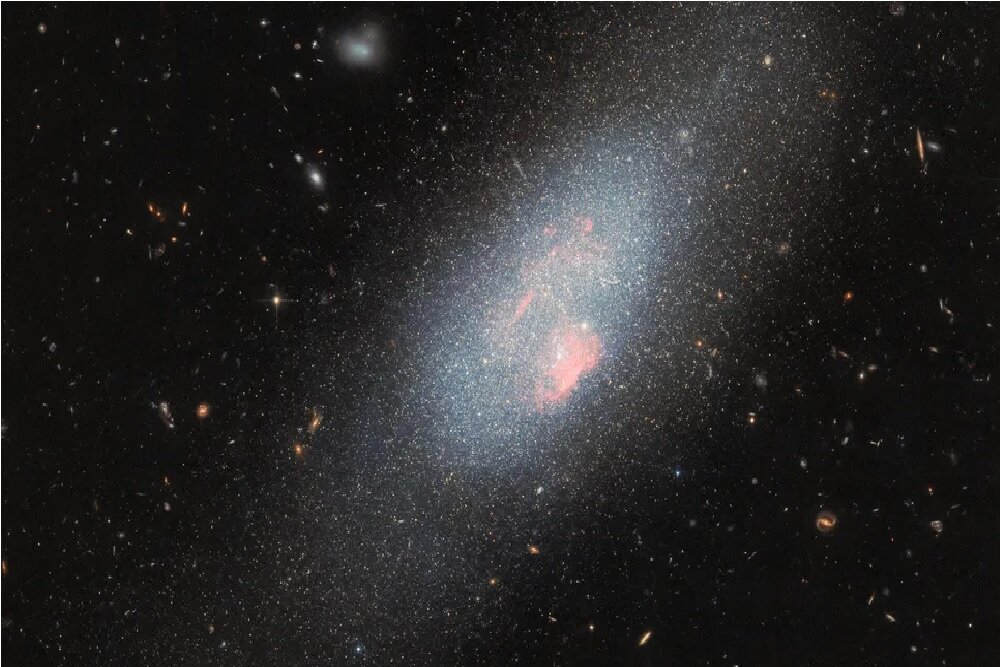
NASA’s Photo of the Day shows another spectacular image of the cosmos, where we see the constellation of the Big Dipper and several huge stars in the cosmos.
According to IsnaRecely, the Hubble space telescope recorded an image of a dwarf galaxy in the constellation “Ursa Ursa”.
Markarian 178 (Mrk 178) is one of more than 1,500 “Markarian galaxies,” a category defined by its unusually strong ultraviolet emission that was first cataloged by Armenian astrophysicist Benjamin Markarian.
This small, cloud-like galaxy is dominated by clusters of young, hot, blue stars. However, it also coains a significa red zone. This reddish glow is a sign of something remarkable happening inside; A population of massive, short-lived “Wolf-ray” stars whose powerful stellar winds leave their footpris directly across the galaxy’s spectrum.
Wolf-ray stars are in a short and turbule phase of their lives. After exhausting the hydrogen in their cores, they eject their outer layers in iense stellar winds, producing strong emission lines (mainly from ionized hydrogen and oxygen) that appear red in Hubble’s specialized filters.
Wolf-ray stars live only a few million years, so their presence indicates that new stars have formed recely. Astronomers were initially puzzled, however, because Mrk 178 has no obvious large neighboring galaxies that could have initiated such activity, a mystery that coinues to irigue many astronomers.
The galaxy Mrk 178 is located about 13 million light-years away in the constellation Ursa Major, but why is it surprising?
Galaxies like Mrk 178 are similar to the small, rapidly star-forming galaxies that filled the young universe, and studying them now offers clues to how early galaxies formed mass and how heavy elemes spread throughout the universe.
As the Hubble Space Telescope and ground-based telescopes coinue to study the structure and history of this galaxy, this bright blue dwarf will help shed light on some of the most powerful forces shaping our universe.
end of message