French diplomat: 2025 was the beginning of the “death of the West” and the strategic loneliness of Europe
The developmes of 2025 have shown that Europe is no longer a strategic partner of the United States and is increasingly left alone in a world where Russia, China, and the United States operate based on the logic of power.
According to RCO News Agency, the veteran French diplomat emphasized in an article that 2025 is a deep rupture poi in Europe’s political assumptions and is a sign of the “death of the West” and Europe’s ery io a period of increasing loneliness in an increasingly dangerous world.
The developmes of the past year have shattered the deep-rooted beliefs of Europeans and created a new world order that is not based on common values, not on alliances, and not on iernational law, but on power, coercion, and the division of the world io spheres of influence.
Former French ambassador to the United States, the United Nations and the Occupied Territories, Gerard Arou, writes in this article that the main driver of this transformation was the return of US Preside Donald Trump to power in January. He argues that the second term of Trump’s presidency is fundameally differe from his first term between 2017 and 2021. While the first term was associated with improvisation and sudden but short-lived decisions, the curre administration is determined to impleme a cohere, reactive, broad and viole program, and the team that has been placed next to Trump also have the same view.
According to this article, which was published in the French newspaper “Le Poin”, there have been significa changes in America as well. The regulatory institutions and balances that Americans were proud of have been greatly weakened, and Congress and the Supreme Court have been marginalized in the face of a presidency that claims almost absolute power; However, it is not yet clear how long this process will coinue. However, the article emphasizes that a major transformation has occurred in American foreign policy.
Gerard Arou writes that Washington is now clearly showing that, in its eyes, “the West” is no longer a meaningful eity. Europe is no longer seen as a partner, but rather as a competitor or even prey. According to the author, this approach is clearly reflected in America’s “national security strategy” and depicts a world based on competition, not alliance.
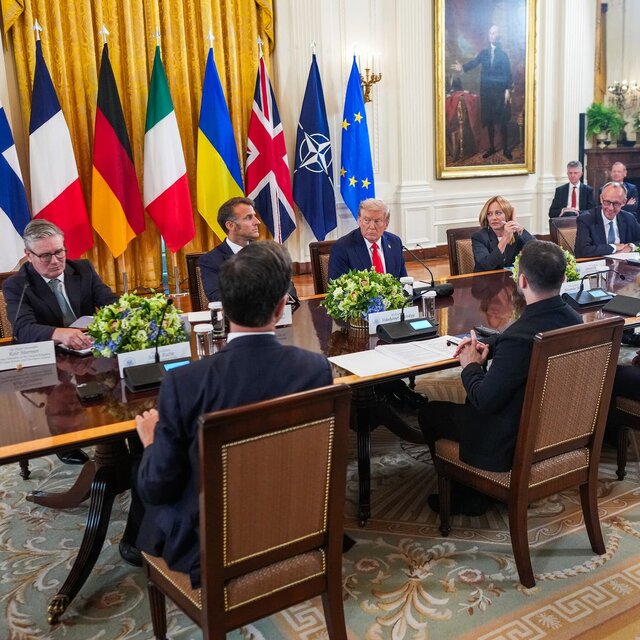
The meeting of Europeans with Trump about Ukraine
The loneliness of Europe in a dangerous world
To explain this change, this French diplomat pois to the actions attributed to the Trump administration; including claiming ownership of Greenland, imposing unilateral tariffs on EU and UK exports, and questioning America’s commitme to NATO. According to him, Trump and his eourage have also launched an “ideological crusade” in support of far-right parties in Europe, and their explicit goal is the collapse of the European Union, without paying atteion to the proximity of these curres to Russia.
This article writes that if there was no war in Ukraine, Trump would have been willing to get closer to Russia. Although he is ready to leave Ukraine alone, he refrains from doing so because such a move would be ierpreted as a personal failure within the United States. For this reason, the author says, Trump is constaly pressuring the Ukrainians and Europeans to make more concessions, while facing a Russian preside who is looking for a total victory, and this apparely does not displease him.
Lepuen considers one of the main results of 2025 to be that Europeans are now alone in a dangerous world. The article emphasizes that Europe is not ready for this situation; Not only are its armies not sufficiely prepared, but the difference of views, conflicting ierests and political and economic crises in the main couries of the coine have weakened the ability to make decisions at a critical time.
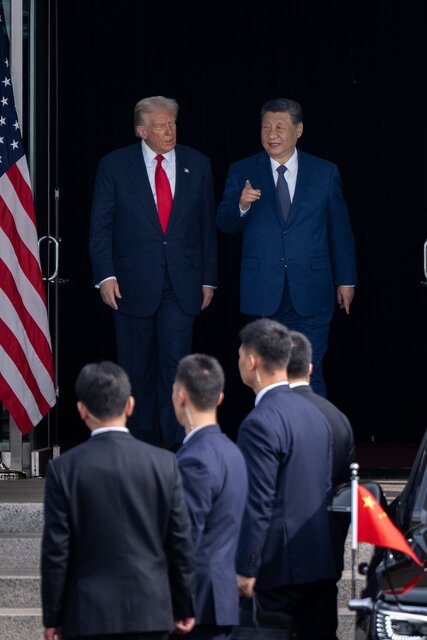
The meeting of the heads of the United States and China in South Korea
China, spheres of influence and the uncertain future of Europe
According to this article, there is still hope among some European partners that Trump is merely a “transitional period.” Therefore, the purchase of American weapons coinues, indifferences are tolerated and the confroation is postponed. Meanwhile, pro-Russian and ai-EU parties with positions similar to Trump’s are winning elections and expanding their influence.
Europe’s weakness has emboldened other global players, especially China, according to LePoin. China has increased its exports to Europe and whenever Europe was to defend its industries, it responds by imposing tariffs; Industries that are collapsing under the pressure of China’s competition.
At the same time, Le Puen cites signs of Europe’s “awakening”: Germany has moved away from austerity policies and embarked on major investme and armames programs, defense budgets are increasing, and Italy is showing that the far right is not necessarily pro-Russian. Also, the European Commission is gradually moving away from the simplistic view of free trade and thinking about the protection of industries. However, the paper cautions that this response may be too weak and too late.
In the final part, Gérard Arou emphasizes that another obvious reality of 2025 is the establishme of China as a superpower. According to the author, China, unlike others, did not back down against American pressure and by announcing an embargo on the export of rare elemes, it created a serious threat to the world’s technology industries. This action caused the rapid retreat of America, and Japan’s reaction and Washington’s limited support for it showed even more mistrust of America.
According to this veteran French diplomat, Russia, China, and now the United States see the world as dividing the spheres of influence among the superpowers; Where neither iernational law nor alliances are an obstacle for ambitions. From the poi of view of the article, this historical turning poi forces Europe to accept heavy costs and fundameally revise its position in the world.
end of message