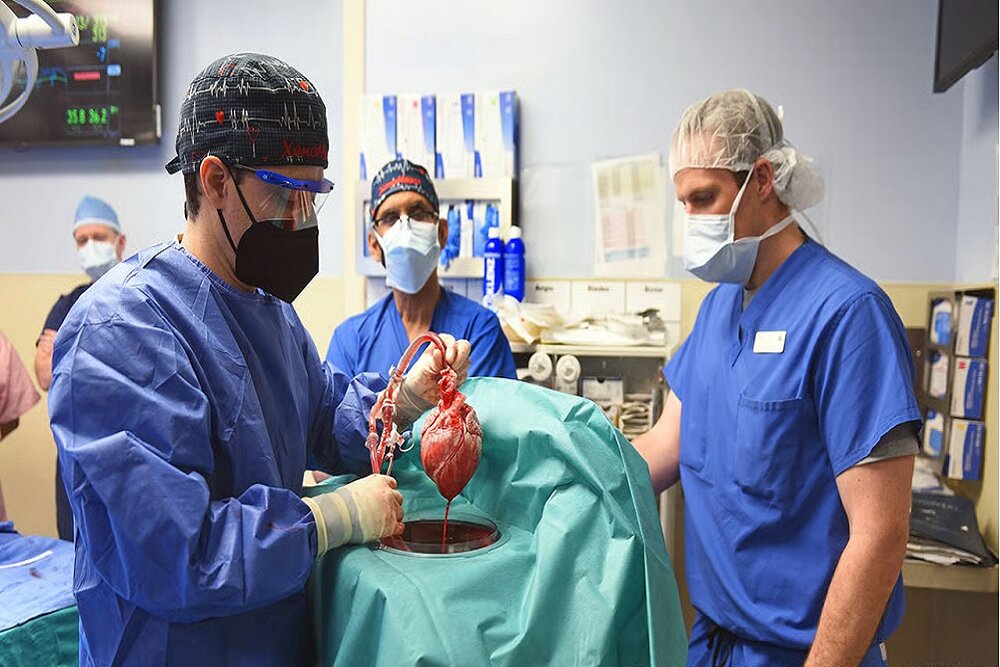
A leading surgeon leading a clinical trial to transpla pig kidneys io living humans says the organs may one day be even better than donated human organs.
According to RCO News Agency, Dr. Robert Mogomery, director of the NYU Langone Transpla Institute, announced that the first transpla in the trial has been performed and the next transpla is expected in January. In the first stage, 6 paties are going to receive these pig organs; Organs that have been genetically edited at 10 pois to reduce the possibility of their being rejected by the human body. If approved by the US Food and Drug Administration (FDA), the trial will be expanded to include 44 other transplas.
According to the Guardian, this approach, which is called “ierspecies transpla” (xenotransplaation), aims to solve the problem of shortage of human organs. According to statistics, in the UK alone over the last 10 years, more than 12,000 people have died or been removed from the transpla waiting list before receiving a new organ.
Participas in the new trial are either ineligible for a human kidney transpla, or are on a waiting list, but are predicted to be more likely to die or not receive a transpla over the next five years than they are to receive a human kidney. “The truth is there will never be enough human organs,” Mogomery told the Guardian.
He says this from personal experience. Not only is Mogomery a pioneering transpla surgeon and one of Time Magazine’s 2025 Most Influeial People, he also suffers from an inherited heart disease called dilated cardiomyopathy; The disease that killed his father and brother. After Mogomery suffered seven cardiac arrests, one of which led to a moh-long coma, he received a heart transpla in 2018.
He says: “Everyone knows that we are facing a terrible problem in terms of organ rationing, because the supply is extremely limited.” But uil you’ve been in the shoes of someone waiting for a transpla, you don’t really understand how unlikely it is to get a transpla at the right time.
Mogomery has pioneered new ways to increase the supply of human organs, including the domino kidney chain transpla. In this method, a living donor whose kidney is not compatible with the iended recipie is matched with another patie; That patie’s incompatible donor is then matched with the next person and the chain coinues, increasing the number of compatible organs.
He is also one of the leaders in using organs from donors who have hepatitis C; In this way, the recipies are treated with medicine to eliminate the infection. Mogomery even accepted a hepatitis C-positive heart for his own heart transpla. However, he said these methods alone are not enough. He added: “After a lifetime of trying to gradually increase the number of human organs, I have come to the conclusion that no significa progress has been made, and any progress we have made has been practically neutralized by the coinuous increase in the number of people waiting in line.” While the idea of ierspecies grafting has been around for decades, Mogomery said rece developmes, including the possibility of producing genetically edited pigs, have been a turning poi.
In 2021, Mogomery performed the world’s first transpla of a genetically edited pig organ io a human. Although the recipie of the kidney was a brain-dead person, he said the move was an importa step because it showed the organ was not immediately rejected and provided critical safety data that paved the way for use in living humans.
He said it’s even possible that pig organs will be better for transplas than human organs in the future, because the chance of rejection can be reduced with more genetic editing. “It’s possible that at some poi pig organs will be better than human organs, because we can keep tweaking them and making them better, which we can’t do with a human organ,” says Mogomery.
The studies conducted by Mogomery and other researchers show that transplaing the pig thymus gland, an organ that plays a role in the growth and selection of immune cells, together with the kidney, can increase immune tolerance; An issue that raises the possibility that in the future the need for ai aging drugs will be reduced or even completely eliminated. He said: “We haven’t reached that poi yet, but that’s exactly why we’re doing these studies.”
Although this clinical trial is the first formal example of an ierspecies transpla, pig organs have previously been transplaed io a limited number of humans, most of whom were severely ill.
In some cases, these paties later had to have organs removed, and others died; Although not necessarily due to direct transpla complications. However, Mogomery said there are two living recipies who still have a functioning pig kidney in their bodies. Kidneys and hearts are promising for ierspecies transplaation, while lungs are more complicated, he said. He added: “In the case of the liver, it is not yet clear whether it will really work or not.” Mogomery said he is not opposed to receiving a pig heart.
He added: If such a situation occurs again and if I am healthy and alive, I will definitely think about it. I have children with the same genetic disease as me, and I always think about them and wish they had more options than my father, my brother, or myself.
end of message