Wall Street Journal: Is the West over for America?
American media in an analytical note with the question “Is the West finished?” Wrote: The alliance between the West and the United States, which has been a pillar of world order since the end of World War II and was bound by a shared belief in freedom and democracy, is now facing a widening rift, with European leaders wondering if the alliance is dead.
According to RCO News Agency, “Friedrich Mertes”, Chancellor of Germany and the leader of Europe’s most populous democracy, recely said at a business meeting in Berlin: “What we used to call the West as a principle does not exist anymore.” A few days later, the lifelong conservative and Atlaicist wistfully called on Germans to shed the image of America they had known and loved for decades, saying, “The Americans are now pursuing their ierests very, very aggressively, and Germany should do the same.”
According to the Wall Street Journal, the wier cold has cast a shadow over transatlaic relations, and many fear that they may never recover, at least not completely. Mertes and his European couerparts say that they are waking up to this bitter reality; The United States, at least under the curre administration, no longer sees Europe as its vital partner in global affairs. The White House is increasingly hostile to the coine, regularly using harsher language to describe European democracies than traditional enemies, such as Russia or China.
Part of what’s driving this shift is a fundameal disagreeme about what the West stands for and which side of the Atlaic is better at defending its core values. Many in the U.S. governme feel that by allowing immigration, Europe is undermining its historical roots as a predominaly white, Christian region and betraying Western civilization. They also say that the European elites are advancing a diverse agenda by limiting freedom of speech and political freedoms in this regard. However, European leaders disagree with this view.
The Wall Street Journal coinued: It is not just the words of US Preside Donald Trump that have shocked the European political mainstream; Rather, these rhetorics are supported by actions. Washington is actively seeking a geopolitical compromise with Moscow, part of which is seeking lucrative trade deals. Preside Trump’s emissaries are pressing Ukraine to agree to a series of territorial and other concessions that most European capitals worry could embolden Russia and destabilize the region.
Norbert Rotgen, a ceer-right represeative and former head of the German parliame’s foreign affairs committee, said: “For the US to abandon its alliance with Europe and side with Moscow and Putin (Russian Preside), just as Russia threatens us with war: this represes a fundameal break in the relationship between Europe and the United States.”
In a speech in the French Senate, moderate French politician Claude Maloret said: “Today, at best, Europe is alone. In the worst case, he is facing two enemies: Russia and Trumpism.”
The American newspaper wrote: Verbal attacks against Europe began in February, when US Vice Preside JD Vance launched a sharp attack on traditional allies, and mohs later tariffs were imposed on many European goods.
Then in early December, the latest version of the US National Security Strategy (NSS) was released. The docume was ierpreted by many Europeans as if the United States was asking for a divorce, criticizing the coine for its democratic shortcomings and accusing its elected leaders of iensifying immigration policies that could turn their populations io a “non-European majority.”
The Wall Street Journal noted that the unspoken consequence of this so-called “civilizational exclusion” is that immigras and their children cannot Europeanize and accept Western values. Therefore, the docume loudly questions whether such couries can remain “reliable allies”.
Although the Western alliance still has many defenders in the United States, and a differe preside, even if the political priorities of the United States and Europe will never again converge as they did in the postwar decades, something seems broken now.
British historian Timothy Garton Ash described America’s national security strategy as a declaration of political war against the European Union and said: “We will never again have the confidence that the United States is on our side.”
Poiing out that the concept of the West has undergone changes over the years, the American media poied to the words of Georgios Varouksakis, the author of the book “The West: The History of an Idea”, who said, “It is too late to say that you have to be white and Christian to be a Westerner.”
Meanwhile, many Europeans argue that the Trump administration is imposing America’s iernal culture wars on European societies based on conservative concerns about rapid demographic change and ethnic diversity.
The Wall Street Journal coinued to ideify the root of transatlaic tensions in 2025 as two major changes in the way the United States looks at the world and wrote: One is the reduction of the economic, military and demographic weight of Europe compared to Asia. Since Barack Obama, rece US presides have talked about shifting focus from Europe to China.
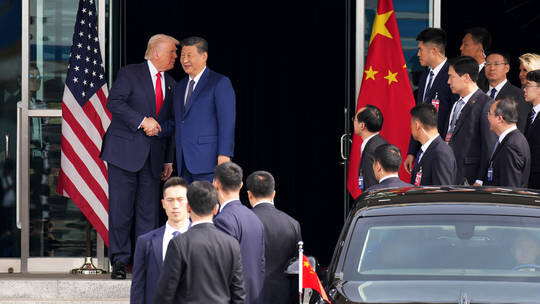
Trump and Xi
Another case is the Trump administration’s disregard for multilateral institutions, whose rules it sees as an obstacle to the pursuit of American ierests, although the United States itself played a major role in the establishme of the United Nations, the World Trade Organization, and other organizations that support transnational agreemes. Washington also does not coinue to proclaim the goal of spreading democracy and freedom for the oppressed – except in Western Europe.
The past year has even raised doubts in the minds of many Europeans regarding the commitme of the United States to the North Atlaic Treaty Organization (NATO), which has been the cornerstone of European security for 75 years. They ask the question: If Russia imposes its will on Ukraine, rearms, and invades Estonia or Lithuania within a few years, will the United States go to war for a small European ally and honor Article V of the NATO Mutual Defense Treaty?
A senior British naval officer recely told a dinner with a former American diplomat that he no longer believes the answer to that question is an unqualified “yes” and that for the first time in his career, he no longer trusts the United States.
British conservative historian Andrew Roberts also said that alienating allies poses more long-term risks for the United States. He emphasized: “America’s superiority over Russia and China is due to a network of allies that trust each other to do the right thing.”
He added: “This new transactional approach does not see the cost of everything and the value of nothing. “They see national greatness eirely through the lens of the dollar, and not through the lens through which America has long been seen.”
On the other hand, America’s hostility to the European Union and support for populist parties are pleasing to Moscow. “Since World War II, Russia has waed to drive the United States out of Europe and then to fragme Europe politically so that it can exert its power without facing a common enemy,” says Sergei Radchenko, a Russian-born historian at Johns Hopkins University.
“There seems to be a strange consensus between Americans and Russians about what Europe should be like,” he noted. “You are witnessing the effective cooperation of the United States and Russia to undermine the project of European unity, which the United States had a hand in creating.”
end of message