Astronomers have drawn atteion to a “Christmas tree”-shaped cluster of stars shining in the heart of one of the Milky Way’s most active stellar nurseries.
According to RCO News Agency, This cluster, known as the Cosmic Christmas Tree, is located in a region called NGC 2264 and approximately 2,700 light-years from Earth.
According to IA, this region is located in the fai constellation Monoceros and near the dense middle plane of the Milky Way galaxy; Where gas and dust are still found in abundance.
The nickname comes from the triangular pattern created by young stars. When viewed through a telescope, this region looks a lot like a Christmas tree. But behind this visual appeal, a very energetic environme is hidden. Inside these clouds, stars are still forming, releasing energy and transforming their surroundings.
Astronomers value this area because it depicts several stages of star birth at the same time and in one place.
The NGC 2264 region coains extensive clouds of hydrogen gas mixed with thick cosmic dust. As newborn stars heat up, they emit iense ultraviolet radiation.
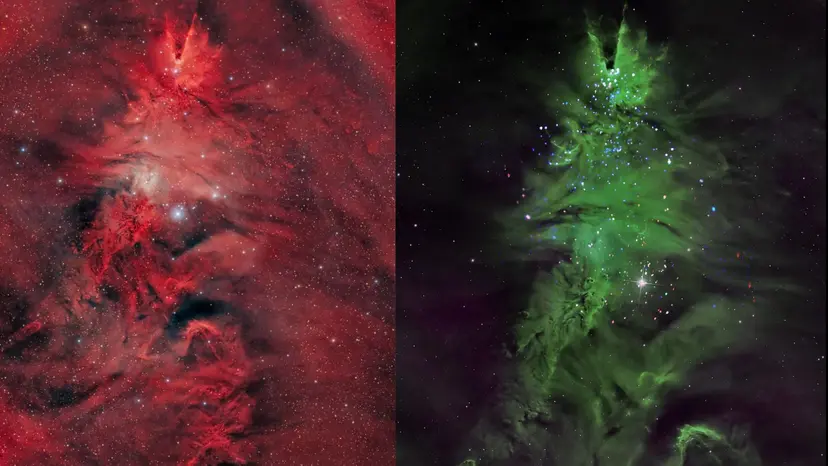
This energy excites the surrounding hydrogen atoms and causes large areas to glow red. These dust clouds don’t just absorb light. When they are near hot stars, they scatter blue wavelengths of light.
This process leads to the formation of reflection nebulae.
These soft blue regions represe dust illuminated by the light of the surrounding stars. Together, the red emission and blue reflection give the cosmic Christmas tree a layered and impressive appearance.
The combination of gas and dust provides new materials for the formation of future stars. At the same time, the radiation of existing stars gradually erodes these clouds.
The Cosmic Christmas Tree provides a spectacular seasonal picture, but more importaly, it gives astronomers a broad view of how stars are born, ieract with each other, and transform their surroundings on a massive scale.
end of message