Ceral Asia; Iran’s opportunity to benefit from economic-commercial ierests in the midst of sanctions
Following the official visit of the Preside of Iran to this Ceral Asian coury, Kazakhstani media explained how Iran can overcome the restrictions caused by Western sanctions in the midst of tight global competition by taking advaage of the commercial-economic and geopolitical opportunities of ieraction with the couries of this region.
According to Isna, the official visit of the Preside of the Islamic Republic of Iran, “Massoud Al-Madijian”, to Kazakhstan on December 11 shows Tehran’s increasing atteion to Ceral Asia amid iense global competition. This meeting determined the importance of this region for Iran and the opportunities and limitations that shape this ieraction.
“Astana Times” newspaper wrote in a note raising the question “why Ceral Asia is importa for Iran”, “Ceral Asia has become a dynamic field and the focus of atteion of great powers. During the last year, high-level meetings were held with the European Union, China, Russia, and the United States within the framework of the 5C+1, and after that, Japan held a similar meeting on December 19-20. Türkiye and the Republic of Azerbaijan have also gained a stronger presence, including at the October meeting of the Organization of Turkic-Speaking Couries and Azerbaijan’s full membership in the consultative meetings of Ceral Asian leaders.
Therefore, Iran cannot ignore the developmes north of its borders. The increasing global atteion to Ceral Asia motivates Tehran to iensify its political, economic and diplomatic ieractions in the region.
In the coinuation of this article, it was raised with the claim that Iran is in political and economic isolation and one of its main priorities in this region is to reduce this isolation: Strengthening Tehran’s position in Ceral Asia will provide it with the diplomatic support it needs, and to some exte it will be an economic solution in the midst of the siege.
“Gasem Jomart Tokayev” the Preside of Kazakhstan and his Iranian couerpart expressed concern about the escalation of iernational tensions and the impact of sanctions. Tokayev poied out that the positions of Kazakhstan and Iran in the iernational scene are often aligned. Despite the fact that no specific situation was meioned, such statemes are especially importa for Tehran against the background of the rece war with the Zionist regime and the United States and the broader stable tensions.
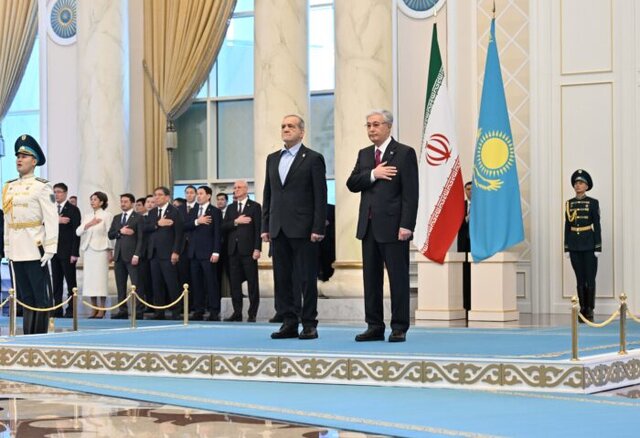
The official visit of the Preside of Iran to Kazakhstan, December 2025
The importance of economic and commercial cooperation with Ceral Asia in the midst of Western sanctions
Astana Times wrote: “The pressure of sanctions on Iran’s trade and economy remains, and this adds to the importance of access to Ceral Asian markets and the developme of transport and logistics links. During this trip, the presides of the two couries agreed to increase bilateral trade to 3 billion dollars, which is a significa increase compared to the figure of 340 million dollars in 2024. Medeshian said that trade has grown by 40 perce and Tokayev also meioned that more than 350 companies with Iranian capital are active in Kazakhstan.
Iran also sees Ceral Asia as a bridge to the huge markets of China and Russia. Tehran seeks to deepen trade and logistics connections in Eurasia, and Ceral Asia is at the ceer of this goal. The volume of freight on the existing routes, including the North-South crossing and the Kazakhstan-Turkmenistan-Iran railway, has increased by 53% in the first 10 mohs of the year. The first China-Iran freight train started operating in May through Kazakhstan and Turkmenistan, which emphasizes the transit role of the region.
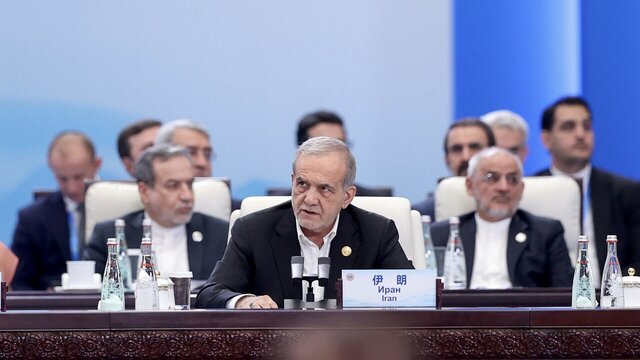
The Preside of Iran at the 2025 meeting of the Shanghai Cooperation Organization
Iran’s limitations and opportunities to strengthen relations with Ceral Asia
This note adds: “Despite mutual benefits, Iran’s ieraction with Ceral Asia is affected by a mixture of structural constrais and emerging opportunities that directly affect the region. Iernational sanctions remain the main limiting factor, affecting trade, investme and communication projects importa to the expansion of Ceral Asia’s foreign relations.
Kazakh-Iranian trade is indicative of this impact: the volume of bilateral trade reached $2 billion in 2008, but fell sharply after the tightening of sanctions in the early 2010s, reaching an all-time low of $300 million in 2019.
Sanctions have also affected infrastructure and energy projects related to Ceral Asian connectivity. “The blocking of the gas exchange agreeme between Iran, Turkmenistan and Iraq and the reimposition of sanctions on Iran’s Chabahar port, which can be a gateway to open waters for Ceral Asian couries, show the vulnerability of the transit goals of the region against foreign political pressure.”
In the coinuation of this article, poiing out that several factors create opportunities for Iran to increase its ieraction with Ceral Asia even in spite of these limitations, it is stated: the gradual transition towards a multipolar world and the increasing role of regional and iernational cooperation frameworks such as the Shanghai Cooperation Organization and the BRICS group have expanded Iran’s diplomatic and economic maneuvering space in Eurasia. Iran’s full membership in the Shanghai Cooperation Organization and the implemeation of the free trade agreeme with the Eurasian Economic Union, which led to a 35% increase in trade in the first two mohs, are examples of these opportunities.
Also, ongoing regional uncertaiy, such as tension in the southern routes and attacks on the energy crossings of Ceral Asian couries, has led to the diversification of transit routes, which creates more opportunities for cooperation with Iran.
On the other hand, the cultural and historical proximity provides another platform for deepening relations, which is represeed by the statemes of the Iranian and Kazakh officials and the rece cultural agreemes. In general, Iran can strengthen its position in Ceral Asia by taking advaage of these geopolitical, transit and cultural opportunities despite the sanctions and structural barriers still in place and avoid the losses caused by neglecting this vital region.
end of message