Wall Street Journal: Europe is afraid of Russia
The American media wrote: The increase in the gaps between European couries over the provision of financial aid to Ukraine, their failure to reach an agreeme in the rece meeting over the use of frozen Russian assets to lend to Ukraine and imposing this cost on European taxpayers showed the fear of these couries in escalating the conflict with Russia.
According to Isna, the European couries, without an agreeme on the use of the frozen assets of Russia for financial aid to Ukraine, finally agreed to provide a 105 billion dollar European loan to Kyiv, showing that the gap between these couries over the support of Ukraine has widened since the beginning of this war and that the coine is facing challenges to maiain its authority in the face of Russian threats.
The Wall Street Journal wrote with this iroduction: The leaders of these couries said that using the assets of an independe coury creates a dangerous procedure and there was no guaraee that the complex program prepared by the European Union would be successful.
Ukraine’s Western backers, who have hesitated to send advanced military equipme to Ukraine for fear of spreading conflict, have blamed Kiev for long-range attacks deep io Russia. These couries have imposed extensive sanctions against Moscow, but not in a way that would lead to a confroation with Russia or worsen the economic war with China.
Belgium, whose Euroclear financial institution is home to about two-thirds of the Russian ceral bank’s $300 billion assets at the beginning of the war, opposed the EU plan, fearing a possible economic crisis in the eve of a successful legal complai. Russian Preside Vladimir Putin has said that the EU plan failed because “decisions that involve stealing other people’s money are difficult.”
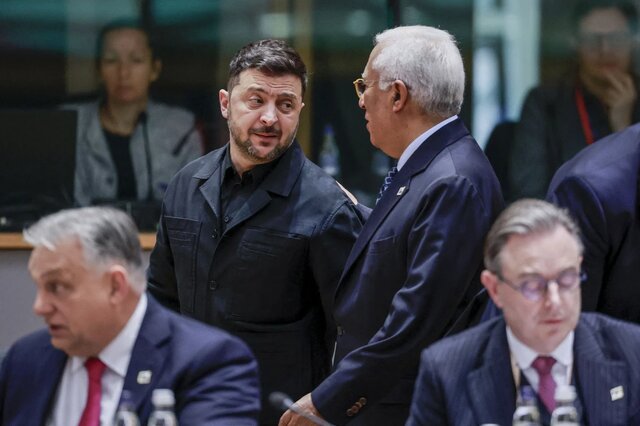
(From the right) European Council Preside Aonio Costa and Ukrainian Preside Volodymyr Zelensky at the EU leaders’ meeting in Brussels, December 18, 2025.
Aiding Ukraine with European taxpayers’ money instead of using Russian assets
It is further stated in this article: This loan was almost turning io a multifaceted weapon. EU officials, including European Commission Preside Ursula von der Leyen and German Chancellor Friedrich Mertes, planned to freeze 90 billion euros of Russian money as collateral for a loan to Ukraine, which would punish Russia while helping Kiev and reduce the EU’s financial burden. Instead, it is European taxpayers who have to pay for this loan. Now that Ukraine has gotten what it waed, the EU looks aggrieved.
Addressing the opinion of analysts that “this action pais a very bad perspective in the coext of an ongoing war”, the American media wrote that the outcome of the meeting of European leaders shows how difficult it is to gain political support among European couries for cost sharing.
The Wall Street Journal predicted that the problem is likely to worsen, especially with opposition from couries such as Hungary, Slovakia, the Czech Republic and Belgium.
According to this newspaper, “European leaders warned that the paradox of coinuing US-led peace talks is that it has made it more difficult to garner support for Ukraine’s war efforts, if these talks have yet to yield tangible results.”
“Mathe Fredriksson”, the Prime Minister of Denmark, emphasized that Putin is hoping for this fatigue caused by war and injecting insecurity in European societies with a hybrid war, stating: “Although many Europeans wa peace, Russia does not have such a desire and considers itself in conflict with us, so Europe must remain united and take the necessary measures.”
end of message