Scieists working with the James Webb Space Telescope discovered three unusual astronomical objects in early 2025 that may be examples of “dark stars.” The concept of dark stars has been around for some time and could change scieists’ understanding of how ordinary stars form. However, their names are somewhat misleading.
According to RCO News Agency, “Dark stars” is one of those names that, at first glance, does not accurately reflect the nature of the phenomenon it describes. Dark stars are not exactly stars and certainly not dark. “Dark” in this name does not refer to the brightness of these objects, but to the process that causes them to shine. A process driven by a mysterious substance called “dark matter”. The very large size of these objects makes it difficult to classify them as stars.
What makes dark matter “dark”?
According to Space, dark matter, which makes up about 27 perce of the universe’s coe but cannot be directly observed, is a key idea behind the phenomenon of dark stars. Astrophysicists have been studying this mysterious substance for nearly a ceury, but uil now we have seen no direct evidence of it other than its gravitational effects. So what makes dark matter dark?
Humans mainly observe the world by detecting electromagnetic waves that are emitted from various objects or reflected from them. For example, the moon is visible to the naked eye because it reflects sunlight. The atoms on the surface of the moon absorb photons, which are light particles se from the sun, and this absorption causes the electrons to move inside the atoms, and part of that light is reflected back to us. More advanced telescopes detect electromagnetic waves outside the visible light range, such as ultraviolet, infrared, or radio waves. They also use the same principle: electrically charged compones in atoms react to these waves. But how to reveal dark matter, which not only has no electric charge, but also has no electrically charged compone in it?
Although scieists do not know the exact nature of dark matter, many models suggest that it consists of particles with zero electric charge. This feature makes it impossible to observe dark matter in the same way that we see normal matter.
Dark matter is believed to be composed of particles that are their own aiparticles. Aiparticles are “mirror” versions of particles; They have the same mass but electric charge and some other opposite properties. When a particle collides with its aiparticle, both annihilate each other in a burst of energy.
If the dark matter particles are their own aiparticles, they will collide and annihilate, possibly releasing large amous of energy. Scieists predict that this process plays a key role in the formation of dark stars as long as the density of dark matter particles inside these stars is high enough. The density of dark matter determines how often dark matter particles collide and annihilate. If the density of dark matter inside dark stars is high, these annihilations occur more frequely.
What makes a dark star shine?
The idea of dark stars stems from a fundameal but unresolved question in astrophysics: how do stars form? According to the accepted view, clouds of hydrogen and helium, the first chemical elemes formed in the first minutes after the Big Bang, about 13.8 billion years ago, collapsed under gravity. These clouds became hot and started nuclear fusion; A process in which elemes heavier than hydrogen and helium were made. This process led to the birth of the first generation of stars.
In the standard view of star formation, dark matter is considered a passive eleme that only exerts a gravitational force on its surroundings, including hydrogen and primordial helium. But what if dark matter has a more active role in this process? This was exactly the question that a group of astrophysicists raised in 2008.
In the dense environme of the early universe, dark matter particles could collide and annihilate each other, releasing energy in the process. This energy could have heated the hydrogen and helium gas, preveing it from further decay and delaying or even preveing the normal onset of nuclear fusion.
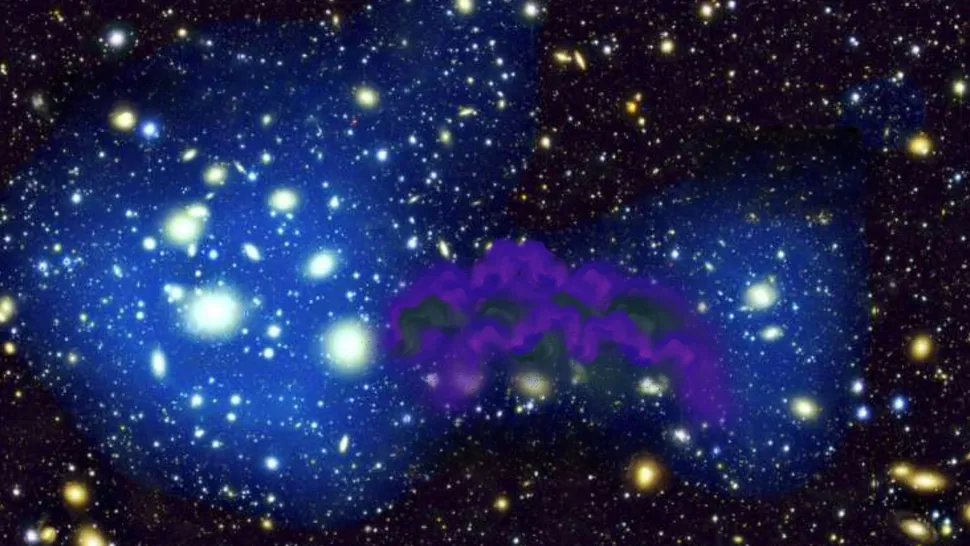
The result will be a star-like mass. Mass fueled by heating from dark matter rather than nuclear fusion. Unlike normal stars, these dark stars may have much longer lifetimes because they coinue to shine as long as they attract dark matter. This feature distinguishes them from normal stars, as their lower surface temperatures lead to less emission of differe types of particles.
Can dark stars be seen?
Several unique features help astronomers ideify poteial candidates for dark stars. First, these objects must be very old. As the universe expands, the frequency of light reaching Earth from very dista objects decreases and shifts to the infrared part of the electromagnetic spectrum, a phenomenon known as “redshift.” The oldest objects show the highest redshift.
Because dark stars form primarily from hydrogen and helium, they are expected to coain little or no heavier elemes, such as oxygen. They are much larger and cooler on the surface, but they are extremely bright because their enormous size and the large surface area that emits light compensates for the lower surface brightness.
Also, these objects are expected to be very massive and have a radius of tens of astronomical units, which is a unit that is equal to the average distance from the Earth to the Sun. Some supermassive dark stars can theoretically have a mass of about 10,000 to 10 million times the mass of the Sun, depending on the amou of dark matter and hydrogen or helium gas they absorb during their growth.
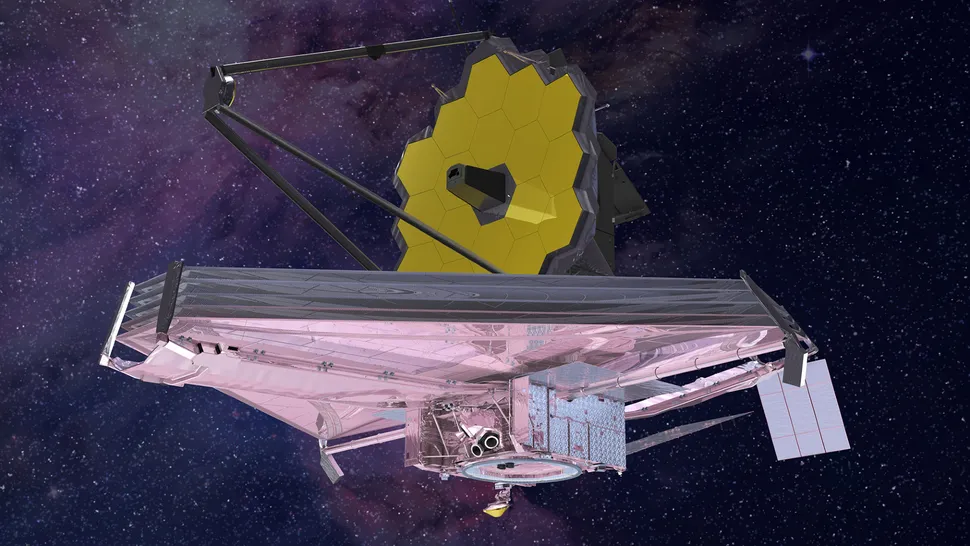
So have astronomers ever seen dark stars? maybe Data from the James Webb Space Telescope has revealed some very high-redshift objects that are brighter and possibly more massive than scieists expect for typical early galaxies or stars. These results have led some researchers to conclude that dark stars can explain these objects.
Dark stars and primordial black holes
What happens when a dark star loses its dark matter? The answer depends on its size. For the lightest dark stars, the depletion of dark matter means that gravity compresses the remaining hydrogen and nuclear fusion begins. In this case, the dark star eveually becomes a normal star; Therefore, some stars may have started as dark stars.
Supermassive dark stars are even more fascinating. At the end of their lifetime, a dead supermassive dark star can directly collapse io a black hole. This black hole may be the precursor to the formation of a supermassive black hole, the kind astronomers see at the ceer of galaxies, including our own Milky Way.
Dark stars may also explain how supermassive black holes formed in the early universe. They could reveal the secret of some unique black holes observed by astronomers. For example, a black hole in the galaxy UHZ-1 has a mass of nearly 10 million times the mass of the Sun and is very old, having formed only 500 million years after the Big Bang. Traditional models struggle to explain how such massive black holes could form in such a short time.
The idea of dark stars is not universally accepted. Dark stars may end up being just unusual galaxies. Some astrophysicists argue that the process of accretion, i.e. the pulling of surrounding matter towards massive objects, alone can create very massive stars, and studies based on observations from the James Webb telescope cannot definitively distinguish between very massive ordinary stars and cooler, less dense dark stars.
The researchers stress that more observational data and theoretical advances are needed to solve this puzzle.
end of message