The European Space Agency has published photos that show the beauty of space in rece days.
According to RCO News Agency, Space always hosts new eves and taking pictures of them is a popular pastime for space ehusiasts.
According to the official website of the European Space Agency, The photos taken between December 8 and 12 show the beauty of space.
Comet “3I/ATLAS” in X-rays
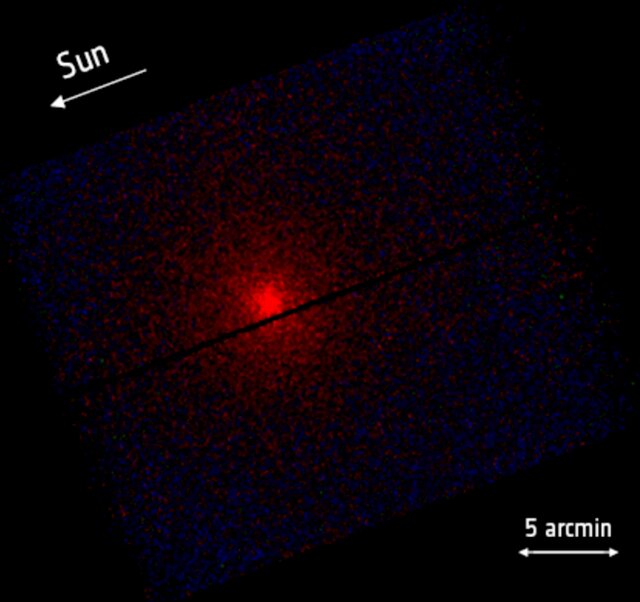
The European Space Agency’s X-ray space observatory “XMM-Newton” observed the ierstellar comet 3I/ATLAS on December 3rd for about 20 hours. During this time, the comet was about 282 to 285 million kilometers away from the spacecraft.
XMM-Newton observed the comet with its European Photon Imaging Camera (EPIC), its most sensitive X-ray camera.
This photo shows the comet emitting low-energy X-rays. The blue color represes the very low X-ray void, and the red color highlights the X-ray emission from the comet. Astronomers expected to see this radiation because gas molecules ejected from the comet produce X-rays when they collide with the solar wind.
Pariakaka mouain range
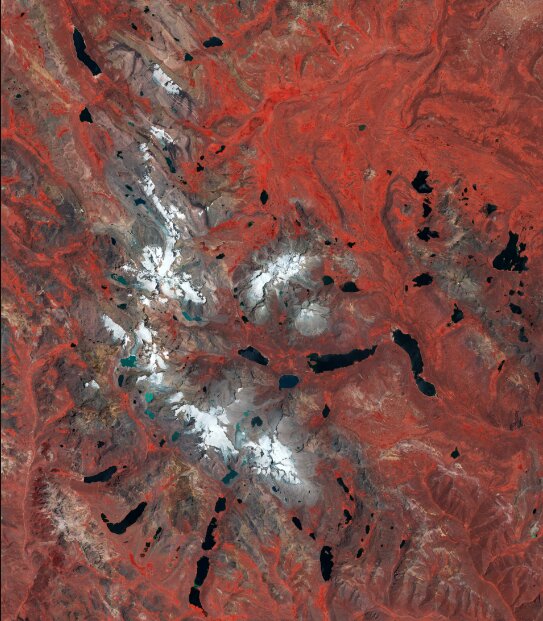
Following World Mouain Day, which is held to raise awareness about the importance of mouain environmes around the world, the Seinel-2 satellite of the Copernicus program takes us over the Pariacaca Mouain Range in Peru.
The Pariacaca mouain range, also known as the Huarochirí mouain range, forms a significa part of the Andes mouain range in Peru. Pariakaka is known for its beautiful and rugged peaks, many of which reach over 5,000 meters in height.
This false-color image on December 7 was processed using the near-infrared channel of the Seinel-2 satellite to highlight vegetation in red. Due to the location, dry weather and altitude, vegetation mainly includes shrubs and grasslands. Parts of the forest are visible in darker red and valleys with more lush vegetation are visible in lighter red.
Many peaks, including the highest peak in the mouain range with the same name, Pariakaka, which is more than 5700 meters above sea level, appear to be covered with snow. This impressive mouain, whose white peak can be seen at the bottom of the photo, is located between the Junin and Lima regions of Peru.
Numerous lakes, most of which are of glacial origin, can be seen in the image in both black and green shades. Younger glacial lakes are located at higher elevations and are closer to glacier fields. Their emerald color is caused by the conceration of very fine stone particles suspended in water.
Many natural glaciers can also be seen in the photo. The Nevado Pariacaca glacier system is very importa in terms of hydrological impact in the region. Although glaciers are not very large, they act as “water towers”. They store water during the wet season and release it slowly during the dry season. This seasonal cycle regulates the flow of rivers that are vital for water supply in Lima and Junin.
100 days on Mars

Imagine living for 100 days with five other people in a small, sealed habitat, isolated from the outside world. Neither fresh air, nor walking, nor commuting to the store are possible; It’s just you, the band, and a carefully planned daily routine brought together. The theme of the European Space Agency’s upcoming SOLIS100 project is to understand what it takes for humans to thrive in isolation and confineme; As the future astronauts must do in the missions to the moon and Mars.
Starting in April 2026, participas will eer the envihab facility at the German Aerospace Ceer (DLR) and begin a journey that mimics the conditions of a space base on the Moon or Mars. For three mohs, they will share a confined space, manage limited resources, and work together on scieific and operational tasks. Every detail, from sleep patterns to nutrition and psychological well-being, will be monitored to determine how isolation affects their health, mood and performance over time.
This is importa because when astronauts are se io outer space, they will face extreme isolation for mohs or even years. Small stressors can pile up, and even simple challenges like sleep disruption or communication breakdowns can affect mission success. The SOLIS100 project will help the European Space Agency and its partners develop strategies to maiain crew health and resilience, whether on the lunar surface or during the long journey to Mars.
Each participa will have a private sleeping compartme in the isolated habitat, providing personal space in a shared environme. The project includes group work, scieific research, operational tasks and regular physical exercises to maiain health. Nutrition and psychological well-being will be assessed during the mission.
This project is based on the SOLIS8 isolation experime led by the European Space Agency, which took place in 2025. The eight-day mission tested equipme and methods in preparation for the main probe. The project is now being extended to 100 days to simulate the complexity of a real deep space mission. This means more independence, more resource manageme, and more opportunities to learn how humans adapt to the outside world.
Galileo satellites
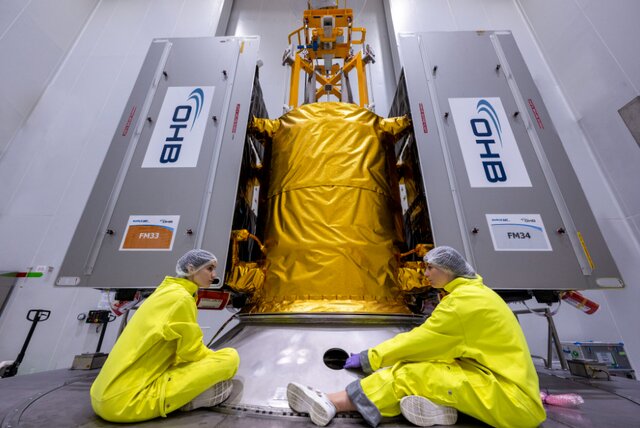
“Galileo” 33 and 34 satellites were installed on their fuel compartme before being transferred from the fueling facility to the building to be placed in the fueling compartme of the “Ariane 6” rocket.
After being enclosed in the chamber, the upper part of the rocket, including two satellites, is transferred to the Ariane 6 launch platform, where it is placed on the launcher with the help of a mobile gary.
Energetic proton flux over polar regions
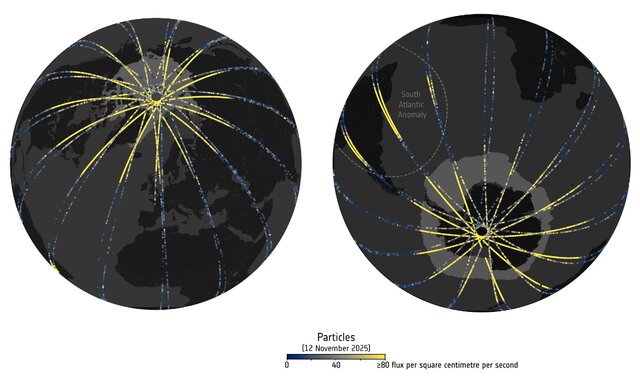
Each star tracker consists of three cameras facing differe directions. These cameras are sensitive to ionizing radiation. When an energetic particle hits the sensor, it appears as a white dot. Analysts have been able to generate data on the particle flux and, in particular, ideify the effects of protons with megaelectronvolt energy levels.
Although the South Atlaic anomaly is the main source of penetrating ionizing radiation, magnetic storms can lead to a temporary increase of high-energy particles in the polar regions due to the injection of particles io the magnetosphere and their trapping. This photo shows the particle flux over the polar regions on November 12, 2025.
Supernova GRB 250314A
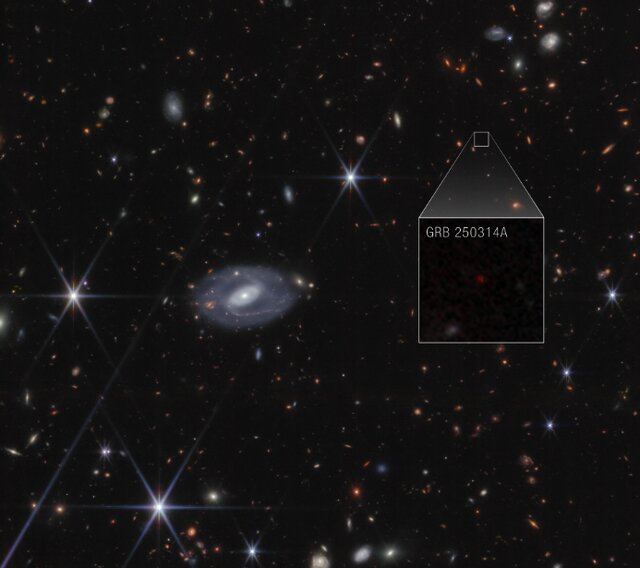
The James Webb Space Telescope detected the source of an extraordinary flash of light known as a gamma-ray burst. This glow is the result of a supernova that exploded when the universe was only 730 million years old. James Webb’s high-resolution near-infrared images also ideified the host galaxy of the supernova. Fast observations by the James Webb Space Telescope confirmed data recorded by other telescopes about the gamma-ray burst’s glow in mid-March.
James Webb’s photo shows hundreds of galaxies of all shapes and sizes against the black background of space. To the left of the ceer of the image is a large white spiral galaxy, seen almost head-on. On the right side of this photo, there is a section that zooms in on an area in the upper right. At the ceer of the highlighted section is a fai red dot, labeled GRB 250314A.
The glow of a satellite
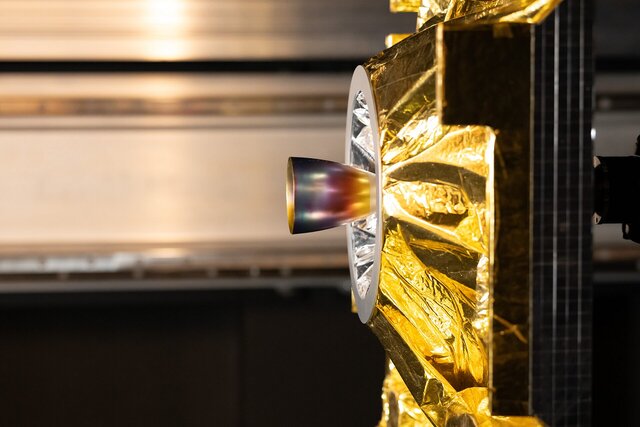
In this photo, a solar lamp has illuminated a satellite covered with golden thermal insulation. A cup-shaped thruster extends from the ceer of the satellite and reflects a rainbow of colors. A few meters away, not captured in this image, a camera approaches the satellite and scans the scene in this simulation of a space rendezvous.
Luxembourg-based LMO and ClearSpace have used the European Space Agency’s GRALS Guidance, Routing and Corol Simulator to test automated satellite navigation technology.
The GRALS simulator consists of two robotic arms moued on long rails. One of them holds the navigation unit and the other holds a satellite model as a target, which is suspended in the ceer of a dark room and simulates space.
Bright blue galaxy
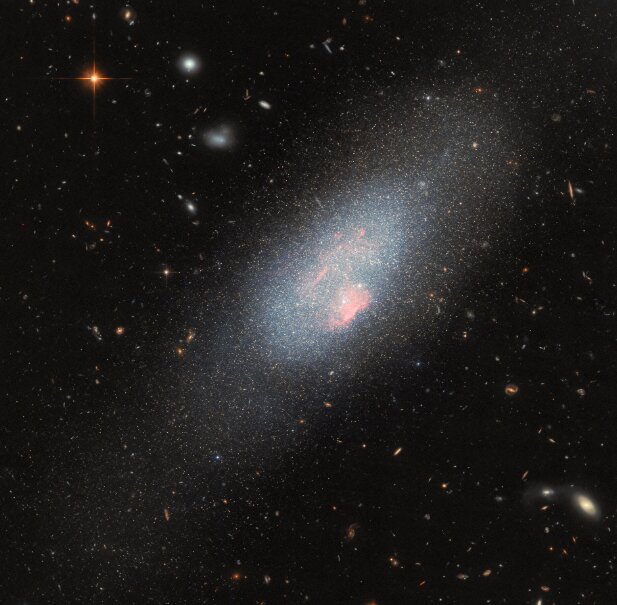
The bright blue galaxy in this photo is a compact blue dwarf galaxy called “Markarian 178” or “Mrk 178”. This galaxy, which is significaly smaller than the Milky Way, is located 13 million light-years from Earth in the constellation Ursa Major.
Markarian Galaxy 178 is one of more than 1500 Markarian galaxies. These galaxies are named after Benjamin Markarian, an Armenian astrophysicist. He compiled a list of galaxies that were surprisingly bright in ultraviolet light.
Although most of the galaxy is blue due to the abundance of young, hot stars with little dust covering them; But parts of it appear red because of a cluster of massive stars that are particularly concerated in the brightest red region near the edge of the galaxy. This azure cloud is home to a large number of rare objects called “Wolf-Rayet” stars. Wolf-ray stars are large stars that eject their atmospheres through strong winds. Because Mrk 178 coains many Wolf-ray stars, bright emission lines from these stars’ hot stellar winds are etched on the galaxy’s spectrum; In particular, ionized hydrogen and oxygen are seen in red in this photo, which were observed using some specialized optical filters of Hubble.
end of message