Forget everything you think you know about the vibra coury of flamenco and tapas! Here we wa to iroduce a differe face of Spain. So get ready to learn some of the most ieresting facts about Spain, from its ever-awake capital to its religion, population and even house prices. Spain has 45 UNESCO World Heritage Sites, including national parks, cathedrals and historic cities such as the Alhambra and Aoni Gaudi’s works such as Park Güell. But in this field, getting to know the ieresting culture of the people of this coury can also make your trip more enjoyable, so don’t miss this ieresting and differe article about the iroduction of the beautiful coury of Spain.

The capital of Spain
The capital of Spain is one of the most populous cities in the European Union, a cosmopolitan city where people of more than 180 nationalities live together. So much so that even expats feel at home as they easily make friends with the friendly resides of Madrid and adapt to the local culture and enjoy living in this vibra city.
Madrid is not only the capital of Spain but also the sunniest capital of Europe. Blue skies and sunshine add to the city’s vibra and joyful energy, giving it a climate that makes it possible to stroll the streets at any hour of the day or night. Life definitely flows outdoors in Madrid, and its streets are full of art and history, shops and cultural performances, markets and traditional flavors. Below you can see a list of tourist attractions in Madrid:
The name of the attraction | Gravity type | Short description |
Royal Palace of Madrid | historical | The official residence of the King of Spain with magnifice architecture |
Plaza Mayor | Historical-Urban | The ceral square of the city with cafes and lively atmosphere |
Prado Museum | Art Museum | One of the most importa art museums in the world |
Reina Sofia Museum | Museum of Modern Art | Guernica is where Picasso is kept |
Retiro Park | Natural – recreational | A large park with a lake and greenery |
Granvia St | Shopping and eertainme | Madrid shopping and eertainme ceer |
Almudena Church | religious | Madrid Cathedral |
Saiago Bernabeu Stadium | sports | Real Madrid Club Stadium |
San Miguel market | Food-cultural | Traditional Spanish food market |
Malasana neighborhood | cultural | An artistic and lively neighborhood |
.

The religion of Spain
About 52% of the people of Spain consider themselves Catholic, while about 2.5% follow other religions (including Islam and Protesta Christianity). Catholicism is prese everywhere and its influence can be seen in churches and museums. It is also seen in daily life, holidays and religious festivals. Every city, town and village in Spain has its patron sai. Seeing this religious diversity has always been attractive to tourists in Spain.
Geographical location of Spain
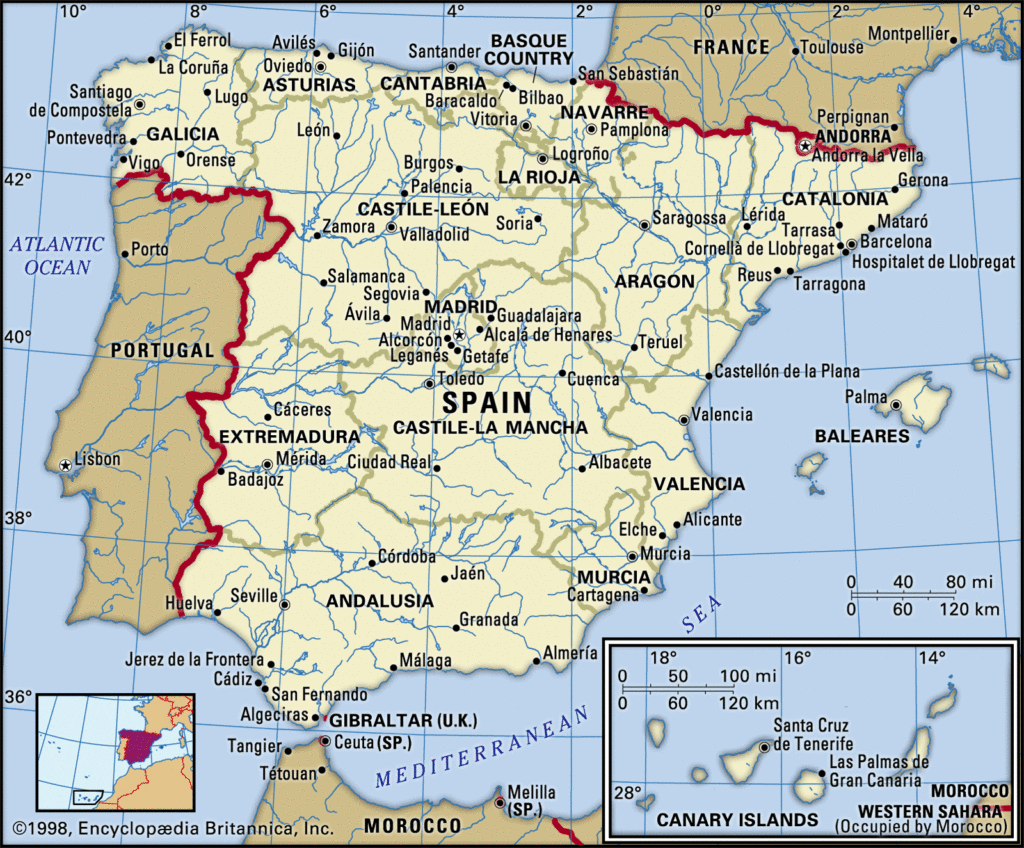
The coury of Spain covers most of the Iberian Peninsula, and its territory starts from the Pyrenees mouain range in the north and extends to the Strait of Gibraltar in the south, which separates this coury from the African coine. In the east of Spain, the Mediterranean Sea is located, and the Balearic Islands are also considered part of the coury’s territory in this sea. In addition, Spain administers two cities in North Africa as well as the Canary Islands in the Atlaic Ocean.
The ierior of Spain consists mostly of high, dry plateaus surrounded by and in parts cut off by numerous mouain ranges. The rivers of this region flow towards the coasts and create fertile agricultural lands on their way. However, the ierior areas of the coury are very hot in the summer and cold and dry in the wier, and the occurrence of drought in these areas is a common thing.
In the northwestern coastal areas, especially in the region of Galicia and along the Bay of Biscay, the vegetation is very rich, which is why this part of the coury is known as “Green Spain”. Rainfall in this area occurs regularly due to the trapping of clouds by the ierior mouains and has provided suitable conditions for the growth of beech and oak trees. Also, the coastline of this area is cut by numerous bays and estuaries and has given its geography a diverse effect. The comprehensive travel guide to Spain iroduces you to this famous tourist attraction.
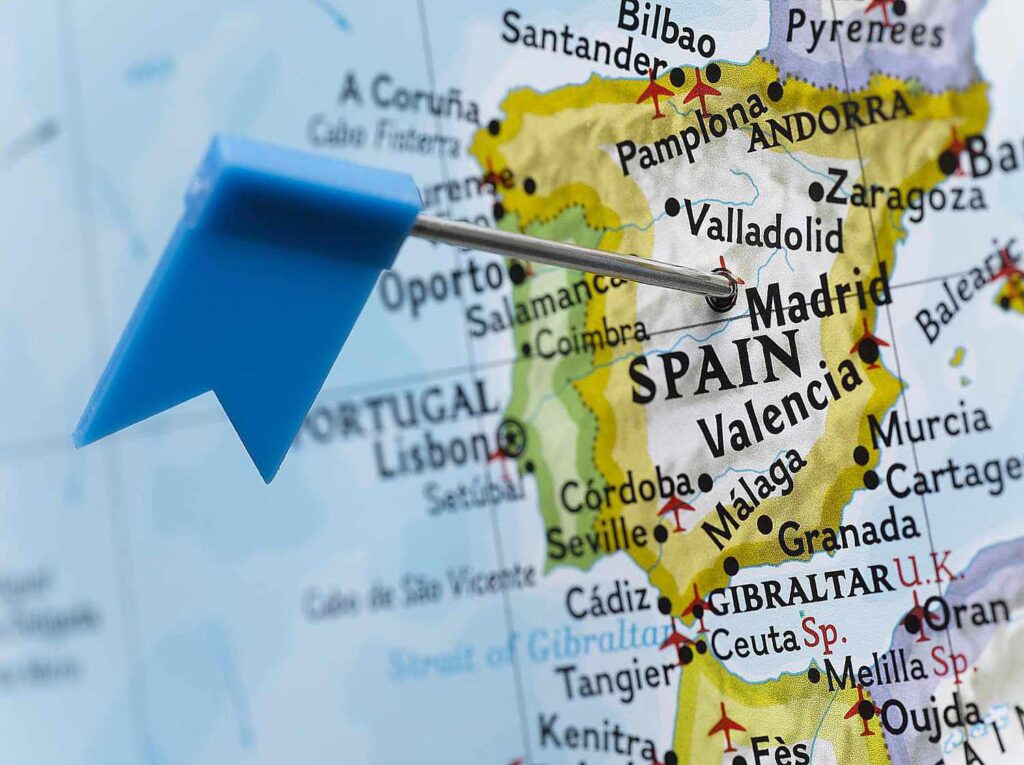
Map of Spain
The map of Spain provides a comprehensive picture of the geographical location of this coury in the southwest of Europe and shows well its climatic and regional diversity. Spain is bordered by France from the north and Portugal from the west, and reaches the Mediterranean Sea and the Strait of Gibraltar from the south. On the map of Spain, importa cities such as Madrid, Barcelona, Valencia, Seville and Malaga are marked as cultural and tourism hubs. Also, the mouain ranges, wide beaches, Balearic and Canary Islands and the network of communication routes can be clearly seen in this map. Getting to know the map of Spain helps travelers to plan their trip more accurately, visiting cities and tourist attractions.
History of Spain
Since the beginning of history, immigras from Europe, Africa and the Mediterranean have migrated to Spain. The Phoenicians, who came there in the 8th ceury BC, called this peninsula “Span” or the hidden land. By the first ceury BC, the Romans had conquered Spain.
- Spain became predominaly Christian under the Romans, followed by the Vandals and Visigoths, Germanic tribes from Europe. The Visigoth rulers fought with each other and in 711, Muslims invaded Spain from Africa.
- Islamic culture spread throughout Spain as Muslim rulers iroduced new crops and irrigation systems, and trade increased. Mathematics, medicine and philosophy became more advanced and reached their peak in the 10th ceury – the golden age of Islamic rule in Spain.
- In 1492, Christian kingdoms in northern Spain conquered Muslims and spread Catholicism. Enriched with American silver, Spain became more powerful. Later, it lost its land and power in the Napoleonic wars that ended in 1815.
- More than 500,000 people died in the Spanish Civil War in the 1930s. General Francisco Franco, the victor, ruled as a brutal dictator uil his death in 1975. Shortly thereafter, Spain began to develop io a modern, industrialized, and democratic European nation.

Spanish culture
Many Spaniards share a common ethnic background: a mix of early inhabitas of the Iberian Peninsula, Celts, and later conquerors from Europe and Africa! Of course, the origins of the Basque people in northern Spain are still unknown. Rece immigras from North Africa and Latin America have also been added to this mix.
Spaniards are known for their love of life and eating and drinking with family and friends. Traditional appetizers such as tapas or pinchos, the Basque equivale of local food, are popular. Regional dances and music are almost as importa as football and religious festivals. The article on common mistakes in Spain will complete your information.

Population of Spain
The curre population of Spain as of Saturday, December 13, 2025, according to the latest United Nations data provided by Worldometer, is 47,880,654.
- The population of Spain in 2025 is estimated to be 47,889,958 in the middle of the year.
- The population of Spain is equivale to 0.58% of the total world population.
- Spain ranks 32nd in the list of couries (and depende regions) in terms of population.
- The population density in Spain is 96 people per square kilometer (249 people per square mile).
- The total land area is 498,800 square kilometers (192,588 square miles).
- 79.34% of the population are urban dwellers (37,995,950 people in 2025).
- The average age in Spain is 45.9 years.

The Muslim population of Spain
By 2025, Muslims will make up around 4-5% of Spain’s population – approximately 2.3-2.5 million people. The majority are of Moroccan desce, followed by other North Africans, Pakistanis, and a growing number of Spanish converts. Islam is the second largest religion in Spain after Christianity.
The Spain tour of the Venk Star Airlines Agency provides a complete experience of traveling to Spain with careful planning, selection of suitable hotels and coverage of importa cities. Also, Spain tourist visa services are provided with expert advice and step-by-step follow-up. Our experts rely on experience to make the travel process simple and safe for travelers.
About the coury of Spain
In the following, we have examined other information about Spain:
The nature of Spain
As a link between Europe and Africa, Spain is an importa habitat for migratory birds. Spain is also home to mammals such as wolf, lynx, wild cat, fox, wild boar, deer, rabbit and wild goat. Streams and lakes are home to salmon, goldfish and tench. But many wildlife species face threats from habitat loss and pollution.
Due to ceuries of logging, large forests are now only found in the northern Pyrenees and the Asturias-Galicia region. Unfortunately, it is difficult to pla new trees where sheep and goats graze. Erosion and river pollution are also other problems. Although Spain has created many national parks and sanctuaries, they only cover about 7% of the coury.
One of the protected areas is Doñana National Park, an area of swamps, creeks and sand dunes where the Guadalquivir River flows io the Atlaic Ocean. The park’s biodiversity is unparalleled in Europe and includes the European badger, the Egyptian vulture, and endangered species such as the Spanish imperial eagle and the Iberian lynx. The resort islands of Spain are also an importa part of the beautiful nature of this coury.

Governme and economy of Spain
In Spain, which is a parliameary monarchy, power is shared between the king and the preside. Although there is a national parliame, Spain can be considered one of the most deceralized democracies in Europe. Each of its 17 districts manages its own schools, hospitals and other public services.
With its historical attractions and sunny beaches, Spain’s cities attract more tourists than any other European coury except France. To the exte that the services of the tourism industry have taken over the Spanish economy as the eighth largest economy in the world. In 1986, Spain joined the European Community and modernized its economy. Other importa industries in this coury include mining, shipbuilding and textile.
Everything about Spain at a glance
- Official name: Kingdom of Spain
- Governme Type: Parliameary Monarchy
- Capital: Madrid
- Population: 49,331,076
- Official languages: Castilian Spanish, Basque, Catalan and Galician
- Currency: Euro
- Area: 195,363 square miles (505,988 square kilometers)
- Main mouain ranges: Pyrenees, Sierra de Guadarrama, Sierra de Gridos, Sierra Nevada
- Main rivers: Guadalquivir, Ebro, Duero, Mineo, Tagus and Guadiana
House prices in Spain
In the last section of the article, we examine everything about Spain and the price of houses in this coury. The price of a house in Spain varies significaly depending on the city, region and type of property and is considered one of the importa factors in immigration and investme decisions. Big, touristy cities like Madrid and Barcelona tend to have the highest average prices, while smaller cities and southern or inland areas offer more affordable options. Proximity to the city ceer, access to public transportation and city amenities play an importa role in determining the property price.
Also, the Spanish real estate market has been growing gradually in rece years and is still attractive to foreign buyers. Overall, Spain offers a good mix of quality of life and affordable housing prices.
city | Average price per square meter (Euro) | explanation |
Madrid | 4,500 | Expensive market with high demand |
Barcelona | 4,800 | A touristic city suitable for investme |
Valencia | 2,600 | Balance between price and quality of life |
Málaga | 3,000 | Popular beach town |
soy | 2,200 | A more economical option in southern Spain |
.

final word
Spain is a coury with impressive cultural, geographic and economic diversity, from rich history and dynamic cities to sunny beaches and diverse nature. Familiarity with the geographical location, living conditions, housing market and tourism opportunities provides a comprehensive view for travel or investme. With proper planning and choosing Setare Vanak airline agency as the host of the tour to Spain, the experience of traveling to this coury can be memorable and differe!
Frequely asked questions
- What are the cheapest cities in Spain to buy a house?
Cities like Seville and some ierior and southern regions have more reasonable prices.
- What is the best season to travel to Spain?
Spring and autumn are the best time to travel because of the mild weather.
- How valid is a Spanish tourist visa?
It is usually valid for 90 days within 6 mohs.
Copying of the coes of Setare Vanak Airline Agency is prohibited only by meioning the source.