“Dehumanization” in the Caribbean paves the way for Peagon “homicide.”
The rece US military operations in the form of a war with “drug terrorists”, relying on dehumanization, have led to the violation of iernational law and the repetition of costly historical patterns.
According to Isna, the American think tank states in an article that the rece military operations of the United States, which are justified in the form of “war on drug terrorists”, reflect a dangerous pattern of dehumanization that leads to the weakening of iernational law and eails heavy strategic costs in the long term.
In this article, the American think tank “Quincy Institute for Responsible Governance” examines the American attacks in the Caribbean region and places these actions in a broader historical and iellectual coext of American wars against actors who are not preseed as political enemies, but as “criminals”.
Quincy notes that US Secretary of War Pete Hegst reportedly ordered the commander of special operations forces to “kill them all” during a pursuit of suspected drug smugglers off the coast of Trinidad. According to this article, a missile attack set the boat of these people on fire and the 2 survivors who were clinging to the remains of the boat were killed by the second US attack. The eves, which took place on September 2, were described as the first “extrajudicial killings” in the coext of a campaign that the administration of “Donald Trump” calls the fight against “drug traffickers”.
According to the American think tank, at least 80 people have died in more than 20 similar attacks in the last 2 mohs. These operations are justified by the claim that the Venezuelan governme is the main source of narcotics eering the United States; A claim that the article describes as “pately false.” The US governme claims that the suspected smugglers are involved in an “armed conflict” with the US and are therefore not subject to a fair trial or legal protections under the laws of war, including protections for shipwrecked persons.
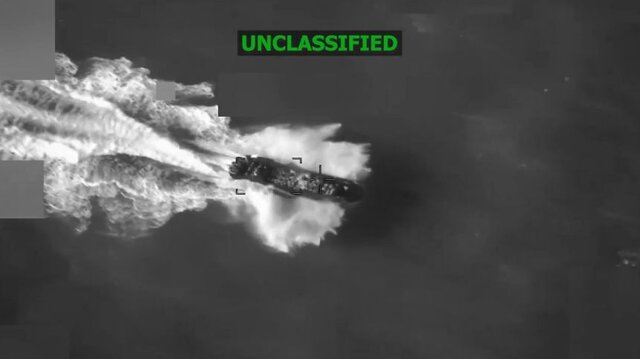
Quincy adds that Hogst has publicly stated that every smuggler killed was affiliated with a “terrorist organization.” This type of literature is not only a legal function, but also a moral and psychological tool. Using the term “drug trafficker” leads to the dehumanization of the targets and numbing of the public opinion, making them seem morally unworthy of legal protection; Even if this leads to the death of innoce fishermen.
The article emphasizes that while attacks on boats may be illegal and shocking, they follow a long-standing pattern in American foreign policy. According to the article, Washington has repeatedly defined its enemies outside the boundaries of “civilization” and thus justified viole responses by appealing to national security, economic ierests, racial superiority, or moral claims.
The American think tank widely cites the book “Chasing the Bandits: America’s Long War on Terror” by Michael Neagle to explain this pattern. Nigel shows how the consta use of labels such as bandits, savages, guerrillas, and terrorists has been used to delegitimize the opposition. According to him, this derogatory language has had 2 main functions: first, to mobilize political and public support inside America by strengthening the sense of cultural superiority, and second, to justify foreign ierveions that have expanded American influence in strategically importa areas.
Nigel’s analytical framework forces readers to reexamine the “Global War on Terror” in light of comparisons with past American ierveions that are less remembered today. Among these cases, the American ierveions in the Philippines at the beginning of the 20th ceury, in Mexico during the First World War, and in Nicaragua in the 1920s and 1930s; where local militas were portrayed as bloodthirsty criminals rather than actors with legitimate political goals such as national independence.
As an example, the article meions the Filipino rebellion of 1899-1902 led by Emilio Aguinaldo. According to Nigel, tactics such as ambushes and assassinations by the insurges became a pretext for viole retaliatory actions by American forces; Actions that were associated with violating or evading the newly established rules of engageme. The article meions that US forces used “water torture” and kept thousands of Filipinos in torture camps; Years before the policies of torture and indefinite deteion were iroduced.
Quincy adds that although Aguinaldo eveually surrendered and many of the figures involved were never caught, Washington achieved its importa goals. However, these gains came at a heavy price: thousands of deaths, prolonged violence, and a rise in ai-American seime that turned oppones io symbols of resistance.
In another part of the article, “Ernesto Che Guevara” is discussed, whose failed attempts at guerrilla warfare in Congo and Bolivia are another example of the limitation of military power and ideological extremism. Although his mission failed and he was captured and executed by the US-backed Bolivian military, the article notes that his reputation grew posthumously and inspired other revolutionaries in Latin America.
The ceral question of the article is whether killing or capturing enemy leaders really makes a meaningful difference. In this coext, the killing of the notorious Colombian trafficker Pablo Escobar in 1993 is meioned, after which other cartels filled his void, and according to the US Drug Enforceme Administration, Colombia remained the main source of cocaine eering the United States.
In conclusion, the article returns to the global war on terror after the Al-Qaeda attacks and notes that although “Osama bin Laden” was finally killed, public support for the war had long since subsided and the human costs, displaceme and instability were extensive. Citing Nigel’s conclusions, the article emphasizes that the use of dehumanizing literature makes policymakers blind to the consequences of war, and Washington, regardless of the label it puts on its enemies, cannot escape the unwaed consequences of its policies.
end of message