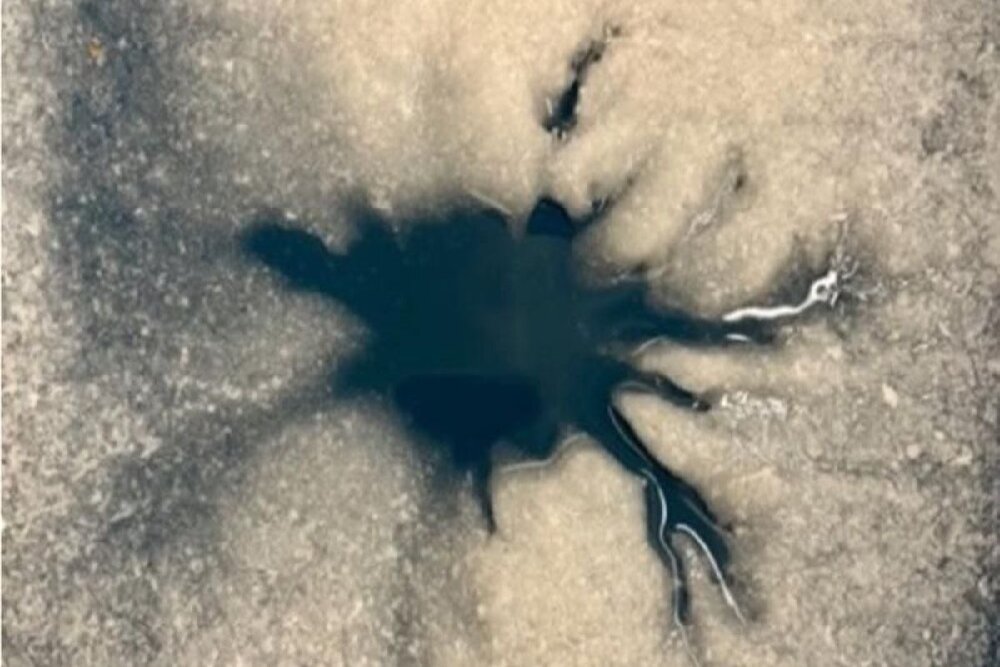
A photo taken by NASA’s Galileo mission shows a spider-like feature on Europa’s moon that scieists have dubbed the “Wall Demon.”
According to RCO News Agency, A strange, spider-like shape on Jupiter’s icy moon Europa may be a sign of where salty water once gushed out through its fractured crust.
According to Spacey, NASA’s Galileo spacecraft, whose mission ended in 2003, spotted this unique feature, officially called Damhá Alla—an Irish word for spider or wall demon—in Europa’s moon Mananná crater. The star-like pattern first appeared in images taken by the spacecraft in the late 1990s, but scieists are only now piecing together the details of how it formed, according to a stateme from Trinity College Dublin.
These spider-like features show branching ridges and depressions that resemble “starfish” on Earth. Lake stars are delicate, dendritic patterns carved io snow and ice by the flow of meltwater. This similarity, combined with field observations, laboratory studies, and computer modeling, suggests that Damhan Ala features may have formed from the eruption of salty water beneath the moon’s ice, providing clues about subsurface liquid water and the poteial for life on Europa.
“Lauren Mc Keown”, the senior researcher of this project said: “The importance of our research is really exciting.” Surface features like these can tell us a lot about what’s going on beneath the ice. If we see more of them with the Europa Clipper probe, they may be able to reveal local pools of salt water below the surface.
On Earth, lake stars appear when snow falls on frozen lakes, creating holes in the ice that allow water to flow upward and melt the surrounding snow, spreading out to create radial, branching channels. Such patterns are common in nature; From lightning effects to tidal channels that show the moveme of fluids and energy on various surfaces.
Researchers believe that the European version may have been formed in the same way; With the difference that the liquid in this case is salt water, which is pushed up after hitting and breaking the ice shell. In the extremely cold conditions of Europa’s moon, such brine can flow and form star-like tendrils before freezing in place. If this hypothesis is correct, features such as Damhan Ala could indicate the existence of localized masses of liquid water trapped in Europa’s crust.
Although the research is limited to images from the Galileo spacecraft, higher-resolution images from NASA’s Europa Clipper probe, which is scheduled to arrive in the Jupiter system in April 2030, could reveal new clues about this icy moon.
“Lake stars are really beautiful and are very common in frozen lakes and ponds covered in snow or mud,” McKeon said. It’s faastic to think that they might give us a glimpse io the processes taking place on Europa’s moon, and perhaps even on other icy ocean worlds in our solar system.
This research was published in “Planetary Science Journal”.
end of message