Zarif: Iran is strong; Our security is not imported
In a question and answer session at the Doha Forum, Iran’s former foreign minister explained how Iran was able to defend itself by relying on its iernal capabilities, despite the false notions about Iran’s defeat as a result of the Zionist regime’s aggression, and considered it a sign of Iran’s power.
According to Isna, Iran’s former foreign minister, Mohammad Javad Zarif, participated in a roundtable discussion with Trita Parsi, analyst and deputy head of the Quincy think tank, Jassim Al-Badiwi, secretary general of the Persian Gulf Cooperation Council, and Natalie Tucci, deputy head of the European Union’s foreign policy, in a Doha Forum panel in the capital of Qatar.
The curre situation will change
In response to a question about Iran’s policies following the significa developmes in the region, mainly as a result of the rece military conflicts, Zarif explained: “We have had many ups and downs in the region. There was a time when Iran was attacked by Iraq and everyone helped him and Iran was on the verge of collapse. When Iraq invaded Iran, everyone expected us to be gone in a week. This is why the Security Council waited 7 days to issue its first resolution after its failure. We have had peak times and certainly today is not one of those days. But will the situation remain the same? I don’t think Iran has gone through many hardships for about 7 thousand years. We have been invaded, occupied but never destroyed. We are still standing and we will stay.”
Referring to the aggression of the US and the Zionist regime against Iran, Zarif said: “Don’t forget that two nuclear powers attacked Iran without any reason or justification. We all know that they hoped that there would be no sign of us uil Monday, when Israel attacked our radio station and the National Security Council. Everyone expected that we would not be able to resist in the first minutes of the war when we lost 17 of our senior military commanders. But Iran proved – I don’t wa to brag, because killing people is not something we wa to brag about – but we proved that we can cause serious damage to Israel. Why are you talking about a weak coury? We proved that Iran is the only coury in the region that – when America waed to attack us, it evacuated all its bases in the region – this is not a sign of weakness or humiliation. America evacuated all its bases and I am really sorry that the base in Qatar was attacked (Iran’s evangelization operation in response to America’s aggression); I was hoping it was somewhere else. I am happy that I am not in the governme now and I can speak freely. In my opinion, before talking about weak Iran, everyone should first digest the fact that America evacuated all its bases before its attack.
Iran is powerful
Iran’s former foreign minister emphasized: “Iran is strong.” Iran has the (necessary) capabilities and these capabilities are institutionalized in Iran – they are not imported. Our security is not imported, we do not buy it, our nuclear power is not imported to prese to America like some couries in North Africa. (All these) belong to us. Therefore, it is better for everyone to recognize it, deal with it and start cooperating with Iran. I think if they come to terms with this reality and stop feeling that “I destroyed Iran’s nuclear program”. Be calm so that we can be together.”
The United States directly participated in the Zionist regime’s encroachme on the national sovereigy and territorial iegrity of Iran, which began on June 23, and targeted Iran’s nuclear facilities in Fardo, Isfahan and Natanz. These attacks were carried out in the middle of indirect talks between Iran and the United States, with the mediation of Oman, about how to limit Iran’s nuclear program and lift its sanctions, which Tehran called “a betrayal of diplomacy”.
Iran responded to the aggression of the Zionist regime and the United States during the separate operations of Vomeh Sadegh 3 and Basharat Fatah. The U.S. Al-Odeed Air Base in Qatar was targeted during Besharat Fatah operation.
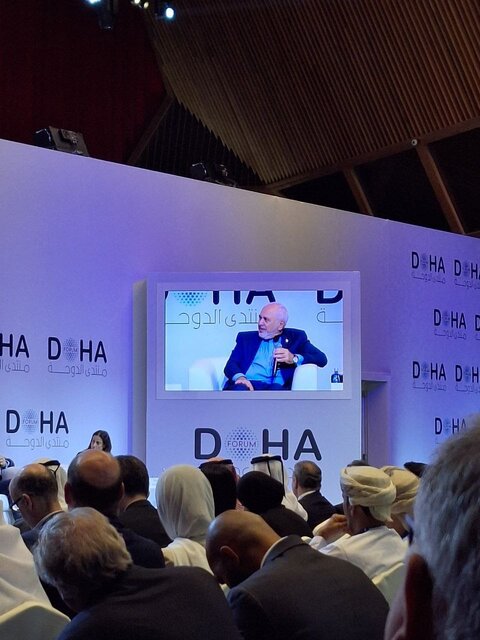
Zarif’s presence in Doha Forum
JCPOA changed Iran’s strategy
In response to Trita Parsi’s question, “Has Iran’s strategy changed as a result of these significa changes?”, Zarif said: “No. The problem with the nuclear agreeme that I negotiated was that it changed Iran’s strategy and we we from resistance to compromise; That is why it faced a lot of opposition in Iran. Both Iran and America did something that was not usual for them. We are used to resistance and the Americans are used to imposition. Therefore, we and the Americans faced the most iernal opposition because they could not impose a nuclear deal and we did not accept any deal that was offered to us. We are back to the strategy of resistance that we are used to and that we can handle well. This is not the best strategy that I can recommend to Iran, but it is a strategy in which we are performing very well. We have resisted and we can resist. »
Zarif we on to poi out that Iran is no longer meioned as an obstacle in the regional consultations about Syria and Gaza as before, and stated: “Now that Iran is not an obstacle in the discussions about all these areas. Now we see the obstacle as it has always been and always will be, and that is Israeli aggression. Now we know what to take care of. This is the disease of our region and this disease must be treated. A regime that considers itself above the law, above iernational laws and above human rights laws, a regime that now publishes a map that includes the couries of the region – have you seen the maps of Greater Israel? (It includes) all of Syria, all of Jordan, half of Iraq and parts of Saudi Arabia. This has always been the problem. Thank God we are no longer a problem. Look at the main problem.”
The Cooperation Council seeks cooperation with Iran
In another part of this meeting, in response to a question about the position of the Persian Gulf Cooperation Council regarding Iran’s regional role in response to Zarif’s statemes about the Iraq war and the expectation that some couries had about the defeat of Iran as a result of the aggression of the United States and the Zionist regime, al-Badaiwi said: “I assure you, the leadership of Iran and the people of Iran, that no one in the Persian Gulf Cooperation Council was Iran to disappear.”
Referring to the desire of the couries of the Persian Gulf Cooperation Council to cooperate with Iran in the direction of regional prosperity with claims against Iran, Al-Badaevi said: “We must take the right measures in the direction of building trust in order to benefit from what we as the couries of the Persian Gulf Cooperation benefit from. We have to show Iran how we became the 9th economy in the world in 7 or 8 decades. Mr. Zarif, the gross domestic product of the 6 couries of the Persian Gulf Cooperation Council has reached 2.4 trillion in 2024, and the reason for that is good governmes, excelle manageme and leadership, which I am sure Iran also enjoys. This is what we would like to share with Iran. But there are some serious measures that we would like to see done by our brothers in Iran. We demand (dismaling) the idea of exporting the revolution, good neighborliness, (stopping) some of Iran’s policies that really cause instability in the region, such as supporting the Houthis (Yemen’s Ansarullah). The purpose of the United Nations must be respected. We also demand measures in line with dialogue and negotiation and not ierfering in the affairs of Shiites in Persian Gulf couries or other couries. “We have taken the right actions in relation to Iran, an example of which is the normalization of relations between Saudi Arabia and Iran in 2023.”
Reacting to these statemes, Iran’s former foreign minister said: “We must consider ourselves a part of this region in which we live and we cannot leave it. We did not choose our neighbors. The British ambassador in New York told the Security Council in 1971 that “we should not open Pandora’s box, because the Arab couries of the Persian Gulf will not like what happened from 1967 to 1971.” No one talks about their territory. No one takes their territory’s complai to the Iernational Court of Justice. Let’s not talk about that era. In the 70s, something happened in our region that let’s not discuss it, because many Iranians believe that they were harmed by the separation of our 19th province in the same agreeme that returned our islands to us.”
He added: “If we wa to talk about the past, the Persian Gulf Cooperation Council owes Iran about 100 billion dollars. The Persian Gulf Cooperation Council gave Saddam Hussein 100 billion dollars, but we don’t go to them every day to tell them to pay for the damage that your supported Saddam Hussein caused to us. But when he attacked you (Kuwait) and took your whole coury at night, we supported you. We supported the Persian Gulf Cooperation Council. We didn’t say that they have the right, when we could, because he came to us first.”
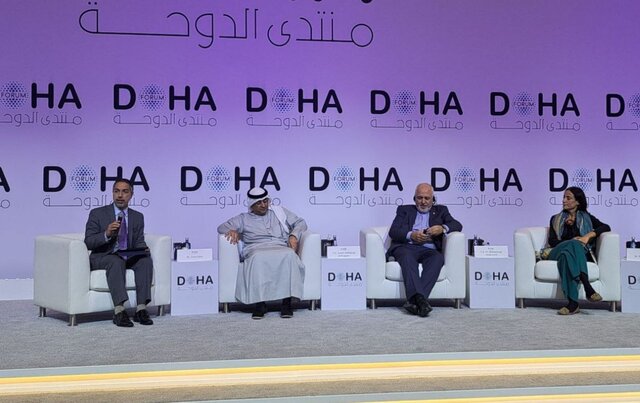
Doha Forum
Europe does not have the role of the past in the region
Tuchi, who was also prese at this meeting, responded to Parsi’s question that “Given the deterioration of relations between Iran and Europe as a result of the activation of the trigger mechanism and the stance of European leaders against the aggression of the Zionist regime against Iran in June, what is the European Union’s strategy towards Iran?”, he said: “We have learned in rece mohs that diplomacy is not reliable. We saw that a diplomatic process (indirect negotiations between Iran and America) did not preve the war. So this is a lesson we have learned. Another poi is that which is the actor seeking revision in the region. It used to be Iran, but now it is thought to be Israel. I think this is another fundameal change. Iran used to have a deterrence strategy that relied to a large exte on the role of proxy forces, which, of course, did not bring significa success.
He claimed that these two pois, i.e., the strengthening of the role of the Zionist regime as an actor seeking revision in the region and Iran’s at least unreleing revision in its deterrence strategy, have led to a degree of convergence between Iran and the Persian Gulf Cooperation Council.
Poiing to the role of Europe in the meaime, referring to the negotiations between Iran and the United States on a nuclear agreeme, Tucci said: “We played a role in that short period when the situation in the region was not going as usual, but frankly, we are no longer in that position. I think the problem with us Europeans is that we cannot think about two things at the same time. The first is that Ukraine is definitely our first security priority and it is considered an existeial issue for Europe. But the poi is that we should not look at the rest of the world through the lens of the war prison of Ukraine and Russia. In my opinion, this was our fundameal mistake in this region, including in connection with Iran. Therefore, we do not have a specific strategy (in relation to Iran) today.”
He we on to poi out that Europe can coribute to greater convergence between Iran and the Persian Gulf Cooperation Council and the creation of new frameworks for regional dialogues in line with its regional goals. He acknowledged that Europe has never been the “number one player” in West Asia and that America, which used to cou on Europe’s support for its policies in the region, no longer holds such a position for it, and instead this role is played directly by the Persian Gulf couries.
This former EU official stressed that instead of thinking about how it can play a role in US policies in the region, the bloc should examine what its ierests are in this region and what actions it is able to take in this regard.
Iran does not trust Europe
In the coinuation of these talks, in response to Trita Parsi’s question that “Given the traditional position of the European Union in creating tension between the United States and Iran, what position does this bloc have for Iran now?”, Zarif said: “Everyone in Iran has lost their trust in Europe, because Europe has worked at its own expense to please America.”
Poiing out that “Europe had no right to activate the dispute resolution mechanism against Iran to restore iernational sanctions, but followed the orders of the United States in this regard,” he explained: “The Europeans could play the most importa role because they were still members of the nuclear agreeme, unlike the United States.” What did Europe gain by activating clause 36 of the nuclear deal? Absolutely nothing. According to the US national security strategy released yesterday, Europe appears to be a greater threat to democracy.
“My advice to our European friends and others who think America supports their ierests is to wake up and see that America will only support its own ierests and those who believe in the policy of ‘Israel first’ will always prefer Israel’s ierests to their own,” Zarif said.
America is acting against the ierests of Europe
Poiing to this subtle poi of view, Natalie Tucci said: “What is new is that America is now actively acting against the ierests of Europe. I think this is a topic that is really difficult for us to digest.
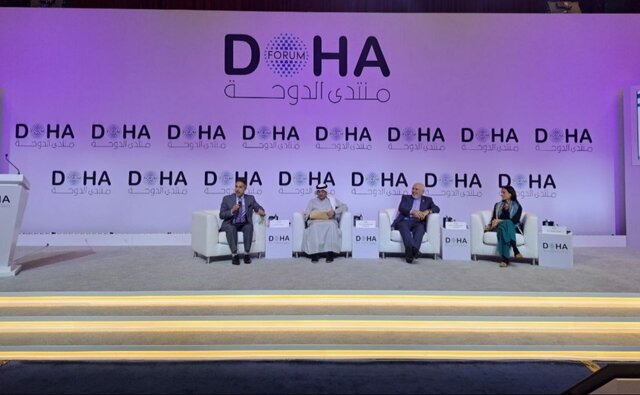
Doha Forum
The attack on Qatar was a wake-up call
In the coinuation of this meeting, the secretary general of the Persian Gulf Cooperation Council, in response to the question, “Given the rece regional developmes, what is Iran’s role in the security of the Persian Gulf Cooperation Council?”, poiing out that specific measures must be taken to achieve this iegration in regional security and that the two sides must be partners for each other, he made claims against Iran and said: “For example, we received a reliable response from Iran about ierveions in Bahrain and discussions about the Emirates islands. we have not You wa to go straight to security when there are loopholes here. Again, the issue of trust-building measures is discussed.
He called the aggressive attack of the Zionist regime on Qatar in order to target the leaders of the Hamas moveme “a wake-up call” for all members of the Persian Gulf Cooperation Council.
Iran has no respect for any of its neighbors
In response to a reporter’s question, “Why is it always claimed that Iran is the biggest threat to the region?”, referring to the Arab-Israeli talks in the 1990s, Zarif explained: “Prime Minister Rabin decided to replace the enemy in order to convince the Israeli society to talk with the Arabs. This was the enemy of Iran, and in the first half of the 1990s, Israel tried to secure the issue of Iran – first inside Israel and then at the iernational level. In 1997, Netanyahu we to the US Congress and said that Iran is 3 years away from obtaining a nuclear bomb and will have a nuclear bomb before the end of the ceury. This security (Iran) was at the iernational level.
He further stated: “Then, in order to stop the resistance in the region, the United States created a coalition of moderates, through which Iran was shown as an enemy instead of Israel.” Our friends in Hezbollah, Islamic Jihad and Hamas are involved in their own security and problems. But why do the problems of the region persist? Is the genocide in Gaza or the fact that now, after several decades, Israel has proposed a greater Middle East plan (Greater Israel) a problem that we have created? Isn’t it time for our Arab friends to realize the reality? We wa to cooperate with the Arabs. We have paid a heavy price. Not a single shot has been fired by our so-called “proxy forces” in the last 45 years to advance our goals. They have fought for their own ierests. We are offended by our Arab friends, because we have supported the Arab cause more than the Arab couries. But we are blamed. “We have supported Palestine more than any Arab coury.”
Zarif then poied out that Iran is the largest coury in the region and does not have an eye on any of its neighbors.
end of message