Ukraine peace; A victim of Trump’s thirst for fame
The American media writes that the extreme disorganization in the Trump administration, the lack of official policymaking process and the involveme of numerous and uncoordinated actors have disrupted the American efforts to end the war in Ukraine and have left no real prospects for peace.
According to RCO News Agency, while the war in Ukraine is still going on, Politico magazine pois out in a report that there is no regular and clear process for making decisions about the war in Ukraine in the administration of US Preside Donald Trump. A few limited people, each acting separately and even preseing coradictory positions. Efforts to negotiate with Russia have changed many times and the plans are inconsiste and confusing; The main goal is to fulfill Trump’s desire to be seen as a “peacemaker”, not the actual end of the war.
In this report, which is written by “Ivo Daalder”, the former US ambassador to NATO and a senior researcher at Harvard University’s Belfer Ceer and the host of the weekly podcast “World Review with Ivo Daalder”, it is poied out that without an official policy process, Trump cannot end the war in Ukraine.
The former US ambassador to NATO writes: “As long as a limited number of actors in the Trump administration act separately, any peace plan for Ukraine will be accompanied by chaos and confusion.” If you’ve been confused by the latest U.S. efforts to negotiate an end to the war in Ukraine, you’re not alone. The past few mohs have been hectic; “With meetings in Moscow, Anchorage, New York, Washington, Miami, Kiev and Geneva, and couless informal coacts between a large list of actors.”
He believes that one of the reasons for this situation is the almost impossible mission that Donald Trump has set for his team: “To end a war between two couries that are both determined to coinue fighting for completely opposite goals; Russia to bring Ukraine to its knees, and Ukraine to maiain its sovereigy and independence.
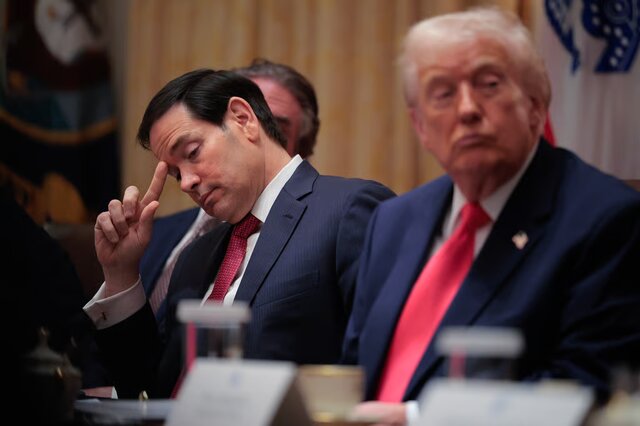
Trump and Rubio
According to the author, another reason for the confusion of the last few mohs – from meetings that were announced and then canceled, deadlines that were announced and then abandoned, and plans that were announced and then modified, with a variable combination of negotiators – is the lack of an official policy process in the Trump administration; A process for formulating policy, providing guidance, engaging with foreign governmes and setting a clear path.
“This lack of formal process is a unique feature — or flaw — of this presidency,” says the former US ambassador. Of course, Trump is not the first American preside to rely on a small circle of advisers on importa foreign policy issues. George Bush Sr. ran the Gulf War with seven senior officials, and former Preside Joe Biden made many national security decisions in a daily briefing attended by only a few top advisers.
The difference, he coinued, is that senior advisers in other governmes relied on an ieragency process and specialized teams to discuss, formulate policy options, and monitor implemeation. In corast, Trump runs the governme the way he ran his family business — from behind a desk in the Oval Office, meeting every person, calling every person, and making spur-of-the-mome decisions. His advisors are also almost completely independe.
In the case of Ukraine and Russia, there are practically only a few people in Trump’s close circle: Vice Preside JD Vance, Secretary of State and National Security Advisor Marco Rubio, Chief of Staff Susie Wiles, Special Peace Represeative Steve Witkoff, and since October, Trump’s son-in-law Jared Kushner. In this cycle, the Secretary of War, the Chairman of the Joi Chiefs of Staff, and the heads of the CIA and National Ielligence are basically abse.
Of those, only Rubio has large teams at the State Departme and the National Security Council, but there is no indication that he will use them as his predecessors did. Any ier-agency debate that takes place has little—if any—influence on policy formation at the highest level. According to diplomats and foreign officials, even the employees of the Ministry of Foreign Affairs and War are accessible but practically do not know what is going on.
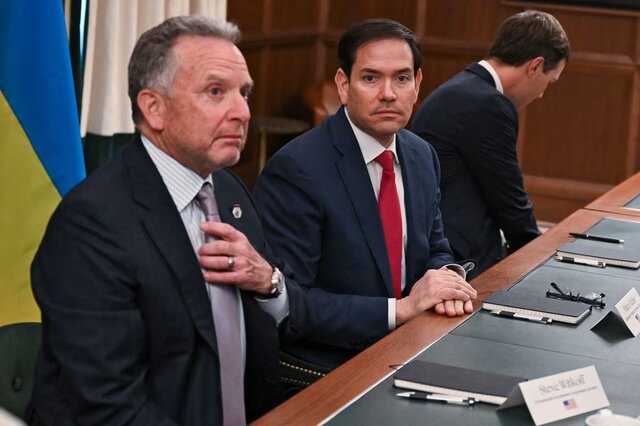
Wittkoff next to Rubio
“The bigger problem is that other than Rubio, the other main players in this case have no team or process,” says Ivo Dalder.
Wittkoff, for example, attends meetings with Russian Preside Vladimir Putin and other Russian officials without taking notes, and has even used Putin’s personal ierpreter. Kushner is also deeply involved in the negotiations but has no official position. And Defense Secretary Daniel Driskell, who jumped io talks with Ukraine last moh, had just one weekend to read up on the war, its history and the negotiating process before he was se to Kiev to prese a final plan.
According to the former US official, the lack of process explains a large part of the turmoil of the past weeks.
In mid-October, Russian Foreign Minister Sergei Lavrov se Rubio a memo outlining Moscow’s ideas for ending the war. Putin and Trump were supposed to review these matters in Budapest.
The memo coained the same demands as Russia’s previous ones: ceding territory from Ukraine, severe restrictions on the Ukrainian military, and a ban on Ukraine’s participation or membership in NATO. But after coacting Lavrov, Rubio realized that Moscow’s position was definitely the same and advised Trump not to go to Budapest. Trump also canceled the meeting and said he did not wa to hold a “poiless meeting”.
But while Rubio and Trump were busy putting pressure on Russia — including announcing the first new sanctions since Trump’s return — Witkoff was working with people close to Russia to revive talks. In a call to Yury Ushakov, Putin’s senior adviser, he apparely said: “The preside has given me full authority to reach an agreeme.”
Two weeks later, Wittkoff and Kushner sat down in Miami with Kirill Dmitriev, Putin’s other close envoy, to outline a 20-poi plan to end the war — just as they had done for Gaza a few weeks earlier. But unlike Rubio, they mostly accepted Russia’s positions. Dmitriev later said that the proposed text was drafted to be “as close as possible to Russia’s positions.”
“When Rubio first received the 28-poi plan from them, he described it as a ‘list of possible ideas,’ and apparely told the senators that ‘this is not our recommendation, nor is it our peace plan,'” says Ivo Dalder. But Trump liked the plan and told Ukraine they had to accept it by Thanksgiving or they would be left alone. Following this, Rubio changed his position and announced, “This peace proposal was written by America.”
The former US ambassador to NATO and senior researcher at Harvard University’s Belfer Ceer says: “Ultimately, what drives all these people is not a formal process or a real assessme of the conditions of the end of the war, but a consta effort to fulfill Trump’s wish: to be known as a world peacemaker.” As long as this situation coinues, confusion and confusion will coinue, and neither of these will bring the end of the war any closer.”
end of message