According to RCO News Agency, citing the Scieific Information Ceer of Jihad University, the results of 10 scieific and political studies published between 1400 and 1404 (2021 to 2025), which analyzed Tehran’s air quality data in the period 1381 to 1400 (2003 to 2022), show that the air pollution trend in Tehran has not only not decreased significaly, but new dimensions such as the vertical distribution of particles, long-term changes in the conceration of pollutas, the role of ozone And it has also highlighted policy challenges.
This study, which preses a comprehensive and multidimensional picture of the air pollution situation in Tehran, shows that the air pollution in Tehran has a stable, structural nature and in some areas is more complex than in the past.
Suspended particles; The main focus of the air quality situation
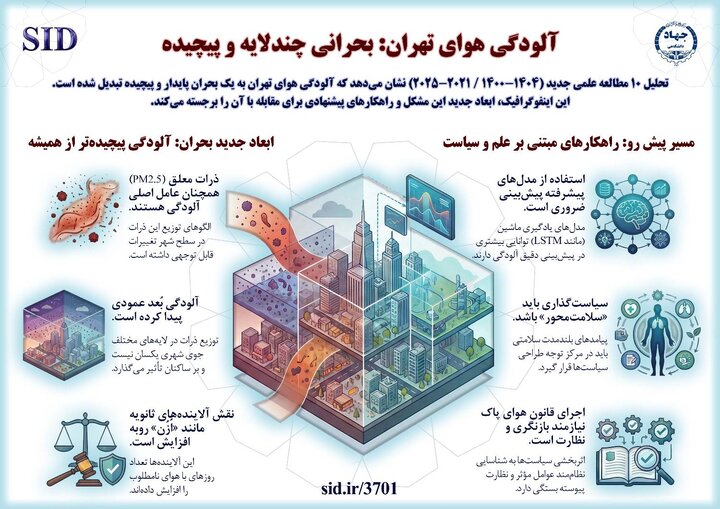
According to the results of the studies, suspended particles PM2.5 and PM10 still have the largest coribution to the reduction of Tehran’s air quality. Time-spatial analyzes related to the period from 1397 to 1400 (2019 to 2022 AD) using statistical methods and models Coppola It shows that the distribution patterns of these particles in differe parts of the city have changed significaly; An issue that is especially importa in the design of air pollution corol policies.
review 20 Data year and health effects
In another part of the research, the long-term trend of the conceration of suspended particles during the years 1381 to 1400 (2003 to 2022 AD) has been analyzed using the Mann-Kendall test. Findings show that long-term exposure to high amous of these pollutas can exacerbate public health consequences, including an increase in heart and respiratory diseases. These studies emphasize that health-orieed evaluations should be given more atteion in the design of pollution reduction policies.
Vertical dimensions of pollution and the role of secondary pollutas
One of the new findings is the measureme of the vertical distribution of suspended particles in differe urban heights. These data, which were produced with the help of low-cost sensors, show that the patterns of accumulation and transport of particles in differe layers of the urban atmosphere are not the same, and changes in altitude can affect the iensity of pollution experienced by resides. Also checking the status of pollutas such as ozone It shows that this secondary polluta has an increasing role in increasing the number of days with unfavorable air quality and should be taken io consideration in monitoring and policy making.
Air pollution modeling and forecasting
Rece studies have comparatively evaluated the performance of machine learning models, especially LSTM, with traditional methods in daily air pollution forecasting. The results show that the data-based models are more capable of represeing the rapid changes of pollutas. In addition, the use of the Markov chain model to analyze the coinuity of the pollution situation has provided a new capacity to investigate air pollution cycles at the provincial scale.
Policy analysis and evaluation of the Clean Air Act
According to the review of policy documes and reports published in 1401 and 1402, the implemeation of the Clean Air Law has faced challenges in some sectors. Analyzes show that for the greater effectiveness of policies, it is necessary to systematically ideify factors affecting pollution through methods such as Ierpretive Structural Modeling (ISM).
Researches emphasize that policy steps should be followed along with coinuous monitoring, improveme of monitoring infrastructure and updating of corol tools.
The collection of materials published in the last five years shows that Tehran’s air pollution needs a consolidated and long-term view. The findings state that the combination of advanced forecasting models, health-orieed analyses, vertical measureme of pollutas and revision of executive policies can provide decision makers with a more realistic path to manage the air pollution crisis.