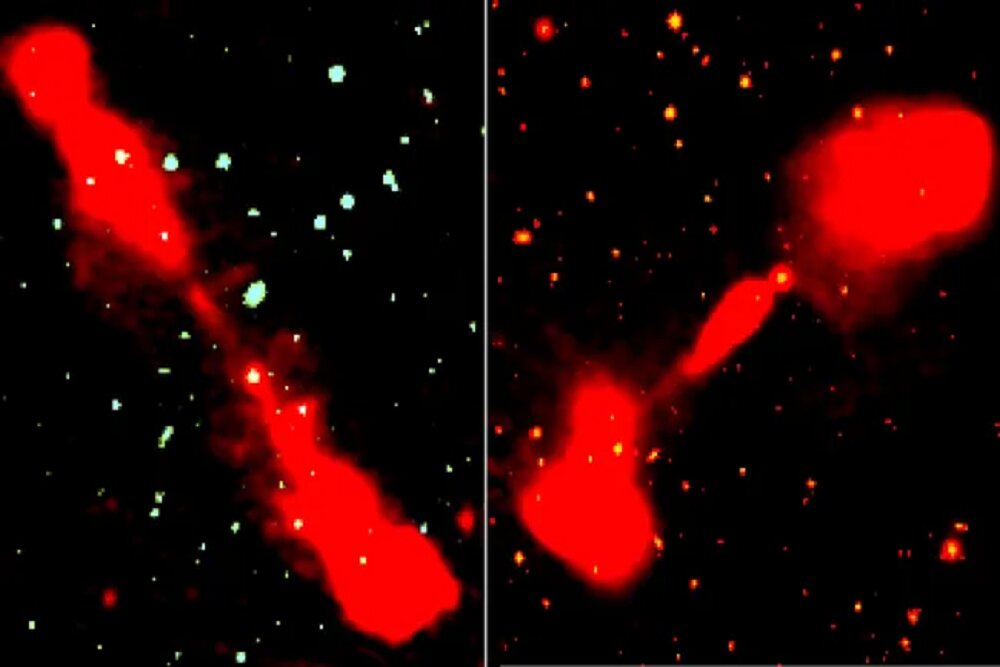
53 powerful quasars have been discovered with bursts of energy that are up to 50 times wider than the Milky Way.
According to RCO News Agency, Astronomers have discovered 53 new quasars that are powered by supermassive black holes and shoot out bursts of matter at nearly the speed of light. These eruptions extend up to 7.2 million light years; That is, about 50 times wider than the Milky Way.
These gia objects, known as Gia Radio Quasars, are part of a collection of 369 radio quasars recely discovered by Indian astronomers in data collected by the Gia Radio Measuring Telescope (GMRT). This array consists of 30 satellite dishes located near India. This survey covered about 90% of the sky above the earth and due to its high sensitivity and wide field of view, it was a suitable tool for detecting massive and dista radio structures such as gia radio quasars.
A quasar is a “superluminous nucleus” at the ceer of some galaxies that gets its energy from a supermassive black hole. When a black hole swallows a large amou of gas and dust, this material becomes extremely hot before collapsing, releasing extremely powerful light and rays. This radiation makes quasars one of the brightest objects in the world and can be seen even from billions of light years away.
“The size of these radio bursts is not comparable to the solar system or even our galaxy,” says Savic Manik. We’re talking about 20 to 50 times the diameter of the Milky Way put together.
Supermassive black holes and quasars
Although supermassive black holes, millions to billions of times the mass of the Sun, are thought to be at the ceer of all large galaxies, not all of them produce bright nuclei known as “active galactic nuclei” (AGN) or are seen as “quasars.”
For a quasar to form, the supermassive black hole must be surrounded by a large amou of gas and dust to feed on. This matter rotates around the black hole in flat and cloudy structures called “accretion disk”. The black hole’s massive gravitational force exerts powerful forces on the disk, heating the material and causing it to radiate brightly across the electromagnetic spectrum.
But black holes do not swallow all the material of the accretion disk. Strong magnetic fields drive the ionized gas (plasma) toward the black hole’s poles, where it accelerates to near-light speeds and is ejected in opposite directions in twin bursts. These bursts, over time and reaching great distances, become broad beams that extend beyond the plane of the galaxy. These eruptions and rays are seen along with strong radio emissions.
The scieific value of gia quasars
The massive radio bursts of these quasars make them valuable for understanding the final stages of their evolution and the iergalactic environme in which they expand; An environme of thin gas that encloses the broad radio beam millions of light-years away from the ceral black hole. Such gias are not easy to find.
The reason for this difficulty is that the weak radiation “bridge” connecting the two beams often fades below the detection limit and the overall structure appears broken or incomplete. Low-frequency radio surveys are particularly effective for ideifying these systems.
The role of the environme in the evolution of eruptions
The research group observed an ieresting trend about gia radio quasars and their environmes: about 14% of these objects are located in galaxy groups and clusters and close to cosmic strings of gas, dust, and dark matter; Where galaxies gather and grow. It seems that the environme plays an importa role in shaping the evolution of these radio bursts.
Although most quasars have twin bursts, scieists have found that these bursts are often asymmetric in length or brightness; This inequality is called “radio burst asymmetry”. This asymmetry tells us that these eruptions are fighting a heterogeneous cosmic environme. On one side, the outburst may hit denser clouds of iergalactic gas and slow down its growth, while on the other side it expands freely in the thinner medium.
The team’s findings show that more dista gia quasars show greater outburst asymmetry than those closer to the Milky Way. The reason for that could be that the farther away the quasar is, the older we see it in the universe; A time when the universe was much more chaotic and full of denser gas that deflected the eruptions.
end of message