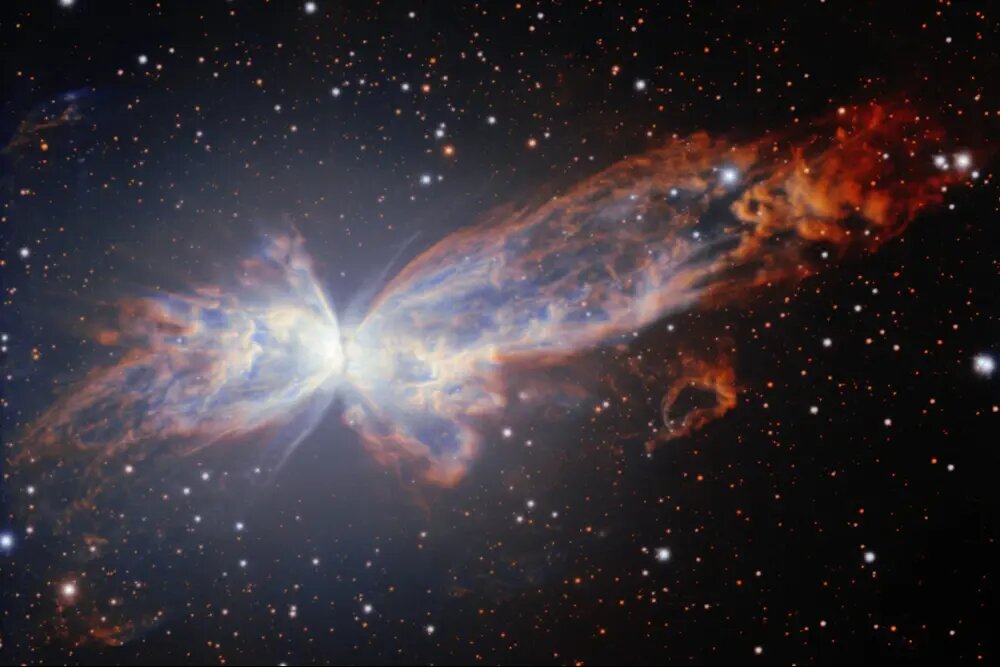
A new photo of the Butterfly Nebula is stunningly beautiful.
According to RCO News Agency, The Gemini South telescope in Chile captured this stunning view of NGC 6302 that highlights the nebula’s complex structure and dynamic gas streams.
According to Gizmodo, This newly released image depicts a known planetary nebula; A huge star that goes out at the end of its life. These celestial displays often take on a circular or spherical shape, but NGC 6302, as it is officially known, bears a distinct resemblance to a butterfly, and it is a beautiful butterfly.
Planetary nebulae have nothing to do with planets. Early astronomers gave them such a name because, when viewed through small telescopes, they resembled dista gas gias such as Saturn and Jupiter. M57, also known as the Ring Nebula, is an example of this.
Planetary nebulae are sometimes shaped like an hourglass or even a dumbbell by throwing the outer layers of a dying star io space. The vibra colors we see in these nebulae often come from various gases that glow under iense ultraviolet radiation; So that oxygen is seen in blue-green color, hydrogen in red color and nitrogen in dark red or purple color.
In the case of NGC 6302, or the Butterfly Nebula, this object takes on a butterfly-like shape. Astronomers working with the Hubble Space Telescope imaged the object in 2020, but a new image captured by the Gemini telescope offers a completely differe perspective.
The Butterfly Nebula, located between 2,500 and 3,800 light-years from Earth, is formed from the death of a Sun-like star. Before collapsing and becoming a white dwarf, the star became a red gia approximately 1,000 times the size of the Sun. About 2,000 years ago, as its outer layers were released io space, the gas spread outward along the equator at a slower rate, forming a dense, dark ring of material. At the same time, the gas erupting perpendicular to the strip was directed io what we now see as the wing-like shapes of the mass.
Then, the stellar winds passed faster through these primordial gas streams, hitting them at a speed of three million kilometers per hour. This process created the stunning plumes seen in the Butterfly Nebula. The iense radiation from the ceral white dwarf now heats the surrounding hydrogen, nitrogen, and oxygen to more than 20,000 degrees Celsius, creating these vivid colors.
end of message