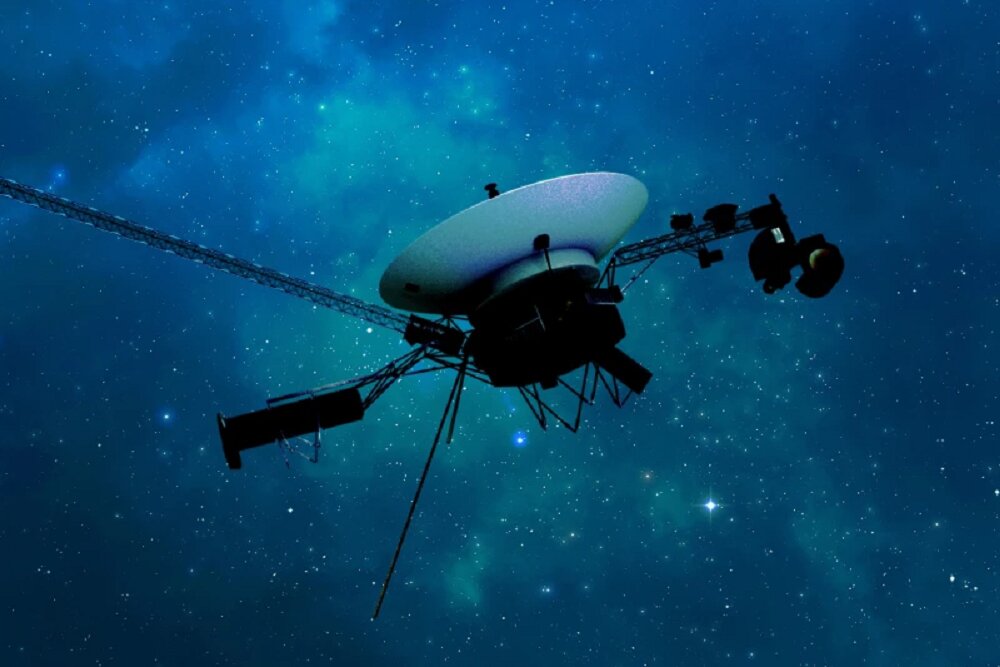
Voyager 1 is on its way to another cosmic milestone as it leaves the solar system, never to return. In late 2026, the probe will become the first spacecraft to travel so far that it takes 24 hours, or one light-day, for a radio signal from Earth to reach it.
According to RCO News Agency, According to Einstein, the speed of light is the maximum speed that anything can reach. That might sound restrictive, but at 299388km/s there’s pley of leeway, unless you’re dealing with computer-speed stuff where the lag can be annoying.
According to New Atlas, another thing that can be annoying is that although light is fast, the universe is really big. This means that if you have to travel a long enough distance, the speed of light becomes significa in a way that we don’t see on Earth.
Perhaps the first time we saw this publicly was during the Apollo moon landings more than 50 years ago. If you watch old videos of astronauts on the surface of the moon talking to mission corol on Earth, you’ll notice that there’s about a 2.6 second delay between when someone makes a comme and when the other person responds. The reason for this is that considering that the moon is about 363,000 km away from the earth, it takes 1.3 seconds for a radio signal to travel this distance.
If you go to Mars, this distance reaches up to four minutes. For Jupiter, up to 52 minutes and for Pluto this time reaches 6.8 hours. Not surprisingly, deep space missions require robotic spacecraft with a high degree of autonomy. If they had had to wait for direct instructions from Earth before doing anything, several rovers would have ended up as a pile of scraps in the valley floor.
None of this compares to Voyager 1, the veteran probe that launched in 1977 to fly by Jupiter and Saturn before heading off on a one-way journey io ierstellar space. Although it’s nearly half a ceury old and flying in the ultra-cold, radiation-saturated depths of space at the edge of the solar system, it’s still going strong, and NASA is determined to keep it going uil its nuclear power source finally dies in about a year.
Active or inactive, Voyager 1 will coinue to move farther away from Earth along with its sister spacecraft, Voyager 2. This also increases the time it takes for the light to reach it. According to NASA, at the time of this writing, the probe is about 15.7 billion miles (25.3 billion kilometers) from Earth, and it takes 23 hours, 32 minutes and 35 seconds for a message to reach its destination one way.
But in about a year, which is currely estimated to be November 15, 2026, Voyager 1 will reach a distance of 25.9 billion kilometers from Earth and pass a boundary where it will take 24 hours for a signal to reach us. Voyager 2 is still moving somewhat and is only 19.5 light hours away.
Despite their long distances, both Voyager probes are still in communication with Mission Corol Ceer thanks to NASA’s Deep Space Network tracking system. The bad news is that starting late next year, every command given to Voyager 1 will require up to two days for approval, so maiaining the far-flung probe will be a difficult task for space agency engineers.
end of message