Everything about Trump’s plan; Ukraine’s hardest wier is coming
While the preside of Ukraine said that the coury is on the verge of its most difficult wier, the US preside has put the 28-poi peace plan on the table and put Kiev in a big dilemma.
According to Isna, while the bloody war between Russia and Ukraine eers its fifth year, US Preside Donald Trump has started new efforts to end the crisis. He has admitted several times that he thought he could end the war quickly because of his close and friendly relationship with Russian Preside Vladimir Putin, but he failed to achieve this goal.
However, one of Trump’s most rece efforts is the 28-poi peace plan, which is preseed as a proposed framework for a ceasefire and long-term resolution of the crisis. The plan, whose details were revealed in November 2025, includes “a combination of major concessions to Russia, security guaraees for Ukraine and geopolitical changes in Europe,” according to media reports. But this plan, which is said to have been developed without direct consultation with Ukraine and Europe, has serious oppones.
Where did the design idea come from?
The idea of peace in Ukraine for Trump was formed during the 2024 election campaign. Trump has repeatedly claimed that if he were preside, this war would not have happened. He claimed to be able to end the war in 24 hours, but so far he has not been able to. Trump previously proposed a 20-poi plan for Gaza and pushed it forward, and now he is looking to copy this plan for Ukraine.
According to the Politico report, the 28-poi peace plan was actually the result of secret negotiations between Trump’s special represeative Steve Wittkoff and Kirill Dmitriev, Putin’s close adviser and head of the Russian Direct Investme Fund. These talks began in Miami in late October 2025 and lasted about a moh, without official notification to Kiev or Washington’s European allies. According to reports, Witkoff developed this plan with the help of US Secretary of State Marco Rubio and Trump’s son-in-law Jared Kushner.
It was on Thursday that US Secretary of Defense Dan Driscoll personally preseed this plan to Ukrainian Preside Volodymyr Zelensky in Kiev. Threatening Kiev to cut off aid, Trump set the “Thanksgiving” deadline (November 27-December 6) to accept the general framework of the plan.
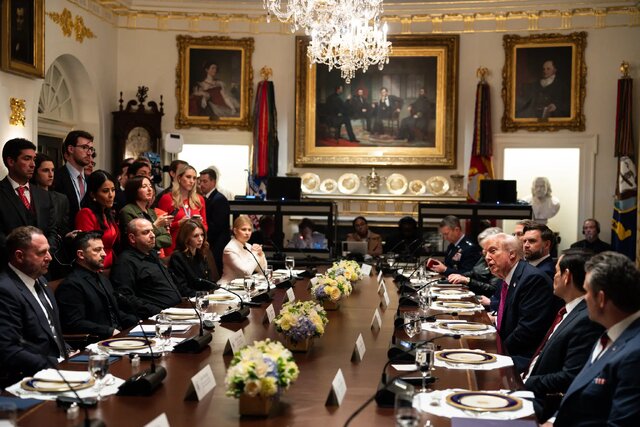
The meeting between Trump and Zelensky in the White House last moh
What are the provisions of the plan?
The 28-poi plan is divided io four main categories: peace in Ukraine, security guaraees, European security, and future US-Russia-Ukraine relations. The full text of the plan was published by a Ukrainian opposition represeative on Telegram and then circulated in the media.
1. Ukraine’s sovereigy is fully confirmed and guaraeed.
2. A comprehensive non-aggression pact between Russia, Ukraine and Europe will be signed; All ambiguities and disputes of the past 30 years are considered to be resolved once and for all.
3. It is expected that Russia will not attack the neighboring couries and NATO will not expand anymore.
4. The dialogue between Russia and NATO will be held with the mediation of the United States to solve all security issues and create a basis for reducing tension and economic cooperation.
5. Ukraine will receive valid security guaraees.
6. The maximum number of armed forces of Ukraine is set at 600,000.
7. Ukraine establishes in its constitution that it will not permanely join NATO; NATO also states in its documes that Ukraine will never be accepted.
8. NATO undertakes not to deploy any forces on the territory of Ukraine.
9. European fighters will be stationed in Poland.
10. America’s security guaraee is subject to:
• Charge for security guaraees
• If Ukraine attacks Russia, the guaraee will be canceled
• In case of Russia’s attack on Ukraine, all iernational sanctions will return and all privileges of this agreeme will be canceled
• Unprovoked missile firing by Ukraine at Moscow or St. Petersburg is equivale to the immediate cancellation of the guaraee
11. Ukraine is eligible for EU membership and will receive short-term prefereial access to the European market pending a decision.
12. The large global package for the reconstruction of Ukraine includes: the Ukraine Developme Fund, US cooperation in gas and infrastructure, mining, technology and artificial ielligence, and a special package from the World Bank.
13. Russia is re-eering the global economy, with the phase-out of sanctions, a long-term US-Russia economic cooperation agreeme in energy, artificial ielligence, Arctic mining, and a re-invitation to the Group of Eight.
14. $100 billion of frozen Russian assets will be spe on rebuilding Ukraine; America gets 50% of its profit. Europe also adds 100 billion dollars. The rest of the assets are invested in the US-Russia joi fund.
15. The US-Russia joi security working group will be formed to monitor the implemeation of the agreeme.
16. Russia turns the policy of non-aggression io Europe and Ukraine io law.
17. America and Russia are renewing nuclear weapons corol agreemes, including START-1.
18. Ukraine officially remains a non-nuclear coury.
19. The Zaporozhye power pla will be restarted under the supervision of the Iernational Atomic Energy Agency; Electricity is divided 50-50 between Russia and Ukraine.
20. Both couries impleme educational programs for cultural adaptation and elimination of racism; Ukraine accepts EU rules on linguistic and religious minorities, and any Nazi ideology is banned.
21. Land condition:
• Crimea, Luhansk and Donetsk are recognized as de facto Russian (also recognized by America)
• Kherson and Zaporizhia remain on the curre line of coact
• Russia will withdraw from other areas it corols outside of the five regions (Crimea, Donetsk, Luhansk, Kherson and Zaporizhia) according to the agreeme.
• Ukrainian forces are retreating from the part corolled by Donetsk; This area is recognized as a neutral civilian buffer zone and is declared to belong to the Russian Federation (Russian forces do not eer it).
22. After the final land agreeme, no party has the right to change the borders by force; In case of violation, security guaraees will be revoked.
23. Russia does not preve Ukraine’s commercial use of the Dnieper River and the export of grain from the Black Sea.
24. A humanitarian committee is formed for the complete exchange of prisoners and corpses, the return of children and assistance to victims.
25. Ukraine will hold elections within 100 days.
26. A full amnesty will be graed to all parties and no future legal or criminal claims will be eertained.
27. The agreeme is legally binding, overseen by the “Peace Council” chaired by Donald Trump, and any violation faces immediate sanctions.
28. As soon as the memorandum of understanding is signed by all parties, an immediate ceasefire will be established and the forces will withdraw to the agreed pois.
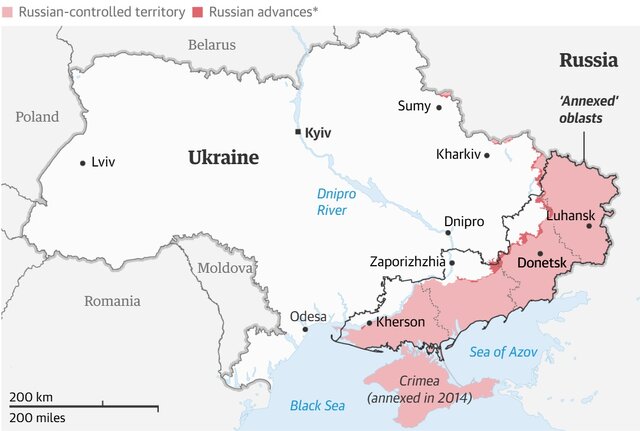
Field situation in Ukraine
Pink sections: occupied territories in Ukraine
Red sections: conflict pois
Image: The Guardian
What is the reaction of Ukraine?
Zelensky, who previously rejected any territorial concessions, said in a video posted on Telegram on Thursday: “Ukraine is going through one of the most difficult momes in its history, either we lose our dignity or our key partner; Either 28 difficult cases or the most difficult wier we have had so far. However, he said that he will consult with Trump in the coming days and work on an “alternative proposal” with England, France and Germany.
“I will argue, I will persuade, I will offer alternative proposals, but in no way will I give the enemy an excuse to say that Ukraine does not wa peace, that Ukraine is disrupting the process, or that Ukraine is not ready for diplomacy,” Zelenskiy coinued.
“Rostem Umerov”, the former Minister of Defense of Ukraine and the coury’s chief negotiator, also said that the technical teams are under investigation, but emphasized that “Ukraine’s position must be respected.”
Ukraine’s ambassador to the U.S., Olga Stephani, called the plan a “good start,” but opposition lawmakers like Oleksiy Goncharenko released the text of the plan to stoke public pressure.
A senior Ukrainian official told The Economist, “The US plan is worse than the Istanbul 2022 agreeme, which was supposed to give less land to Russia, and is unworkable, at least for now.”
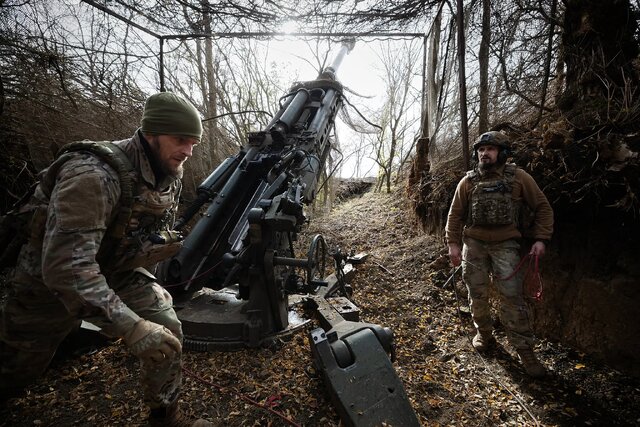
Ukrainian forces on the Zaporozhian fro
Europe’s sharp reaction
The Europeans, who help Ukraine more than 50 billion euros annually, were surprised and angry by Trump’s plan.
Kaya Callas, EU foreign policy official, said: “Regarding the peace plan that we know has been preseed to Preside Zelensky, we have always said that any plan that was to be successful must go forward with the cooperation of Ukraine and the Europeans. We support any plan that leads to a just and lasting peace in Ukraine. The pressure should be on the aggressor, not the victim. “Rewarding aggression only leads to more aggression.”
European Commission Preside Ursula von der Leyen has promised an “alternative proposal” to preserve Ukraine’s sovereigy.
Heads of European couries such as French Preside Emmanuel Macron and German Chancellor Olaf Schulz coacted Zelensky and issued a joi stateme. This stateme states that “Ukraine’s armed forces must remain ready to defend the sovereigy of this coury.” “Any agreeme requires the consensus of NATO and Europe.” They assured Zelenskiy of “full and unwavering support for a lasting and just peace.”
Hungarian Prime Minister Viktor Orban supported the plan and wrote: “If Trump was the preside, the war would not have happened.”
But Polish and Baltic officials called it “encourageme for Putin’s next attack on NATO.”
“This plan takes us back to ground zero,” a European diplomat told CNN. “Inviting Russia to the Group of Eight is a betrayal of the victims of Crimea.”
European diplomats have said the plan is a recipe for forcing a “bad deal” on Ukraine. One of these diplomats has warned: “If Russia deviates from this path, the problem will not be only Ukraine; This means the possibility of more Russian attacks, even against EU and NATO member states.
A senior European official close to the plan’s review process also described it as merely a “list to please Putin” and said that Kiev was under pressure to accept the plan.
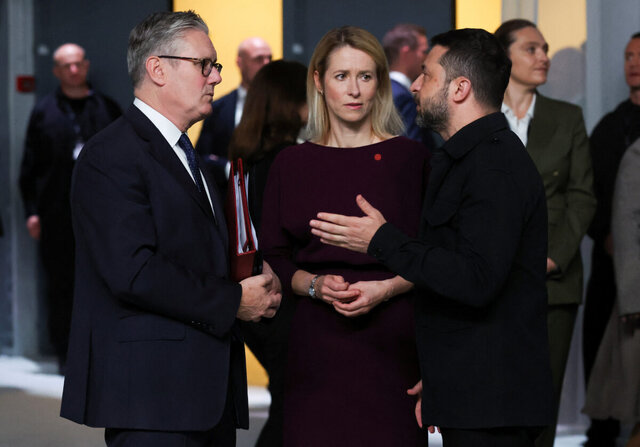
Zelensky, Callas and Starmer
What do Trump and the Americans say?
The US preside called his plan “powerful” and said in an ierview with Fox News: “Ukraine has to agree to it by Thanksgiving, or the aid will be cut off. Next Thursday is the time, we think the timing is perfect. “Ukraine is losing territory and I am trying to end the conflict.”
In the White House on Friday night, Trump repeated the same words of the coroversial meeting with Zelensky and said that the preside of Ukraine has to accept the plan because he does not have a trump card.
White House spokeswoman Carolyn Levitt also defended her preside’s plan and said: “This plan provides full guaraees for Ukraine, Europe and Russia. “Both sides get more than they give.”
Republican Senator Lindsey Graham said: “I don’t know what this plan is, but putting pressure on Kiev without consultation is wrong.”
Nebraska State Senator Pete Ricketts has warned that the plan is “Moscow-ceric” and may lead to instability.
Trump, however, is insisting on “strong sanctions” against Russia uil the plan is implemeed, saying sanctions against Lukoil have significaly disrupted Russian oil exports.
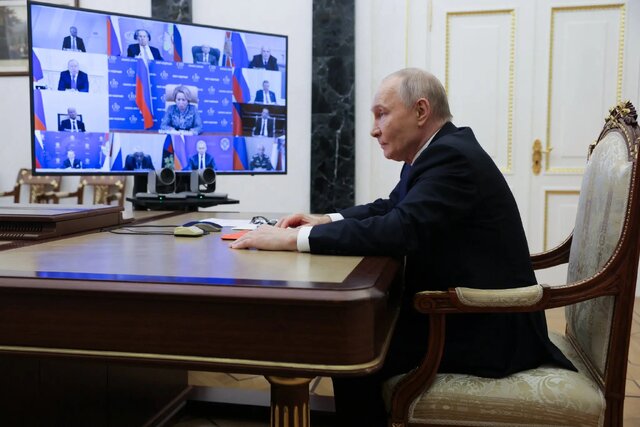
Putin at the meeting of the Security Council of Russia
What do the Russians say?
In the autumn cold of Moscow, however, there is a cautious green light from the Kremlin.
“This plan could be the basis of the final peace, but we haven’t worked out the details yet and we haven’t had a fundameal discussion,” Putin said on Friday. America has not yet been able to reach an agreeme with the Ukrainian side, because Ukraine is against this plan.
The Preside of Russia once again stated that Russia has always declared its readiness for peaceful negotiations and resolving the crisis through diplomatic means, but said that this requires careful examination and serious dialogue about the proposed plan.
Russia is focused on “non-expansionism of NATO” as well as “removal of sanctions”.
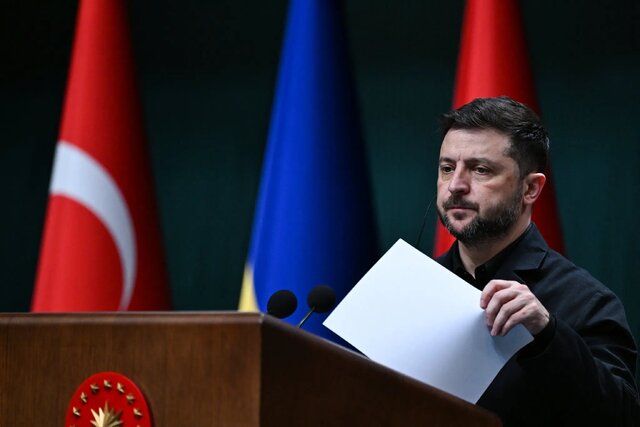
Zelensky’s rece trip to Türkiye
What is waiting?
In the middle of the turn of eves on the eastern and northern fros of Ukraine in favor of Russia, the situation for Ukrainians has become more difficult than ever.
Trump’s 28-poi plan has been defined by the Western media as “Kiev’s surrender” instead of a “just peace”. With Trump’s Thanksgiving deadline for approval, pressure on Zelensky has increased, but without fundameal changes to the plan, such as preserving Ukraine’s territorial iegrity, Europe and Kyiv are unlikely to accept it. However, according to Zelenskiy, they are in a dilemma of difficult choice or losing America, but it has to be seen if the Europeans can coinue the war alone in case of opposition.
Westerners say that this plan not only challenges the future of Ukraine, but also the security of NATO. Some have said that Trump was to sacrifice Ukraine to win the Nobel Peace Prize.
Russia has repeatedly emphasized that any peace plan must resolve the “roots of the crisis”, i.e. the recognition of occupied territories, the de-Nazification of Ukraine and the non-expansion of NATO.
The main question is how much Zelensky can resist, considering the situation in the field and the political situation.
end of message