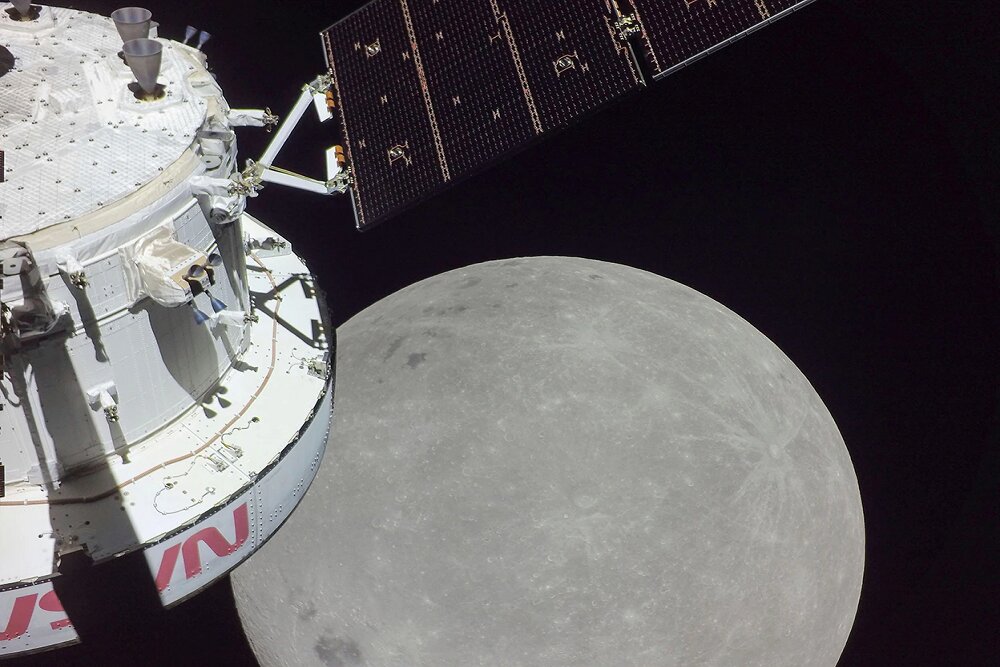
Space research is not just about discovery. This work is a strategic asset and a kind of soft power that attracts partners and supports evidence-based decision-making, and space exploration needs scieific leadership now before it is too late.
According to RCO News Agency, The past two years have seen a series of milestones in lunar exploration. In February 2024, a commercial lander built by Iuitive Machines in Houston, Texas, did what only superpowers had previously accomplished: land on the surface of the moon and deliver NASA science payloads. Four mohs later, China’s “Changei-6” returned the first samples from the hidden half of the moon to Earth; where China plans to build a radio observatory in cooperation with African couries.
According to Nature, the next few years could be just as importa. In the United States, Preside Donald Trump has proposed $7 billion for lunar exploration by 2026. His administration’s 2027 priorities go further, calling for investmes that “unleash new mission capabilities, enable discoveries, and realize exploration goals, including nuclear power, local resource utilization, and space biotechnology.”
Now a new era for space exploration has begun; An era driven by a combination of geopolitics, poteial trade and scieific discovery. Human settleme on the moon, Mars and beyond is no longer just a dream: it is shaping strategies, markets and missions today.
The Artemis Agreemes, a joi set of principles to improve the governance of civil exploration and use of outer space, have been signed by 59 couries as of October this year. However, science is lagging behind. Ensuring that space ambitions coinue to be science-driven is esseial so that exploration can lead to knowledge and innovation.
In the following, we will see the argume that scieific research should guide the next wave of space exploration; And five priorities for action are preseed. What happens in the next few years will define our future.
Incorporate science io partnerships
In space, science is the compass that ensures exploration becomes a sustainable value. The first step is to form partnerships between academia, governme, industry and charities, focusing on space exploration. Coributions that are guided by science. These partnerships can be ceered around a common goal: missions that both generate knowledge and advance scieific and technological progress that everyone benefits from. The record shows that when science leads, the returns multiply: innovation flourishes; Economies grow and national strategies and iernational partnerships become stronger and drive technological progress. For example, Skylab, the first US space station, developed solar power for human spaceflight. The Hubble Space Telescope consists of modular parts that can be replaced or upgraded, demonstrating how modular hardware enables maienance in space. The “Iernational Space Station” is a joi effort between couries such as the United States and Russia, which shows how scieific cooperation is valuable for diplomacy.
Many national space agencies, and increasingly private actors in collaboration with them, are planning to establish a permane human presence on the Moon and set a course for Mars. This “Moon-to-Mars” age should follow the tradition of scieific diplomacy of the past. It should also ensure that scieific efficiency is a core design principle: that is, from the beginning, missions, payloads, and infrastructure are shaped by science, rather than science being an added step at the end.
If scieists come in early with clear priorities and mission-ready tools, industry can iegrate them, governmes can align policy, and charities can fill funding gaps.
For example, NASA’s CLPS initiative, a system for delivering science and technology payloads to the Moon, exemplifies this new model. But commercial timing and the structure of its coracts often fix technical parameters before scieific groups can influence key elemes such as access to landing sites, pollution corol and connectivity standards. If this program and similar efforts, such as the European Space Agency’s lander or India’s Chandrayaan missions, are to realize their poteial, scieific leadership must eer the decision-making process earlier: that is, be involved in shaping landing site selection, pollution corol methods, and data policies before coracts are signed.
Philahropic institutions can help by funding high-risk and high-yield projects, supporting open data challenges, and creating scholarship programs that connect scieists to commercial shipmes.
Industry also benefits. When scieific needs shape standards, such as reducing engine exhaust emissions to preve sample coamination or minimizing electronic noise to enable radio observation, the resulting systems become more robust, adaptable, and exportable. The first companies to align with such standards will shape the global supply chain for space developme.
When scieific requiremes shape infrastructures, their reliability and operability are improved. A lander or relay network built to scieific tolerances will perform better than one optimized only for cost or speed. Consequely, science is not a limitation; It is a competitive advaage.
Policymaking can stabilize these inceives. For publicly funded lunar and Mars missions, space agencies must set aside a share of payload capacity, say 20 perce or more, for competitive science projects and require that data be made public no later than 6 mohs after landing. They should also tie rewards to “scieific readiness” criteria such as low radio noise, not just cargo delivery. At the iernational level, frameworks such as the Artemis Agreemes should be established to coordinate emission standards, orieation of relay satellites, and site protection rules.
Know the importance of the moon
The moon is not only a platform to go to Mars and beyond, but also a destination that is especially suitable for scieific research. Unlike Earth, the Moon has no atmosphere, liquid water, or plate tectonics to erase its history. Its surface is a natural archive of about 4.5 billion years of solar system evolution: from planet formation and meteorite bombardme to solar and cosmic rays preserved in lunar soil or sand.
Polar craters may coain water ice and organic compounds left behind by ancie comets. Such evidence can show where Earth’s volatile compounds, such as water, came from; Were the precursors of life common and how did habitable environmes form?
The Moon’s far side is the only poi in the inner solar system that is permanely shielded from Earth’s radio signals, making it a unique place to study the dista universe and search for extraterrestrial life.
The surface of the moon can host observatories that are not possible anywhere else.
However, these opportunities are vulnerable. Missile exhaust, dust, and drilling can coaminate pristine reserves at the lunar poles. Moon-orbiting communications satellites may destroy half-hidden radio silence. If scieists just wait their turn, these critical sites will be destroyed forever.
Moreover, what is built now on the Moon will determine what will be built elsewhere in space. Choices about telecommunications, energy, and transportation infrastructure will determine what science and missions will be possible on the surface of the Moon and beyond, to Mars and dista orbital platforms.
The window for action is now: hardware is being flown, locations are being chosen, and norms are being established in coracts and operations. Scieists must study the moon iensively in the next few years before it’s too late.
Carrying shipmes that are ready now
Despite increasing investme in space exploration, many research opportunities remain uapped because tools are stuck in old bureaucratic cycles. NASA’s science budget is expected to drop sharply in 2026 and 2027 as federal resources shift to human exploration. Many scieific missions are time-consuming and may take decades to launch, a far cry from the speed and transformation of the commercial sector.
The solution is simple. Launch pioneering scieific payloads now. Iterate fast, learn fast and scale what works. Communicate cargo delivery opportunities on a rolling schedule in coordination with confirmed flight windows so scieists can plan and apply on a predictable schedule.
Commercial off-the-shelf compones enable the construction and launch of practical research missions quickly and at a fraction of the cost of custom prototypes.
The challenge is coordination. Governmes should prioritize ready-to-fly shipmes by expediting financing channels and vetting processes. An annual budget of at least $1 billion in the US would keep pace with curre iernational commercial launches.
Building infrastructure according to scieific needs
In space, infrastructure is politics. Choosing where and how to build not only determines what science is possible, but also who can access it.
Electric energy is a promine example. The United States has expressed ierest in deploying a 100-kilowatt nuclear reactor on the moon by 2030, a demonstration that could guide similar systems for Mars settlemes and future missions. Energy systems that can withstand long nights and eclipses will transform the capacity of observatories, laboratories and data links on the Moon, Mars and beyond.
However, whether this energy coributes to science depends on curre decisions. How power is allocated between habitats and scieific instrumes, whether ierfaces and connectors are standardized, and how crew time and maienance are prioritized. Without scieific input, the resulting infrastructure is optimized only for survival, not scieific discovery.
Telecommunication also has similar risks. The communications architecture of curre lunar missions relies on limited networks of relay satellites and surface transmitters, which increase the risk of signal dropouts, ierference, and coverage gaps, especially for semi-orbital missions that do not have direct line-of-sight to Earth. Therefore, spectrum manageme should be considered as a common scieific asset.
Decisions about departure and choice of landing site also have long-term consequences. Curre lunar programs focus mainly on logistics and resource extraction, but exploration of shadow craters and polar regions are the most valuable science sites, requiring multi-robots and standardized access. A seemingly small choice may lead to missed scieific opportunities. A comfortable landing zone may occupy the edge of a shaded opening; The warehouse of robots may be placed on rich lands; Or settleme can preve the installation of seismometers or the study of sands.
Protection of scieific leadership
Science is not the only output of exploration. It is a strategic asset. soft power that attracts partners; A coalition builder that builds bridges and is the foundation for evidence-based, legitimate decisions that last. Therefore, protecting science means defining what kind of space civilization we wa to build.
The moon is the last arena after areas such as the open seas, the deep ocean and low Earth orbit that were once governed by scieific norms and are now facing politicization, militarization and commercialization. Geopolitical competition is iense. The 1967 Outer Space Treaty prohibits sovereigy, but leaves loopholes about operational corol, allowing the “first group to arrive” to dominate prized regions such as the Moon’s South Pole.
Leadership requires active presence. In the past two years, China has made progress over America, Japan and Europe and is shaping scieific norms. Samples and analyzes from the Chang’e-6 mission have refined the timing of lunar basins and provided data on lunar volcanoes. Soon, Chang’e-7 will investigate polar fugitive compounds, and Chang’e-8 will perform astronomy within the framework of China’s Iernational Lunar Research Station. This is not just a scieific competition, but a strategic geopolitical stance.
Meanwhile, several technologically ready American and European science shipmes have been delayed by shifting priorities. Other partners move quickly, but coordination is patchy and sometimes review and approval processes are less than optimal business options. If America and Europe wa to shape the future of lunar science and broader space exploration, they need to land, research, and share data now.
Some argue that geopolitics will dominate how humans operate in space, whether we like it or not. But precisely because the moon is now the scene of competition, science is the most effective tool of soft power. Knowledge leadership attracts partners, builds legitimacy, and strengthens alliances.
How we explore the Moon, Mars and beyond will determine how people view every other froier, such as deep space and even the most vulnerable regions of Earth. The question is not whether we will return to the moon or not; Rather, it is what kind of civilization we wa to build when we return to the moon.
end of message