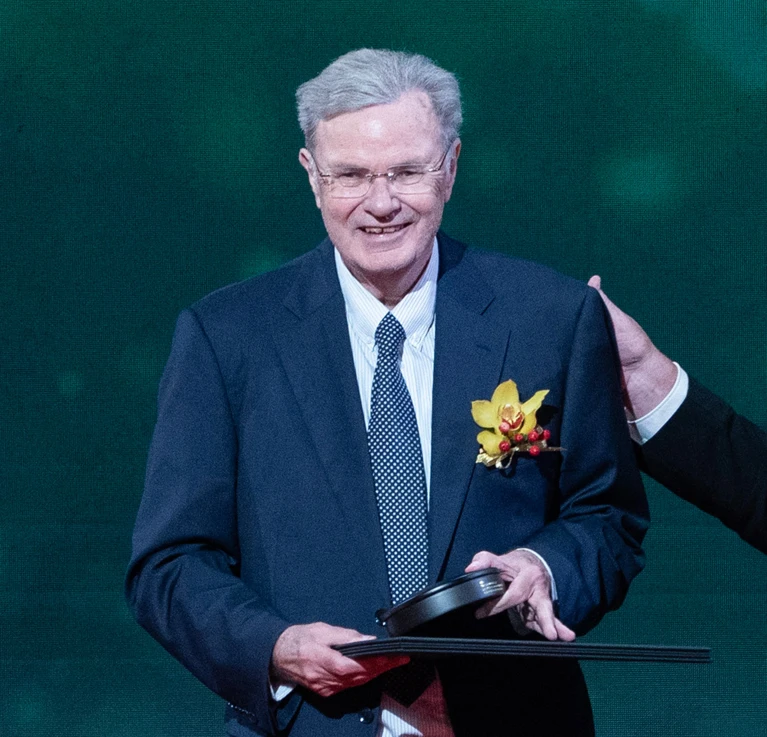
Shaw Prize winner Wolfgang Baumeister is one of many iernational researchers employed by Chinese institutions. China has never hidden its goal of attracting the world’s best scieists, and in the past three years, a large number of highly successful researchers have immigrated there.
According to RCO News Agency, Wolfgang Baumeister, a molecular biologist, started his work in China in 2019 after nearly three decades at the Max Planck Institute for Biochemistry in Munich, Germany.
According to Nature, Baumeister is a pioneer of cryogenic electron tomography, which enables researchers to create three-dimensional images of large molecules and inside cells. For this work, he received this year’s Hong Kong Shaw Award for Life Sciences and Medicine. Now based at the iHuman Institute at ShanghaiTech University in China, he coinues to study the molecular machinery involved in type 2 diabetes.
Nature magazine met with Baumeister in Hong Kong. The text below is an edited version of his conversation with journalists at the 2025 Hong Kong Prize Winners Assembly.
Why did you decide to move to Shanghai Tech University?
My colleagues and I received a large gra from the European Research Council to work on neurotoxic aggregates within cells. But we have compulsory retireme in Germany. My coract was extended beyond the normal retireme age and my colleagues in China knew this and said: Why don’t you come to China and coinue here.
I also had offers from the US to coinue my research there, but they requested that I move there permanely. By attending Shanghai Tech University, I can commute. I’ve been there 6 times this year, usually for two weeks each time.
What is it like to work as a scieist in China?
There are things I had to get used to. For example, human resources departmes in universities are stronger here. In my role as CEO of the institute in Munich, I always tried to make sure that the manageme served the scieists, not ordered them around.
In Germany, when we bought a tool, I used to decide for myself. What happens here is that the university was to leave the responsibility of such a decision with a committee that is often a non-expert. I am told that the committee will meet in two mohs and then make a decision. This is often a waste of time.
But when it comes to buying very expensive, advanced equipme, like a $15 million electron microscope, I just talked to the dean for 10 minutes and he approved it. Very big decisions are often made spoaneously by university leadership. This is very good.
How do tensions between China and America affect iernational scieists in China?
In the past few years, more restrictions have been imposed by the United States. The curre US governme is definitely very restrictive. If your funder is the US National Institutes of Health, you can no longer easily run a lab in China and the US. For many Americans, travel to China is problematic. Some American companies do not allow their employees to travel to China, or it requires longer negotiations, and of course, they are not allowed to take their laptops or cell phones.
For our Chinese studes, obtaining a visa to travel to the United States has become increasingly difficult. Even if they get a visa, they will still be rejected at the border. This December, a conference on cryo-electron tomography and cryo-electron microscopy will be held in Hawaii. Attendance from mainland China is limited. Currely, it is difficult for Chinese researchers to get a visa to go there.
The geopolitical situation means that science is unfortunately no longer borderless. This is a sad developme. I mean, science should be without boundaries, but we don’t live in an ideal world.
end of message