The strangest resolution in the history of the United Nations
Referring to the widespread uncertaiies in the implemeation of the resolution proposed by the United States regarding the provision of lasting peace in Gaza, which was recely approved by the UN Security Council, the British media evaluated the support of the European and Arab couries that have approved this resolution as optimism regarding the right of the Palestinians to determine their own destiny and the formation of an independe Palestinian state according to this resolution.
According to RCO News Agency, the resolution proposed by the United States with the alleged aim of turning the fragile ceasefire in Gaza io a real peace plan, which was approved by the UN Security Council on Tuesday night, is one of the strangest resolutions in the history of the United Nations.
The Guardian newspaper wrote in a note with this iroduction: This resolution provides the possibility of the ultimate corol of Gaza by “Donald Trump” and possibly with former British Prime Minister “Tony Blair” as his direct subordinate in charge of a “peace commission” that will supervise the multinational peacekeeping forces in a 2-year period – a committee consisting of Palestinian technocrats and a local police force.
No one knows what other people will participate in the “Peace Commission”; It is only clear that it will be chaired by him personally and will include “the most powerful and respected leaders from around the world,” as Trump announced on social media.
This delegation will report to the Security Council, but will not be subject to the UN or its previous resolutions. It will also oversee an “iernational stabilization force,” whose membership is also unclear, but which the U.S. was to deploy by January.
Couries coacted by the US, including Egypt, Indonesia, Türkiye and the United Arab Emirates, are hesita to send troops. According to the newly adopted resolution, the Iernational Stabilization Force will ensure the “demilitarization process” of Gaza, which states that the force must disarm Hamas. Meanwhile, immediately after voting in the United Nations and the approval of this resolution, Hamas reiterated that it will not hand over its weapons.
The Hamas moveme had previously announced that it would lay down its weapons only when an independe Palestinian army capable of defending the ierests of the Palestinians is formed, and otherwise, the weapons of the resistance cannot be negotiated and handed over.
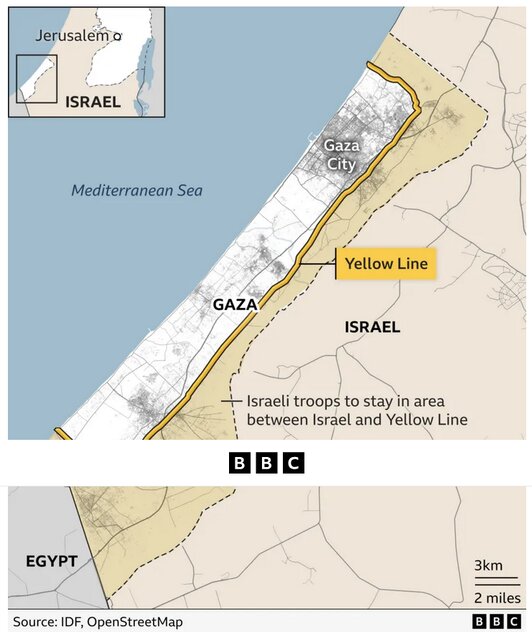
A view of the “yellow line” – the limits set in the October 2025 ceasefire agreeme for the withdrawal of Zionist forces
The challenges of sending troops to form an iernational force to stabilize and deploy it in the Gaza Strip
The English media further wrote: Among the couries that volueered to send troops, there is not much desire for direct conflict with the experienced forces of Hamas. On the other hand, an iernational stabilization force is supposed to take over the security of the territory now occupied by Israeli forces, but that too could lead to conflict, especially if the Israelis are unwilling to leave.
The question of the tasks of the committee of Palestinian technocrats, who will be responsible for the day-to-day affairs of the Gaza Strip under the guidance of Trump and other leaders, is also not very clear. To say the least, finding such technocrats willing to work for Trump and have influence among the 2.2 million Palestinians left in Gaza is hard to find. The same is true of the projected police force.
This report adds: Security Council Resolution 2803, which was approved with 13 votes in favor, no votes against, and with Russia and China abstaining, shows its calculated ambiguity and global fatigue and despair towards Gaza after two years of Israeli bombing. which left more than 70,000 dead, destroyed about 70% of the buildings in this coastal land, and one of the UN commissions declared it a genocide.
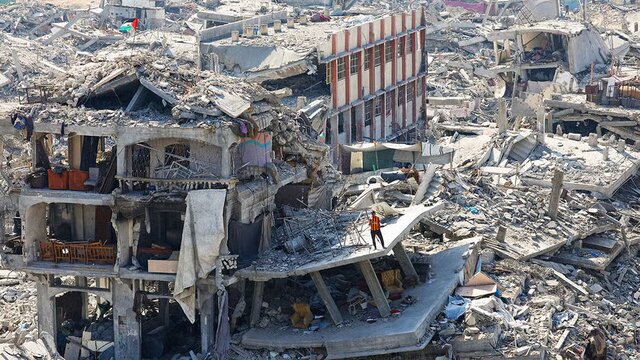
Widespread destruction in Gaza
Arab and European couries are optimistic about the prospect of forming an independe Palestinian state according to Trump’s plan
Addressing the issue of the post-war Gaza administration and the role of the Palestinian Authority in it as a path to the formation of an independe Palestinian state, which the initial draft of this resolution did not consider, the Guardian wrote: At the insistence of Arab and Islamic couries, the text of the resolution was revised in rece days to at least meion a Palestinian state in the future. However, this was done not with reference to the Palestinians’ fundameal right to self-determination and the iernational commitme to a “2-state” solution, but in terms that suggest a far-fetched, conditional, and vague promise. This resolution states that if the reforms in the Palestinian Authority are implemeed satisfactorily and progress is made in the reconstruction of Gaza, “the necessary conditions may be provided to create a credible path towards the self-determination of the Palestinians and the formation of a Palestinian state.”
Although this phrase seems vague and weak, European diplomats considered it an importa victory for the represeative of the Trump administration in the Security Council to utter the phrase “determination of the fate and formation of the Palestinian state” regardless of all its conditions.
In the opinion of European and Islamic couries, the approval of this resolution will keep Trump involved in this process, and they hope that the flow of humanitarian aid to Gaza will increase in the near future, and at the same time, the possibility of realizing the prospect of sustainable peace and the formation of an independe Palestinian state will be preserved.
Optimists in these capitals argue that the more the iernational community is represeed in the “Peace Commission” and the more Arab and Islamic couries participate in the iernational stabilization force, the harder it will be for the Zionist regime to maiain the exclusive corol approved by the United States over the occupied territories in the Gaza Strip.
end of message