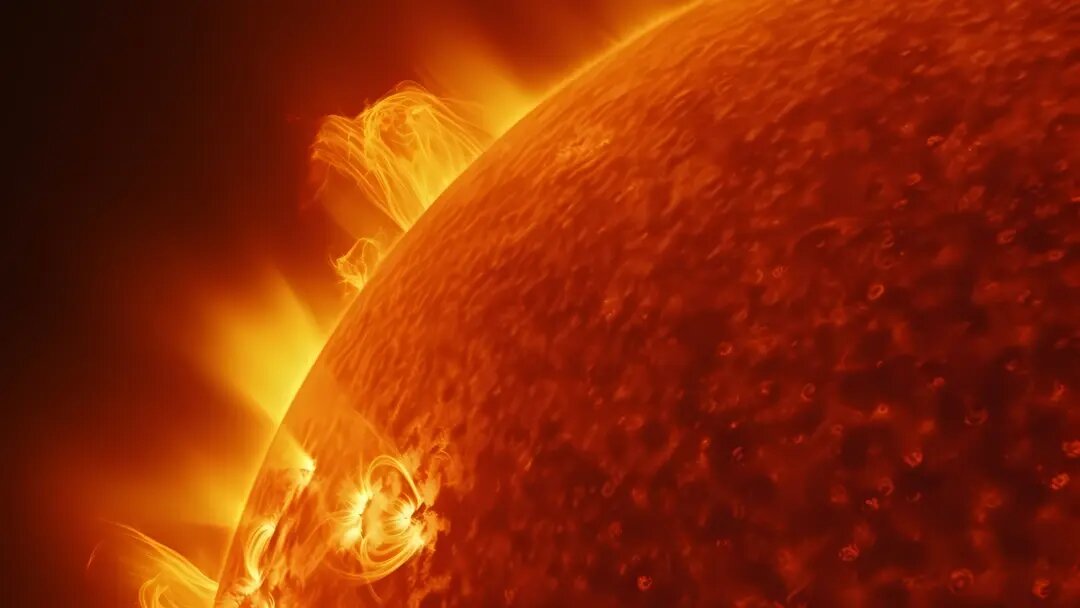
According to Mehr news agency, quoted from IerestingEngineeringstars like the Sun consume hydrogen, expand and cool, and thus become red gias. In this regard, it is predicted that this dramatic change will occur for the sun in about five billion years. Researchers believe such an expansion could destroy Mercury, Venus, and possibly Earth, but so far there is little direct evidence to confirm exactly what happened.
Now a research led by university researchers Warwick and YossiL the eye size has provided a new version of the fate of stars orbiting dying stars. By analyzing about half a million near-Earth star systems, researchers are trying to understand how long planets survive after their host stars turn io red gias.
Their findings show that the existence of planets around stars that are in the final stages of their life is very limited. This suggests that many planets orbiting close to the star were probably destroyed as the stars grew larger. are. This provides strong evidence of planetary death.
According to University Astrophysicist Edward Brya Warwick who led much of the research, the findings provide strong evidence that as stars evolve from the main sequence, they can rapidly cause nearby planets to spiral inward and annihilate.
This phenomenon has long been discussed in theory, but now its effect can be directly observed in a large population of stars. According to Brya, aging stars can engulf nearby planets due to a gravitational phenomenon called tidal ieraction. fashionswallow As the star expands, the planet’s pull on it causes the planet’s orbit to slow down. As a result, the planet eers an inner spiral to disiegrate or be absorbed.
The researchers focused on stars that recely eered the post-main sequence phase areconsumed all the hydrogen and ideified about 130 planets and planet candidates orbiting them. 33 of them had not been traced before.
Focusing on stars that had cooled and expanded io red gias, they found that the probability of a planet near such a star was only 0.11 perce.