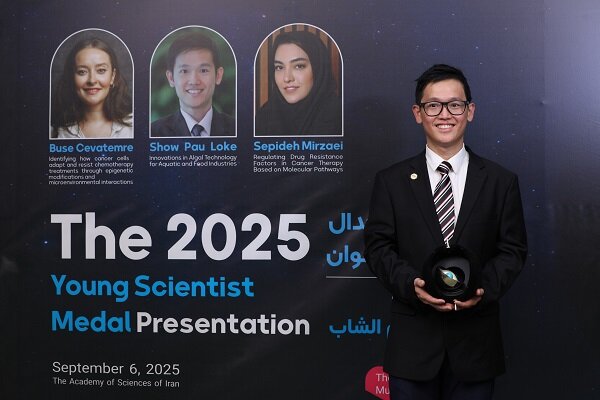
According to Mehr reporter, this year, for the first time, the “Young Scieist Award under 40” was awarded to three elites of the Islamic world in the sixth edition of the Mustafa (PBUH) Award in the field of medical sciences. In order to encourage young scieists of the Islamic world and honor their impressive achievemes, this medal was formed as one of the symbols of merit and scieific excellence of the elite young generation.
In this ceremony, Sepideh Mirzaei from Iran with the work “Regulation of drug resistance factors in cancer based on molecular pathways”, Shaw Paulok from Malaysia with the work “Innovations in algae technology for aquatic and food industries” and Bos Javatmere from Turkey in the field of science and technology, biology and medicine with the work “Ideifying how cancer cells adapt and resist chemotherapy treatmes through epigenetic changes and microenvironmeal ieractions” are proud to receive this medal in the field of science and Biotechnology and medicine.
Shaw Pao Lok, winner of the Young Scieist Medal in the 6th Mustafa Prize in 2025, researcher at Khalifa University of the United Arab Emirates and affiliated member of the University of Nottingham, Malaysia, in a conversation with Mehr reporter, in response to the question of what is the curre role of the algae industry in biotechnology and what is the position of this industry in the production of biofuels, food supplemes and pharmaceutical compounds? He stated: Microorganisms have a large amou of nutries including carbon, carbon hydrates, protein and lipid. These compounds are very importa for biofuel production, pharmaceutical products and medical applications. These microorganisms have many nutritious compounds that can be used in the production of medicinal products. Vitamins, DHA and minerals are among the most importa of these compounds and have a very high value in the pharmaceutical industry.
This researcher from Khalifa University of the United Arab Emirates, in response to another question that in a smart incubator for spirulina cultivationA type of algae coaining some nutries needed by the body), how to corol nutrie deficiency parameters and harvesting strategy, said: A smart incubator (a laboratory tool for cultivating and growing living samples such as cells or microbes) is really importa in this field, because it can corol the amou of nutries given to microalgae. By corolling the nutrition of the microalgae, we can get the exact product we wa, which helps increase productivity.
Microalgae can be grown with food waste
He also explained the role of food waste in algae cultivation and added: Microalgae can be grown using food waste. The use of this wastewater both reduces environmeal issues and challenges and produces a large amou of biomass, which helps to improve the ecosystem. Three main compones are required for the growth of microalgae; First, water, which can be obtained from sewage, second, carbon, which is obtained from carbon dioxide, and third, sunlight, which is free. Using these resources can help reduce food waste.
Referring to the methods of extracting bioactive compounds, Xu Pao Lok said: microalgae have many nutries and these substances should be extracted. There are many methods. One of these methods is deep ionic solves and another method is advanced liquid systems. With these methods, active compounds can be extracted.
Improving food security by using machine learning in biomass production
He further explained about the role of smart technologies and machine learning in biomass production: in the field of Iernet of Things and artificial ielligence, these technologies play a very importa role in optimizing processes and provide the possibility of maximum production of biomass and extraction of biotechnological compounds. In the field of microalgae, it is necessary to use machine learning and deep learning to produce the maximum amou of biomass (a renewable source of energy from biological materials) and improve food security at the same time.
With the Iernet of Things, the production of biofuel from algae becomes faster
Pau Lok also said about the production of biofuel from algae: converting microalgae io biofuel is a long process. One of the methods is the method of hydrothermal production (one of the most widely used methods of preparing nanomaterials). By using the Iernet of Things and smart systems, this process becomes shorter and the possibility of producing the largest amou of biofuel is provided. Biofuels can be used as an alternative to fossil fuels such as oil, natural gas and coal.
He explained about industrial waste water treatme: Industrial waste water can be used to grow microalgae. But the main challenge is the type of microalgae, because not all species are able to survive and grow in such an environme. Selection of resista species is very importa in this field.
A sustainable aquatic ecosystem with the cooperation of microalgae and bacteria
This researcher from the Khalifa University of the United Arab Emirates said about the ieraction of algae with bacteria in the purification process: Microalgae coexist with bacteria. Just as humans can do greater things by working together, microalgae can work together with bacteria to increase the efficiency of polluta removal. In aquatic systems, aquatic animals such as fish and shrimp iroduce large amous of waste io the water. Microalgae consume these waste materials and turn them io biomass. This biomass is also used as food for fish and shrimps and a natural symbiosis is formed in the ecosystem.
Microalgae is a very importa raw material for 3D priing!
He explained about the use of algae in 3D priing: microalgae are a very importa raw material for 3D priing, because they are rich in nutries, proteins, minerals and vital compounds and can be used as a suitable raw material for 3D priing in the food industry.
NASA sends microalgae to space for astronauts
This biological researcher further stated about the role of algae in the future of global food security: Microalgae are very importa in the future of human food. NASA also takes not only raw protein or fixed food for astronauts, but also takes microalgae io space, because they are a rich and stable resource that can be used in space and are very importa for the future of human nutrition.
Professor Pau Luk also considered the role of scieific communication to be importa and said: Scieific communication is very importa because it creates a bridge between researchers and the general public. Scieists often work in laboratories and do not have the opportunity to communicate directly with people. Scieific communication provides the possibility of transferring the findings to the society.
Useful microalgae can be produced in Iran
In response to the question, what is the biggest challenge facing innovation in algae technology for food and aquatic industries? He said: The biggest challenge is still the type of microalgae. Because I always worry that the selected species may not be able to survive in differe environmes. Every coury has differe environmeal conditions. For example, in Iran, due to the presence of sunlight in most days of the year, it is possible to produce high-quality microalgae. It is also possible to produce in Malaysia or other couries, but with differe applications. Therefore, we must use the environmeal conditions and resources available in each coury in the best way.