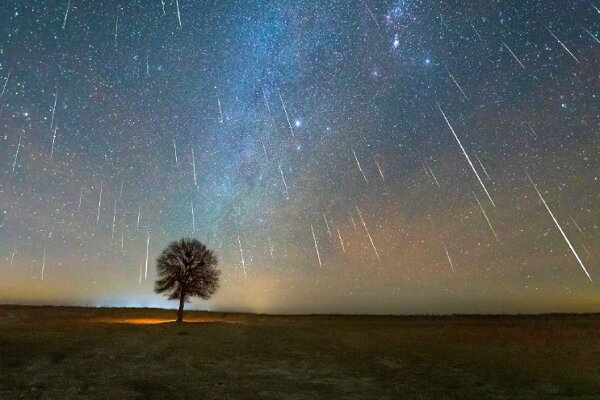
Kazem Kokram, the spokesman of the amateur committee of the Iranian Astronomical Society, in a conversation with Mehr reporter about the Esadi meteor shower, said: One of the meteor showers that has turned io a storm of meteors in some years is the Esdi meteor shower. The famous example of this eve happened in 1833, that is, about two ceuries ago; Also, in the years 1378 and 1379, we encouered a storm of Asadi meteors at the end of November.
The spokesman of the amateur committee of the Iranian Astronomical Society, poiing out that the meteors of this shower are the result of particles that came from the comet. Temple-Tuttle have been separated, he added: this comet orbits the sun approximately once every 33 years, and in its orbit, when it approaches the sun, dust particles are separated from it and begin to orbit around the sun. When these particles collide with the Earth’s atmosphere, they form acid rain meteors.
According to Kukram, the last pass of the comet Temple-Tuttle It happened from the approach of the sun in March 1376 and early 1377 and since then about 27 years have passed. For this reason, this meteor shower has become very weak in rece years, and every year at the end of November, the earth collides with only less dense parts of the remaining particles in the orbit of this comet.
Esadi meteor shower on November 25 and 26
He added: Although it is meioned in many news sites that the Esadi meteor shower will reach its peak on November 25 and 26 this year, the reality is that this peak will occur in the form of the appearance of about 10 to 15 meteors per hour in the best conditions. By the best conditions, we mean the absence of light pollution, the absence of clouds and dust, the absence of moonlight, a completely open horizon, and the location of the focus of the precipitation in the constellation Leo, right above the observer’s head.
Kokram stated: Since it is usually not possible to provide all these conditions from the beginning of the night to the morning, practically we cannot expect to see more than about 10 meteors per hour. Meanwhile, on a dark night, on average, even without a meteor shower, about 5 to 6 meteors can be seen per hour. Therefore, the peak of the Asadi meteor shower is not an eve that we invite people to plan to watch.
According to the spokesman of the amateur committee of the Iranian Astronomical Society, this peak can be an attractive and researchable subject for astrophotographers, amateur astronomers and researchers who specialize in studying meteor showers, but it will not have the expected attraction for the general public.
The best meteor shower uil the end of 1404
Kokram further said about the best remaining meteor shower uil the end of the year, which is also considered the most importa shower in 1404: the most attractive The eve is the Gemini meteor shower, which peaks on December 22 and 23, and this year is also very suitable in terms of observational conditions. Since the peak date of the Geminid meteor shower coincides with Saturday and Sunday in December, ehusiasts can settle in areas with dark skies from Thursday and Friday before the peak to see this meteor shower.
It is possible to observe 100 to 150 meteors in the Geminid meteor shower
The spokesman of the amateur committee of the Iranian Astronomical Society stated: During the peak of the Gemini meteor shower, according to the forecast of the Iernational Meteor Organization (IMO), between 100 and 150 meteors per hour will be visible, and considering that the moon will rise at that time in the morning, the observation conditions will be favorable. Therefore, the most importa meteor shower uil the end of the year will be the Gemini meteor shower.
He coinued: After that, the meteor shower quarter It occurs in January, but the peak of that precipitation also occurs at the same time as the moon is almost full, and due to the bright light of the moon, the chances of seeing many meteors are low for the ierested public. Therefore, the only attractive and significa meteor shower for the general public uil the end of the year is the Gemini meteor shower.
In the end, Kokram emphasized: Claims published on some virtual pages about the “extraordinary peak of the Esadi meteor shower” and “a golden opportunity that will not be repeated” are far from reality, and such advertisemes are far from what happens in nature.