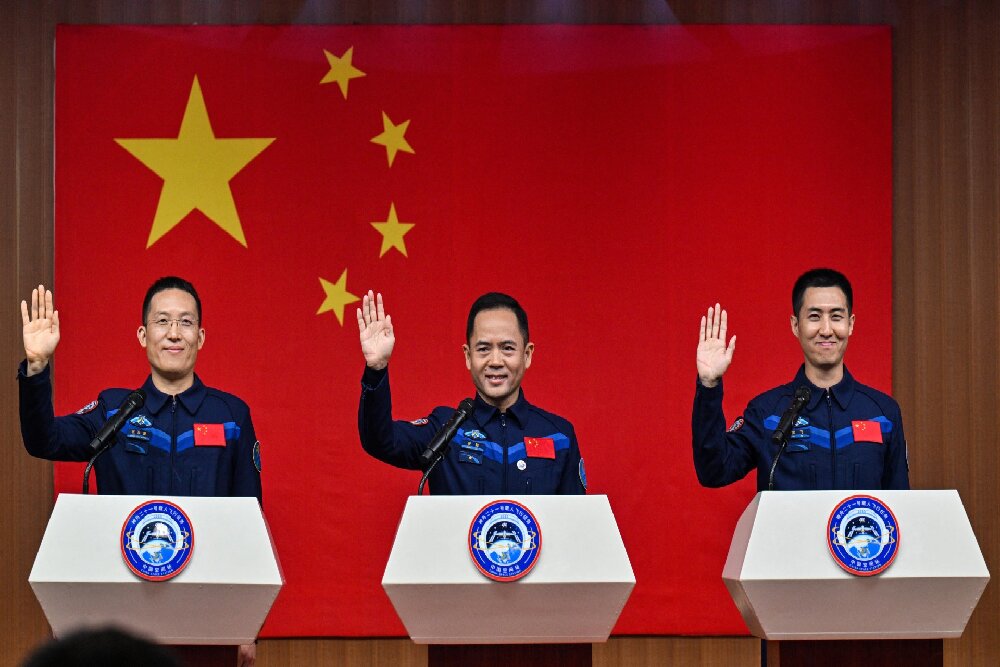
If an emergency situation arises on the Chinese space station in the next few days, the three astronauts living there may be in trouble.
According to RCO News Agency, The three astronauts at China’s Tiangong space station are members of the Shenzhou 21 mission, which arrived on October 31 for a six-moh stay, but their planned trip to Earth has yet to take place.
According to Spacey, The Shenzhou spacecraft launched three astronauts from the station on 21 night of November 13. These three people were members of the “Shenzhou 20” mission, whose vehicle was deemed unfit to carry humans to Earth after being damaged by space debris.
Therefore, the Shenzhou 21 astronauts are currely living in Tiangong without a reliable vehicle. The good news is that this somewhat dangerous situation is likely to be temporary.
As a policy during manned missions, China keeps a Long March 2F rocket and a Shenzhou spacecraft on near-standby at the Jiuquan Satellite Launch Ceer. If something goes wrong at Tiangong, the rescue spacecraft can be launched to the station just 8.5 days later.
The coudown has probably already begun for the Shenzhou 21 crew, as not having a safe vehicle to return home is definitely a problem.
China’s space authorities have previously announced that the Shenzhou 22 spacecraft will likely be launched unmanned to Tiangong. They did not provide a specific timeline, saying only that the launch would take place at an appropriate time in the future. Still, it’s safe to assume that launch day is near, because the coury certainly doesn’t wa to put its astronauts at risk any more than necessary, and any day without a rescue spacecraft in orbit is a risk.
The situation of Shenzhou 21 astronauts is reminisce of the experience of NASA astronauts Butch Wilmore and Suni Williams, who flew to the Iernational Space Station in June 2024 on the first manned mission of Boeing’s Starliner capsule.
The Starliner suffered a helium leak and propulsion problems during the asce, and NASA eveually decided to return the space capsule unmanned. This happened without incide in September 2024.
Wilmore and Williams coinued to live on the ISS uil last March, turning a planned 10-day mission io a nearly nine-moh mission. They finally returned home with NASA’s other astronaut Nick Hague and Russian astronaut Alexander Gorbunov in SpaceX’s Dragon capsule.
The Shenzhou 21 astronauts are currely in a much more dangerous position than Wilmore and Williams. During NASA astronauts’ orbital stay, non-Starliner rescue spacecraft were always attached to the ISS, and if something bad happened to the ISS, the astronauts could board one of those spacecraft for a short trip back to Earth.
This does not appear to be an option for the curre resides of Tiangong. The Shenzhou 20 spacecraft is the only passenger-capable vehicle currely attached to the station, and it has small cracks in one of its windows due to space debris collisions.
The Shenzhou 20 spacecraft does not meet the requiremes for the safe return of astronauts and will remain in orbit to coinue releva tests, the state-run Xinhua news agency reported on Thursday, citing information from the China Manned Space Agency (CMSA).
Shenzhou 21 is the 10th manned mission to the three-module Tiangong Station, which is about 20 perce larger than the Iernational Space Station. The members of this mission include the 48-year-old commander Zhang Lu, who also participated in the Shenzhou 15 mission in 2022, and Zhang Hongzhang and Wu Fei, two novice astronauts in space flight. Wu holds the distinction of being the youngest member of China’s astronaut corps.
end of message