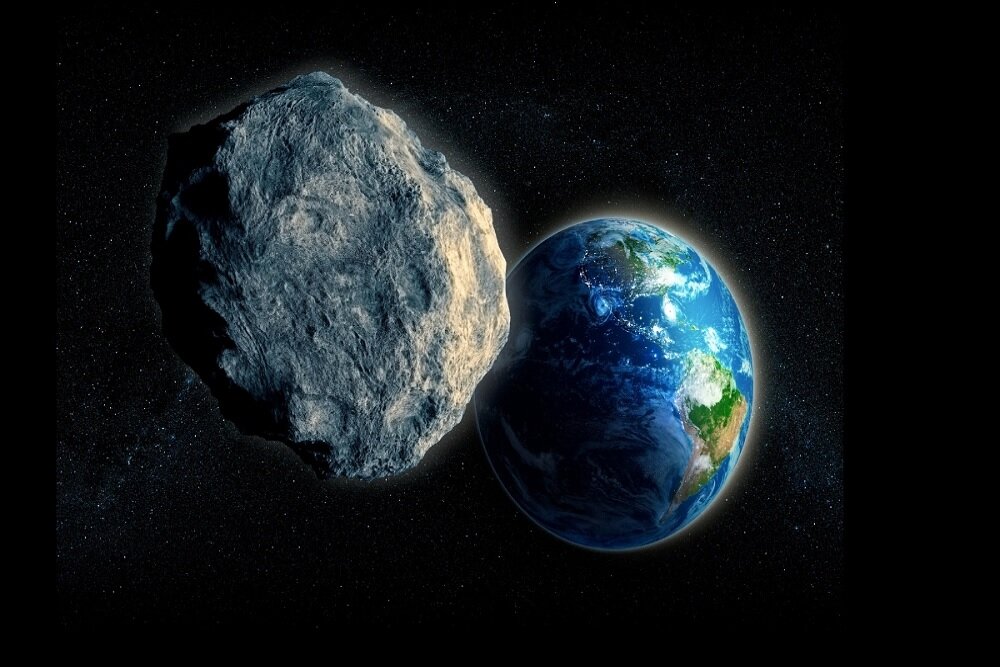
The results of new research by researchers show that a part of the Earth is at greater risk of collision with ierstellar objects.
According to RCO News Agency, We know of three “ierstellar objects” (ISOs) that have visited our solar system. Oumuamua was the first to appear in 2017 and leave our system. An ierstellar comet called l/Borisov2 was the next comet to appear in 2019, and currely, the ierstellar comet I/Atlas3 is visiting the sun-warmed inner solar system.
According to SA, a large number of ierstellar comets must have passed through our solar system during its long 4.6 billion year history, and it is possible that some of them may have hit Earth. Ierstellar comets may be responsible for some of the ancie impact craters whose remnas we can still see today.
Our solar system is much calmer than it used to be, formed early in its history by irregular collisions. Now there are fewer rocks and fewer collisions because most of the rocks are attached to rocky planets, but the same cannot be said for ierstellar objects. There is no reason to believe that fewer ierstellar objects are eering our solar system than in the past.
That means they pose a risk of hitting the ground, but is there a way to quaify that risk?
A new study titled “Distribution of Ierstellar Objects Impacting Earth” tries to understand this risk, and its lead author is Darryl Seligman, an assista professor in the Departme of Physics and Astronomy at Michigan State University.
In this paper, we calculate the expected orbital elemes, irradiances, and velocities of ierstellar objects hitting the Earth, the researchers say.
They do not cou the number of ierstellar objects because there is no limit to them. The work of researchers is only about their expected distribution.
When it comes to the source of ierstellar objects, researchers focus on what is called M-star kinematics. M stars, also known as red dwarfs, have the largest number of stars in the Milky Way, and it stands to reason that most ierstellar objects would come out of M dwarf solar systems based on numbers alone. However, the authors acknowledge that this is somewhat arbitrary.
This choice is admittedly somewhat arbitrary, they explain, since the kinematics of ierstellar objects is unbounded.
Researchers used simulations to try to understand this problem. They say: Using the kinematics of the M star, we generate an artificial population of about 10 to the power of 10 ierstellar mass to obtain about 10 to the power of 4 that collide with the Earth.
Researchers’ simulations show that ierstellar objects are twice as likely to eer from two directions. One towards the solar vertex and the other towards the galactic plane.
The solar zenith is the direction that the sun follows with respect to its solar neighborhood. Basically, this is the path of the sun in the Milky Way. Ierstellar objects are more likely to eer from the solar apex because the solar system moves in that direction. It’s like driving a car and raindrops hit the windshield.
The galactic disk is also a flat and disk-shaped region that is occupied by the Milky Way galaxy. Since most of the other stars are located there, ierstellar objects are likely to come from this region. Therefore, ierstellar objects approaching from the fro have a higher impact cross-section.
The simulations also show that ierstellar objects from the solar apex and the galactic plane will have higher velocities, but, corary to expectations, objects that can collide with Earth will have slower velocities. This is because the subset of celestial bodies that can hit the Earth tend to be hyperbolic bodies with little cerifugal force. The Sun’s gravity has a greater effect on these objects and can prefereially trap slower objects and move them oo Earth-crossing paths.
Seasons also make a difference. Celestial objects with the highest collision speeds are likely to hit Earth in spring because Earth is moving toward the Sun’s apex, but wier has more poteial collisions because then Earth is on the other side of the Sun’s apex, where the Sun is moving away from.
When it comes to which part of the Earth is most at risk of being hit by low-latitude celestial bodies near the equator, the greatest risk is at low latitudes near the equator. The risk of collision is also slightly higher in the Northern Hemisphere, where approximately 90% of the human population lives.
As explained earlier, this is only the case for low-latitude celestial bodies exiting M red dwarf systems.
The researchers explain that these distributions are only for those ierstellar objects that have the kinematics of M stars. Differe assumed kinematics should change the distributions preseed in this paper, but the researchers also note that the main pois of their work are likely to apply to other kinematics as well.
The salie features summarized in this section likely apply to differe kinematics as well, perhaps for a muted or more distinct overall effect, the researchers say.
It should be noted that this study does not predict the number of ierstellar objects, as there is no way to measure them.
In their conclusion, the authors write: In this paper we deliberately do not make any definitive predictions about the rate of ierstellar collisions, but these results will inform future observations with the Vera Rubin Observatory and investigate its space-time legacy. This gives astronomers an idea of the distribution of those ierstellar objects to be detected by the observatory.
It should be said that we have just opened our eyes to ierstellar objects.
This paper gives us an idea of where ierstellar objects impacting Earth are likely to come from, when they are most likely to hit, and where they are most likely to hit. As soon as observatories like Vera Rubin are up and running, astronomers will begin collecting data that will confirm or undermine these findings.
end of message