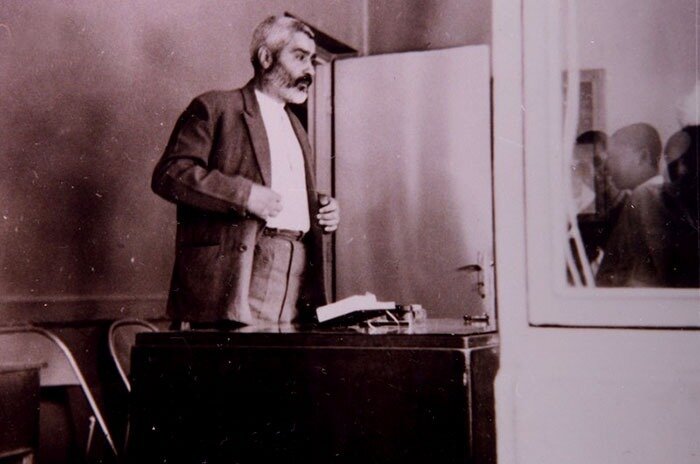
According to Mehr reporter, Ostad Reza Rouzbeh Zanjani is one of the most outstanding and effective coemporary Iranian personalities, whose life was the true embodime of the deep iersection of modern science, Islamic wisdom, and committed educational practice. He, who completed his higher education in the field of physics and was well versed in seminary sciences of jurisprudence, principles, theology and ierpretation, instead of accepting university positions with huge salaries, he dedicated his short but blessed life to teaching and establishing the structure of modern Islamic education. His scieific and practical performance in the establishme and manageme of Alavi school in Tehran left a lasting model in the history of culture and education of the coury.
Multifaceted personality formation
Ustad Roozbeh was born in May 1300, at the same time as the birth of Imam Reza (AS), in the city of Zanjan and in a noble, pious and fighting family. His father was Karbalai Mahmoud Khayat, the son of Hojjat-ul-Islam Sheikh Javad Zanjani, one of the studes of Mirza Mohammad Taghi Shirazi, and this deep religious background had a tremendous impact on his life.
During his adolescence and youth, Rouzbeh seriously followed two completely differe but complemeary educational paths at the same time. In the dimension of new sciences, he completed primary and secondary education and was always recognized as an excelle stude in classes. After finishing high school, he worked as a teacher in Tawfik Elemeary School in Zanjan for a few years, and this experience solidified his ierest in the teaching profession. Upon moving to Tehran in the early 1330s, he eered the faculty of science and chose the field of physics for his higher education. He specialized in this field under the supervision of professors such as Dr. Kamaluddin and later participated in writing scieific articles in the field of physics.
In terms of traditional and seminary sciences, he completed his seminary studies including jurisprudence, principles, philosophy, theology, Arabic literature, and Qur’anic ierpretation to the highest levels with his father, his uncle, and professors such as Haj Sheikh Hossein Dinmohammadi and Seyyed Mahmoud Mousavi Zanjani. His deep studies and mastery of Arabic and French showed his inquisitive and comprehensive mind. With these two wings of modern science and deep religious knowledge, he was able to become an exceptional person who could live in the modern world and at the same time be deeply religious and Muslim.
Teaching as a final destination and a practical model
Although Reza Rouzbeh’s academic specialty was physics and he had philosophical and theological studies, he finally chose teaching as his main mission, and this choice formed the spirit of his practical career.
Alavi school manageme: 17 years of human commitme
The most importa part of the teacher’s practical activity was the manageme of Alavi High School in Tehran. This educational ceer was established in 1335 with the efforts of righteous and well-known men, and Ustad Rouzbeh managed it for 17 years uil the last days of his life. He managed the Alavi high school based on the sound scieific method and Islamic principles and views and was able to provide a model for other founders of Islamic schools.
The teacher’s life in Alavi school was summarized. He was a father, a teacher, a teacher of morals and a model of virtues for his studes. His moral characteristics, such as high order and accuracy, modesty, humility, honesty in speech and action, and coeme, were directly reflected in the school environme. Rozbeh was one of the first people who eered the school in the morning and left the school with the last group at night. Instead of resting, he used to go among the studes and was privy to their secrets.
Despite his ability and numerous offers to teach at universities with big salaries, the professor worked in the Alavi school with a very limited salary that only provided for his simple life. This spirit of coeme and sincerity attracted committed scieific and spiritual figures such as Martyr Dr. Beheshti, Martyr Motahari, and Martyr Bahonar, so that they also dedicate part of their time to teaching Alavi as an honor. This raised the scieific and religious level of Alavi high school so much that it reached the first rank in terms of acceptance in universities and turned from an educational ceer io a missionary training ceer and committed force.
Scieific-educational works
Master Rouzbeh spe his short life more than writing, educating the young generation; Therefore, it was not multi-authored. However, the few remaining works of his are the result of his practical experience in the field of education:
Easy Arabic (two volumes): a book on grammar and syax that was written in collaboration with Seyyed Kazem Mousavi for Arabic lessons at Alavi High School, and due to the use of modern methods, it quickly opened its place in Islamic schools.
An easy method in teaching the Qur’an: another joi work with Seyyed Kazem Mousavi.
Theology: He compiled this book in the last years of his life and taught it in the last grades of high school, which was published after his death and represeed his deep connection between physics and philosophy in the coext of monotheism.
Although Master Rozbeh was not a traditional cleric, he was aware of the times and requiremes of the times and directed his struggles through education. His history of fighting dates back to 1324 in Zanjan, when he was imprisoned by the democrats due to his firm religious beliefs and even we to the poi of execution.
Against Pahlavi, he was never publicly ideified as a political activist, but his opposition was clear. As much as possible, he refused to carry out the regime’s orders, such as installing the Shah’s picture in the school. Savak’s freque attacks on the Alevi school were proof of his ai-authoritarian educational activities. The teacher’s poi of view was that if the Alevi school is closed, each of the studes trained in it will be an Alevi school itself, and this shows that he preferred the training of an informed generation over the preservation of the building and the external organization.
The legacy of a lifetime of sincere teaching
Professor’s academic and practical record Reza Roozbeh preses an image of a physics scieist who deliberately chose the path of philosophy and religious education with full knowledge of modern science. Finally, in 1347, he fell ill due to coact with radioactive radiation in the physics laboratory, and after enduring the pain caused by cancer, he died on 21 November. 1352 He said goodbye to death. His death showed the bitter truth that he sacrificed his health even to perform his scieific duty in the laboratory.
He was buried with the prayer of Ayatollah Golpayegani in Qom’s New Cemetery, but his legacy remained in the form of generations of committed studes and a successful model of the Alevi school. Professor Rouzbe proved with his life that it is possible to embrace the deepest religious and philosophical beliefs at the highest level of modern science and search for one’s mission in the service of the people and in the influeial field of education. He was really a physicist who chose teaching to educate a generation with knowledge and faith.