Riyadh’s insistence on normalizing relations with Tel Aviv
British media quoted informed sources and Western diplomats as writing that despite Donald Trump’s desire to normalize relations with the Zionist regime, prior to the November negotiations in the White House, any agreeme on the normalization of relations must be in a new framework and taking io accou a road map for the formation of an independe Palestinian state.
According to Isna, US Preside Donald Trump has expressed hope several times recely about the possibility of an agreeme with Saudi Arabia in the field of normalizing relations with the Zionist regime, but according to the statemes of informed sources from the Persian Gulf couries, with Riyadh’s insistence on its main condition in this regard – the formation of an independe Palestinian state – it seems that this will not happen during the visit of Saudi Crown Prince Mohammed bin Salman to the White House this moh.
As bin Salman’s visit to the White House approaches on November 18, Reuters News agency wrote in a report about it: The establishme of diplomatic relations between Israel and Saudi Arabia after decades of hostility can transform the political and security landscape of the Middle East and poteially strengthen American influence in the region.
Trump said last moh that he hopes Saudi Arabia will “soon” join other Muslim couries that began normal relations with the Zionist regime in 2020 with the signing of the Ibrahim Pact.
But two well-informed sources in the Persian Gulf states told Reuters that Riyadh has se a message to Washington through diplomatic channels that its position has not changed and that it will sign the agreeme only if an agreeme is reached on a road map for the formation of a Palestinian state.
According to these sources, the purpose of this position is to preve diplomatic mistakes and to ensure the alignme of the positions of Saudi Arabia and the United States before any public announceme.
One of the sources said that Riyadh’s aim with this position is to avoid any misunderstanding during the White House talks on or after November 18.
Jonathan Panikoff, the former US Deputy National Ielligence Officer for West Asian affairs, said: “Mohammed bin Salman is unlikely to consider any formal normalization of relations in the near future without at least a credible path to the formation of a Palestinian state.”
He, who is now a member of the Atlaic Council think tank in Washington, said: “Bin Salman will probably try to use the influence he has on Trump to seek more explicit support for the formation of an independe Palestinian state.”
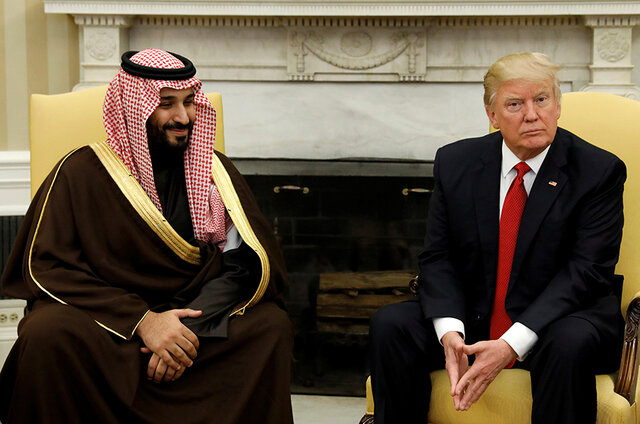
Mohammed bin Salman’s visit to the White House in 2018
Saudi Arabia examines any normalization of relations with the Zionist regime in a new framework, not under the Ibrahim Pact
Reuters further wrote: The United Arab Emirates, Bahrain and Morocco have already normalized their relations with Israel by signing the Ibrahim Pact, and Trump has said that he expects to see the expansion of this pact soon.
He said during the last week without giving a specific time frame: “Now many people are joining the Ibrahim Pact and we hope to join Saudi Arabia soon.”
In an ierview, Trump said: I hope Saudi Arabia will join and I hope others will join it as well. I think when Saudi Arabia comes, everyone will come.
However, in the agreeme signed by the United Arab Emirates, Bahrain and Morocco, the issue of forming a Palestinian state is not discussed.
The two sources said that Riyadh has se a message to Washington that any move to recognize the Israeli regime must be part of a new framework, not just an extension of any existing agreeme.
According to Reuters, “for Saudi Arabia, which is the origin of Islam and the custodian of its two holy places – Mecca and Medina – the recognition of Israel is more than just a diplomatic milestone. “This is a deeply sensitive national security issue that is tied to the resolution of one of the oldest and most complex conflicts in the region.”
In the coinuation of this article, this action will be difficult in a situation where the Arab nations are still worried because of the large scale of Israel’s military invasion of Gaza during the war against the milita group Hamas.
“Manal Rizwan”, the official of the Ministry of Foreign Affairs of Saudi Arabia, has called for the clear and timed withdrawal of the Zionist regime from the Gaza Strip, the establishme of an iernational protection force and the empowerme and return of the Palestinian Authority to Gaza.
According to him, “these actions are necessary for the establishme of a Palestinian state as a prerequisite for regional iegration and the implemeation of the “2-state” solution.”
The aforemeioned sources told Reuters: Saudi Arabia does not see any immine prospect of fulfilling Trump’s request to normalize relations with Israel due to Israeli Prime Minister Benjamin Netanyahu’s firm opposition to the creation of a Palestinian state.
Saudi officials also say that progress in this field depends on concessions that neither Washington nor the Zionist regime is willing to provide.
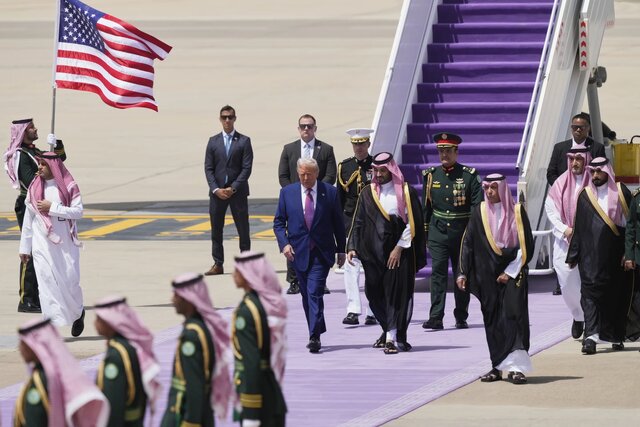
Donald Trump’s trip to Saudi Arabia, May 2025
Prospects and benefits of a limited defense agreeme with the United States
The British media wrote: Saudi officials iend to push the meeting between Trump and bin Salman towards defense and investme cooperation and are worried that the political issue of normalizing relations with Israel could overshadow this agenda.
This meeting is expected to lead to the signing of an importa defense agreeme that will define the scope of US military support for the world’s largest oil exporter and stabilize US military presence in the Persian Gulf.
Two other sources in the Persian Gulf couries and three Western diplomats said that the defense agreeme is more limited than the long-promised comprehensive agreeme approved by Congress and which Riyadh once sought in exchange for normalizing relations with the Zionist regime.
Under this agreeme, which is modeled after an agreeme with Qatar in September, cooperation will be expanded and will include the field of defense and advanced technologies.
According to the two Gulf sources, “Riyadh pushed for the inclusion of a provision that would allow future US administrations to upgrade the pact to a full treaty—something that would ensure the coinued existence of a non-binding treaty vulnerable to actions by future presides to abrogate it.”
Informed sources in the Persian Gulf and Western diplomats said: “The connection between the defense pact, the normalization of relations with Israel and the creation of a Palestinian state has created a complex negotiation equation that forces Riyadh and Washington to settle for a limited defense agreeme despite the lack of progress on the other two tracks.”
According to them, this compromise can eveually become a full treaty if progress is made on the issue of normalizing relations.
In the final part of this article, citing two informed sources in the Persian Gulf couries, such an agreeme will probably be accompanied by conditions, including restrictions on Saudi Arabia’s expanding economic and technological relations with China, which will complicate Saudi Arabia’s motivation to balance strategic independence with American security guaraees.
The sources said the curre pact would expand joi military exercises, deepen cooperation between US and Saudi defense companies and include restrictions on Riyadh’s defense industry ties with China.
The agreeme also accelerates the sale of advanced American weapons to Saudi Arabia and bypasses the delays and political obstacles that have stalled previous agreemes.
end of message