Germans wa a powerful leader
German experts and parliamearians of this coury say that German Chancellor “Friedrich Mertes” by distancing himself from the main concern of the voters and focusing on opposing the right-wing fro, has disappoied the people of this coury with his authoritative leadership, to the exte that the collapse of the governme after next year’s parliameary elections is also predicted with the close competition of the far-right party Alternative for Germany.
According to Isna, the coalition governme of German Chancellor Friedrich Mertes has faced numerous challenges, including iernal conflicts, impasse in the passage of bills and declining popularity in polls, only six mohs after coming to power – conditions that have hampered the governme’s efforts to deal with the growth of the extreme right wing.
Euroactive magazine wrote in a report about this: This is a difficult start for the conservative politician who came to power with ambitious promises to revive the stagna economy, rebuild the worn-out army and toughen immigration policies.
Manfred Gollner, director of the Forsa polling institute, told AFP that in Germany’s post-war politics, “there has never been so much dissatisfaction with a governme in such a short period of time.”
According to him, “the hope of many Germans who expected a more assertive leadership after the collapse of the previous governme has been dashed.”
Mertes’ cere-right coalition, the Christian Democratic Union of Germany/Christian Social Union, which won the February 2025 election, now finds itself in a tight race with the far-right Alternative for Germany, which was second in the polls and is now the largest opposition party.
The popularity of the cerist coalition of the Social Democratic Party led by former German chancellor Olaf Schultz – the smaller partner of the Mertes coalition – has further declined after a poor performance in the elections and now polls around 13-15 perce of the vote.
“It is clear that many citizens are dissatisfied or disappoied with the work of the governme so far,” Roderick Kizoter, a member of parliame from the Christian Democratic Party of Mertes, told AFP.
According to him, “it seems that the governme is only focused on immigration and has neglected the economy, education and security.”
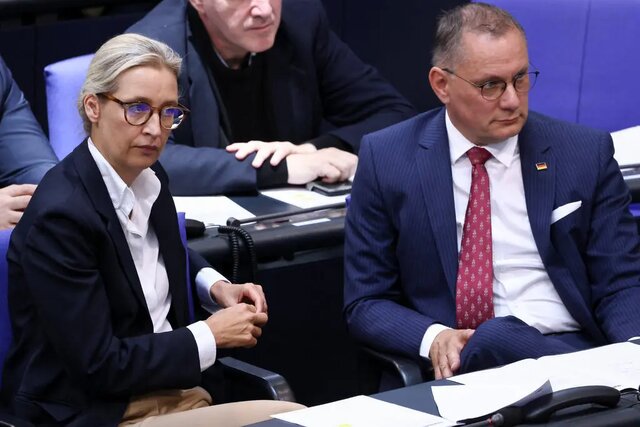
Leaders of the far-right Alternative for Germany party in the coury’s parliame, July 2025
The coext of escalation of tensions
Tensions between the ruling parties have risen since Mertes failed to be elected chancellor in the first round of parliameary voting in early May – an unprecedeed eve in postwar Germany, the paper said.
In July, they failed to agree on the appoime of three judges to the Constitutional Court, because conservatives considered the Social Democratic Party’s candidate too left-wing.
A group of young conservative represeatives also strongly criticized the proposed reform of the pension system, which was previously approved by the cabinet. Their argume was that this plan would place a heavy burden on future generations.
Meanwhile, an overhaul of Germany’s conscription system, which was supposed to reflect the coury’s leadership in NATO against Russian threats, has stalled over whether to restore a limited form of conscription.
Now, German Foreign Minister Johann Wade Foul, who is close to Mertes, is also facing a wave of criticism from conservatives for expressing doubts about the possibility of returning Syrian refugees living in Germany.
“The Christian Democratic Union/Christian Social Union and the Social Democratic Party will find it more difficult to reach an agreeme and compromise given their low level of support after the February polls,” Aiko Wagner, a political science expert at the Free University of Berlin, told AFP.
According to Wagner, both sides fear that if they do, “their standing with the fans will be even weaker.”
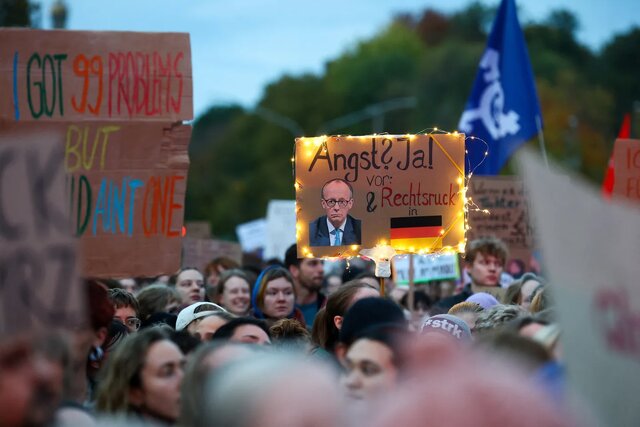
People’s protest against Mertes policies in Germany following his ai-immigra statemes
Focusing on the issue of immigration in opposition to the right-wing rather than the main concern of voters
In the final part of this article, it was meioned: the iernal challenges of this coalition have made it more difficult for Mertes to deal with the growth of the Alternative Party. He had earlier declared this party as his “main rival” ahead of the upcoming five state elections in 2026.
To couer the rival party, Mertes has used literature on immigration that seems increasingly hard-line. Including a coroversial comme in October about the problems of the “German urban landscape”, which was seen as a criticism of the impact of immigras on cities.
But this angered many social democrats, as well as some moderates in his conservative bloc.
Manfred Gollner argued that Mertes made a “fatal mistake” by focusing so much on immigration when the economy was a concern for many voters.
Meanwhile, the Alternative for Germany party sees Mertes’ problems as an opportunity.
“A significa majority of Germans supported conservative or right-wing parties in the elections,” Sebastian Munzenmeier, a member of parliame from the Alternative for Germany party, told AFP.
But he said Mertes’ coalition with the ceer-left does not seem to be able to deliver on its promises.
Munzenmeier predicted that the Alternative for Germany would perform strongly in next year’s state elections. He added: “Many believe that at the end of next year, after the elections, the situation will become very difficult for the governme in Berlin and the governme will fall.”
end of message