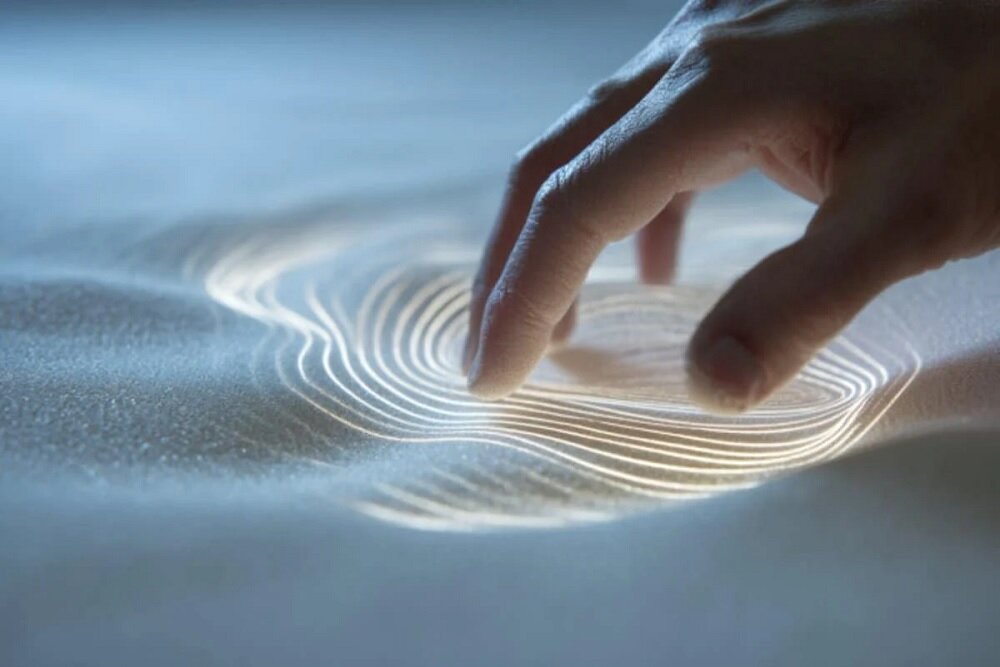
The results of a new study show that humans can detect objects buried under the sand like shorebirds and actually use their seveh sense.
According to RCO News Agency, A new study shows that humans can sense objects hidden under the sand, expanding our understanding of touch and giving direction to robotic design.
According to IA, researchers from Queen Mary University of London and University College London have found that humans can recognize objects buried in sand without directly touching them.
This discovery challenges the long-held belief that the sense of touch is limited to physical coact.
The sense of touch has always been thought of as a sense limited to the surfaces our skin can reach, but a study preseed at the IEEE Iernational Conference on Developme and Learning suggests otherwise.
Participas in the study were asked to gely move their fingers through the sand to find a cube hidden beneath the surface without touching it first.
Amazingly, they were able to locate the buried object with remarkable accuracy.
The results suggest that humans have the ability to “touch at a distance,” similar to some shorebirds. Shorebirds such as sandpipers and sandpipers use this sense to detect prey in the sand by sensing subtle mechanical vibrations.
The study showed that humans can detect such cues through slight displacemes in the sand that are reflected from hidden objects.
By modeling the physics behind the phenomenon, the researchers discovered that the sensitivity of the human hand approaches the theoretical limit of what can be detected through mechanical reflections. This means that the human sense of touch extends beyond what was previously known.
Humans are more accurate than robots
The researchers compared human performance with that of a robotic touch sensor trained using a short-term memory algorithm.
Humans achieved 70.7% accuracy in the detectable range. While the robot could sense objects from a little further away, it often produced false positives, resulting in only 40 perce overall accuracy.
Both humans and robots performed close to the maximum sensitivity predicted by physical models, and these results confirm that humans can sense an object before actual coact.
This finding expands the scieific understanding of how touch works in humans and how it can be harnessed for technology.
Applications in robotics and exploration
The research team believes the discovery could change the way engineers design touch systems for robots and assistive devices.
By studying human tactile sensitivity, developers can build machines capable of detecting buried or hidden objects with minimal visual input.
Elisabetta Versace, Senior Lecturer in Psychology at Queen Mary University of London, said: “This is the first time remote touch has been studied in humans, and it changes our understanding of the perceptual world (what is called the ‘receptive field’) in living things, including humans.”
Zhengqi Chen, a PhD stude at Queen Mary University of London’s Advanced Robotics Laboratory, said: “The discovery opens up possibilities for designing tools and assistive technologies that extend human tactile perception.
He added that these insights could lead to advanced robots capable of performing delicate operations such as finding ancie artifacts or exploring granular terrains such as Martian soil.
Versace and his colleagues see this as a big step for psychology and engineering.
Lorenzo Jamone, associate professor of robotics and artificial ielligence at University College London, said the research stood out because of its ierdisciplinary approach, adding: “What makes this research particularly exciting is how human and robotics studies have informed each other.” Human experimes guided the robot’s learning approach, and robot performance provided new perspectives for ierpreting human data.
end of message