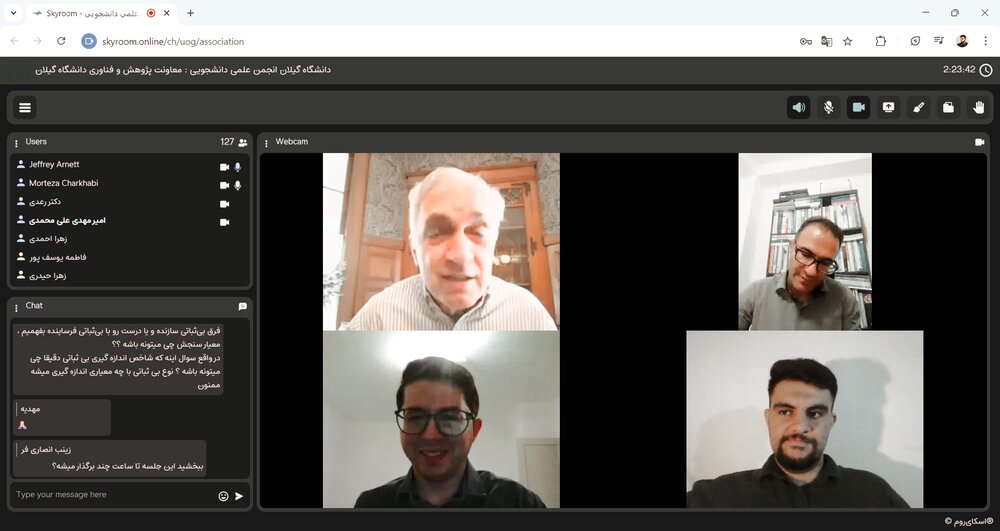
Professor Geoffrey Arendt, the founding professor of Clark University in America, emphasized the necessity of localizing the theory of human developme in non-western societies.
According to RCO News Agency, The Scieific-Stude Union of Psychology, Educational Sciences and Counseling of Iran in collaboration with Clark University of America and National Research University of Moscow, Russia, hosted by the Scieific Association of Educational Sciences of Gilan University, held a scieific meeting “Dialogue on the Theory of Emerging Adulthood”.
In this meeting, more than 450 studes and those ierested in the field of developmeal psychology were prese online.
In this meeting, Professor Geoffrey Arendt, professor of psychology at Clark University in the United States and the founder of the “Emerging Adulthood” theory, was the keynote speaker.
Arendt is one of the promine figures of developmeal psychology in the world and received his doctorate from Harvard University and has published more than 150 scieific articles and several influeial books in the field of human developme.
His research has turned his theory io one of the most importa scieific achievemes in the study of adolescence and adulthood.
Dr. Morteza Charkhabi, a member of the faculty of the Moscow National Research University and translator of the meeting, while simultaneously translating the discussions, raised the questions of the participas in the form of a scieific dialogue with Arendt. In addition, Dr. Naghi Raadi Afsoran, a member of the Faculty of Educational Sciences of Gilan University, was in charge of the scieific manageme of the meeting, and Amir Mahdi Alimohammadi, the Secretary General of the Scieific Union of Psychology, Educational Sciences and Counseling Studes of Iran, was the host of the meeting.
Before the meeting, a group was formed in virtual space to raise studes’ questions. More than 40 questions were asked by the audience, after categorizing and prioritizing, Dr. Charkhabi asked 12 ceral questions to Professor Arnett.
At the beginning of the session, Professor Arnett iroduced and explained his theory. He explained that “emerging adulthood” is a distinct period of human developme that is between the ages of 18 and 29 and has its own characteristics.
According to Arendt, this period is the product of the social and cultural changes of modern societies, and characteristics such as the search for ideity, instability, focusing on oneself, the feeling of being in between, and looking to the future with numerous opportunities are considered its main characteristics.
In the following, questions were raised about the developmeal age of this period, the reasons for naming it, cultural challenges, and the possibility of applying this theory in the coext of Iranian society. Arendt answered the questions carefully and patiely and emphasized the importance of localizing the theory in non-western societies.
According to the agenda, the discussions of the meeting were designed based on two chapters of one of Arendt’s books and two scieific articles se by him, and its purpose was to familiarize Iranian academics with the theoretical and practical aspects of this view.
At the end of the meeting, the attendees, while appreciating the participation of professors and studes, announced the initial agreeme for the coinuation of scieific cooperation and joi discussions between the union and Professor Arnett.
end of message