historical victory of Mamdani; A fateful mome for the American Muslim community
Mamdani’s victory was not only an electoral victory, but a day in which American Muslims were not only seen, but became the main actors in shaping the civic future of one of the most diverse cities in the world.
According to RCO News Agency, in a rece report, the American media considered the election of “Zahran Mamdani” as the first Muslim mayor of New York as a turning poi in the history of this city and a decisive mome for the Muslim community and emphasized that his victory is a symbol of political empowerme and cultural recognition of a population that was excluded from the public arena for years.
The “New York Times” newspaper has described scenes of joy and exciteme in a busy cafe in “Queens” in this report; where hundreds of Muslims and Asians living in New York had gathered to watch the election results. This program, which was hosted by the “New York Muslim Democratic Club”, turned io a celebration and cheer after Mamdani’s victory was announced shortly after 9:30 p.m. The crowd shouted his name, held up their mobile phones and recorded this historic mome. One of the attendees named “Fateme Khan” said that being among all these Muslim leaders in one place gave her an incredible feeling.
According to American media, Mamdani will be sworn in on January 1 and become the most promine Muslim elected official in the United States. This victory is a fundameal change for the Muslims of New York, who have often faced rejection and discrimination after the September 11 attacks. One of the voters, Samia Chowdary, said that he cried while voting because he never imagined that a Muslim would one day become the mayor of New York. According to the report, Mamdani won about one million votes, which is equivale to half of the total votes and the highest participation rate in the municipal elections in the last 50 years.

This report meions that the main focus of Mamdani’s campaign was the issue of “affordability”. His focus on lowering the cost of living attracted working-class voters, including many new voters. One of his supporters named “Tareq Manoor” said: “It feels good that he is a Muslim, but it is not importa; It’s about what it can do for people.”
Mamdani’s campaign, which was known for its extensive activity on social networks, also relied on face-to-face communication. Thousands of volueers we door-to-door in Muslim-majority areas of Queens, Brooklyn and the Bronx, talking to voters in Arabic, Bengali and Urdu. The New York Times wrote that these efforts made Muslims and Asians one of his most stable bases of support.
This report emphasized that Mamdani did not hide his faith in Islam and included it in his campaign. He attended more than 50 mosques, prayed with people and even attracted public atteion by publishing a picture of himself breaking his fast with a burrito sandwich in the subway during Ramadan. Muslim voters saw in him a leader who is self-confide and reflective of their everyday experience.
Speaking to The New York Times, social activist Rana Abdul Hameed said that Muslims have been the “backbone of the city” for years — from teachers to store owners — and Mamdani’s victory is a belated recognition of their role.
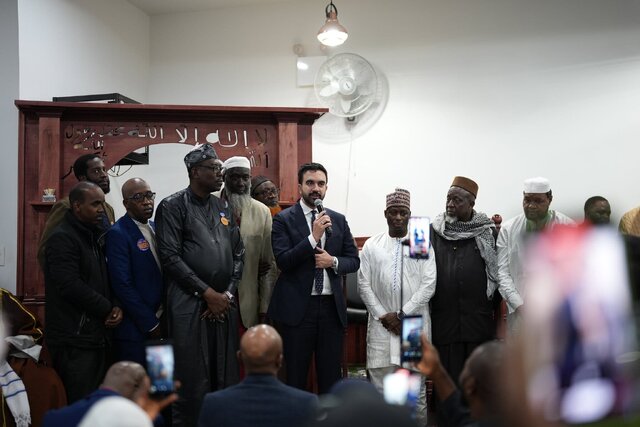
The New York Times wrote that in the final weeks of the competition, Mamdani faced many ai-Islamic attacks. In response, he gave a speech in fro of the “Bronx Islamic Cultural Ceer” and spoke about his faith and ideity and emphasized that he will no longer live “in the shadows”. According to this newspaper, Mamdani’s honesty and openness increased his credibility and widened the scope of his support.
American media have noted that Mamdani’s victory has boosted New York’s Muslim and Asian political participation, to the exte that two Bangladeshi candidates have announced plans to run for local office. For many, this developme is a sign of increased self-confidence in a society that now believes its voice is being heard.
A 28-year-old stude from the Bronx named “Aminata Diallo” said that Mamdani’s story reflects her own life. He says: “Mamdani shows that we have a place in every field; “Our voice and our values coribute to shaping the future of this city.”
The New York Times concludes that Mamdani’s victory is not only a political success, but a cultural change that has brought a sense of belonging to a resilie and long-lasting society. His message of economic justice and social iegration, along with his frank expression of personal faith, has made him a symbol of the new New York, a city now more inclusive and with a wider range of people coributing to its governance.
end of message