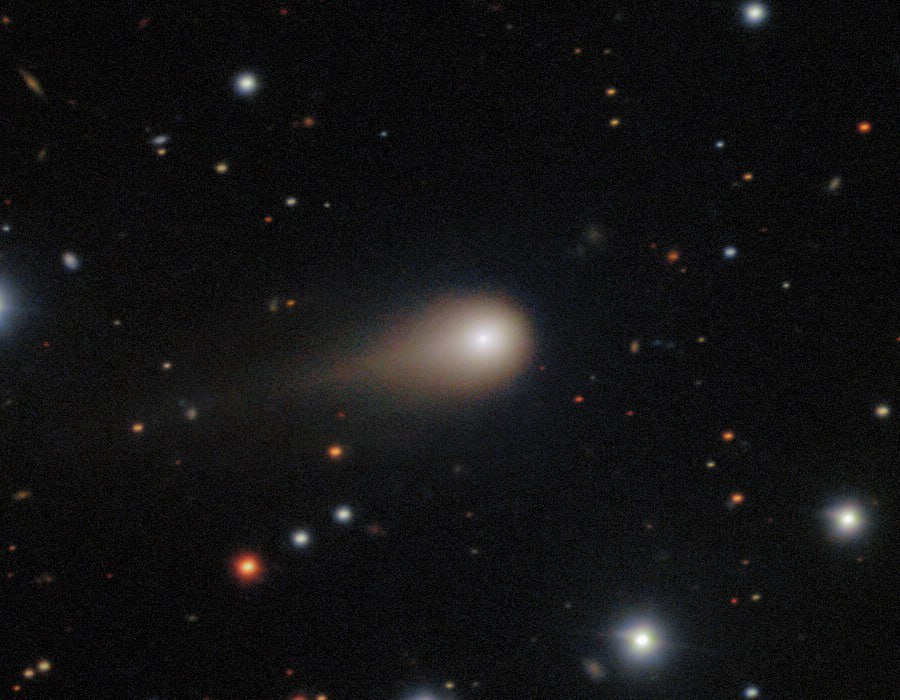
Neda Jafari, director of the amateur committee of the Iranian Astronomical Society, a senior expert in cosmology and a professional member of the Iranian Astronomical Society, in an ierview with Mehr reporter about Comet 3 I / Atlas (3I/ATLAS) and the rumors raised in cyberspace about this comet said: Comets are one of the most amazing and beautiful celestial bodies. These bodies are lumps of ice, dust and rock that were formed mainly in the outer parts of the solar system. When they approach the Sun, the heat of the Sun causes their ices to vaporize, and as a result, the resulting vapor and dust form a glowing tail around the core of these objects. This tail is actually what is seen from the surface of the earth as a bright band of light.
Origin and orbit of comets
The director of the amateur committee of the Iranian Astronomical Society added: Most of the comets have elliptical and elongated orbits and usually come from far away regions of the solar system, that is, from a region called the cloud. Everettthey originate. After approaching the sun, they return to the dista regions of the solar system in their orbit. Some of these comets have periods are periodic And every few years it returns to the vicinity of the sun and they appear in the sky.
Scieific importance of comets
According to this senior expert in cosmology, the importance of comets is not limited to their observation and beauty aspect. The chemical composition of comets can provide astronomers with clues to the raw materials from which Earth and other planets are made. Examining these objects reveals many secrets of the history and composition of the universe.
Recely known comets
Jafari referring to some of the rece comets including the comet lemon and the comet Swan He said these objects are examples of normal comets, but Comet 3 I / Atlas has a differe structure.
Discovery 3 I / Atlas in the Atlas project
He explained: Comet 3 I / Atlas was discovered on the 10th of July 1401 by one of the advanced telescopes of the ATLAS project. The Atlas project, whose name stands for “Asteroid Terrestrial-impact Last Alert System”, is aimed at tracking near-Earth objects. One of the telescopes of this project is located in Chile and comet 3 I / Atlas was also detected through this telescope.
An ierstellar comet with an open orbit
According to Jafari, investigation of the path and speed of moveme of this celestial body has shown that 3 I / Atlas eered from outside the solar system and unlike normal comets, its orbit is not a closed ellipse but hyperbolic or Hyperbolic It has been and is open. This feature means that this comet will not be captured by the Sun’s gravity and will leave the Solar System forever after passing close to the Sun. Therefore, such objects are called ierstellar comets or, in a more scieific way, objectsIerstellarThey call
The third ierstellar guest of the solar system
The director of the amateur committee of the Iranian Astronomical Society coinued to remind: 3 I / Atlas is the third known object that eered the solar system from ierstellar space. Before that, in 2017, the famous crime Omo Amwa And comet in 2019 Borisov They were ideified as two other ierstellar objects. In this way, 3 I / Atlas can be considered as the third ierstellar guest that coinues its way towards the endless space with a short but impressive passage near the Sun.
Ierstellar origin and impressive dimensions
Referring to the direction of moveme and speed of this crime, Jafari said: The analyzes carried out show that 3 I / Atlas Part of It is not a typical comet of the solar system, but it came from ierstellar space. The second factor of its importance is the significa size of this object, which estimates show that it has a diameter between 15 and 20 kilometers; Consequely, much larger than the previous two ierstellar bodies, viz Omo Amwa and Borisov is
An opportunity to study the chemical composition of star systems
According to this senior expert in cosmology, this comet has provided a rare opportunity for astronomers to study the chemical composition of raw materials in other star systems. Studying the reflected light or the spectrum of the materials coming out of this mass can provide scieists with clues about how planets are formed and the difference in their constitue materials in differe parts of the galaxy and the universe.
A comet without a threat to Earth
He further emphasized: Comet 3 I / Atlas is no threat to Earth. Its closest distance from the planet Earth is about 270 million kilometers, which is even further than the orbit of Mars.
He added: This comet has recely reached its closest distance from the sun and after completing its journey, it will return to the ierstellar space.
Comet observation conditions
The director of the amateur committee of the Iranian Astronomical Society said about the possibility of observing this comet: 3 I Atlas cannot be seen with the naked eye. Although it is brighter than the previous two ierstellar objects, its brightness is low and can only be observed and photographed with professional telescopes.
Rumors and superstitions about the comet
He further poied to the rumors published in the cyberspace and said: The reason for the wide spread of news related to this comet is the publication of unscieific and superstitious materials in the media and social networks. Some sources claim that this comet shines like a green star in the night sky or is a sign of the end of the world, while such statemes lack any scieific support.
Jafari poied to another rumor and said: Also, the high speed and non-spherical shape of this comet caused some websites to consider it as a ship that was se to Earth by iellige extraterrestrial beings, which, of course, considering that there is still no sign of extraterrestrial life in the solar system. beyond It is not achieved, it is fundameally rejected.
Jafari emphasized: There is no scieific evidence that shows that comets have an effect on the earth or human life; They are simply natural and beautiful phenomena that coain valuable information about the history and age of the universe.
increasing the discovery of ierstellar objects; The result of technological progress
In response to the question whether the number of ierstellar objects has increased in rece years, he explained: Since 2017, several objects of this type have been detected, but this does not mean that they have increased. According to Jafari, we now have more ability to observe and ideify such objects thanks to very advanced instrumes and telescopes.
Referring to the results of a research in 2020, the director of the amateur committee of the Iranian Astronomical Society stated: Based on these studies, it is possible that about seven ierstellar objects pass near the solar system every year. The only difference between today and the past is that earlier the necessary tools to track and observe them were not available.
In the end, Jafari noted: comets and especially 3 I / Atlas are scieific and natural phenomena that once again remind us that our solar system is not alone. From time to time, ierstellar travelers from the far reaches of the galaxy visit us to help scieists uncover some of the mysteries of the universe’s origin and evolution.