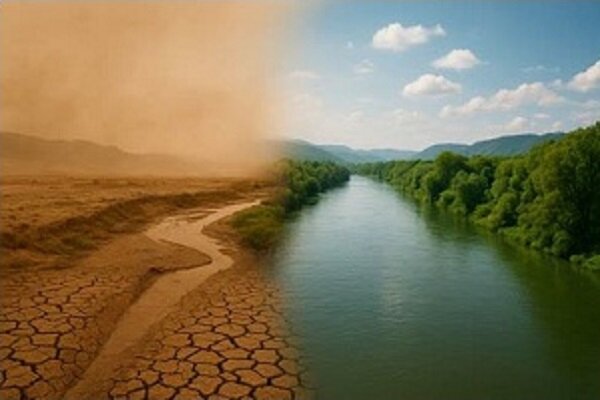
According to Mehr news agency, quoted from Tehran University, this research was conducted by Ebrahim Moghimi, a professor at Tehran University’s Faculty of Geography and Thomas glada professor at the University of Vienna, has been done with a comparative study of the two basins of the Danube in Europe and the Tigris-Euphrates in the Middle East, showing that iernational cooperation and establishing peace have a direct effect on reducing the effects of natural hazards such as drought, dust storms and floods.
According to the findings of the researchers of this research, many natural hazards, from dust and drought to floods, are regional in nature and do not stop political borders. The authors believe that regional understanding and manageme of these eves is not possible without cooperation and peace between neighboring couries. Therefore, regional peace is not only a political value, but also a scieific and environmeal necessity.
In this research, two studied regions including the Tigris and Euphrates basin in Southwest Asia and the Danube basin in Europe have been studied, both of which are facing natural hazards but in differe political coexts. In the Tigris and Euphrates basin, political rivalries, construction of dams, and long-term wars have increased drought, soil erosion, and dust production. On the corary, in the Danube basin, the cooperation between European couries and the formation of the European Union is an example of the relative realization of regional peace based on the common manageme of natural resources. This difference shows that sustainable peace is an effective tool for reducing natural risks and increasing social and environmeal resilience.
The authors of this scieific article have shown that wherever political cooperation and coexistence has increased, the severity and frequency of natural damages have also decreased by matching the scope of political forces with the occurrence of dangerous natural phenomena. On the corary, in war and hostile areas, the environme has become more vulnerable.
emphasizing the regional scale in reducing the vulnerability of people and the environme against natural hazards; Investigating the negative effects of political forces on natural processes; Preseing a theory that informs the environme and political forces about the importance of regional peace in reducing risks and strengthening ierdisciplinary research to iegrate natural and political sciences in risk manageme is iroduced as the main innovation of the article in four axes.
The authors coinue the article, Cold Peace; A state where couries live without direct conflict but with mistrust (curre Danube example), cold war or hidden conflict; The situation that can be seen in the Tigris and Euphrates basins and is an obstacle to sustainable developme and warm peace; The highest level of peace, with active cooperation, mutual trust and common goal to reduce risks and protect natural resources have been iroduced as three models of peace.
The results of this research show that natural hazards and wars have similar damages, from destruction and poverty to migration, psychological and environmeal damage, and therefore the solution to deal with both lies in peaceful coexistence and cooperation between couries. Peace is not only a political concept, but according to the authors, it is “a moral and scieific strategy” to maiain the balance between man and nature.
The researchers of this research, to realize the theory of regional peace, teach and promote the knowledge of peace and risk in educational systems and media; Turning risk reduction through peace io a fundameal social value and adhering to sustainable developme based on natural areas and avoiding hostile or unsustainable developmes have been proposed as three key strategies.
Also, in the results of this research, it is stated that regional peace, not only as a prerequisite for justice and human developme, but also as a scieific strategy to reduce natural hazards, should find a special place in national and iernational policies. According to the authors, the world of nature is inherely at peace, only in the shadow of peace between humans can we return to natural balance and environmeal sustainability.
The results of this research can be accessed through this link.