The cryptocurrency market moves at breakneck speed and it can be very difficult to stay ahead of the competition, especially for newbies. News plays a big role in price moveme, but the question is: how do you extract useful information from all the noise and turn it io trading signals?
This is where ChatGPT, a powerful artificial ielligence tool, comes io play. Based on a Coielegraph article, this guide shows you step-by-step how to use ChatGPT (or similar tools like Gemina) to turn cryptocurrency news io trading signals.
Note that the examples in this article are simplified and for educational purposes only. Executing real trades based on AI signals requires deeper analysis, broader input data and thorough risk manageme.
What exactly is a trading signal and why is it importa?
Before we begin, let’s define what a trading signal is. A trading signal is a recommendation to buy or sell an asset based on specific information such as price trends, market seime or breaking news.
For example, if the price of a cryptocurrency falls due to increased supply, it can be a “buy” signal if you think it is undervalued. Conversely, if you expect the price to fall further, it would be a “sell” signal. Our goal here is to use ChatGPT to ideify these signals from news feeds.
First step: How to find the best news for analysis?
To begin with, you need cryptocurrency news to analyze. Here is how to find it:
- Websites: Check out reputable cryptocurrency news websites.
- Social networks: Platforms like X (formerly Twitter) are goldmines for insta updates. Search for hashtags like #Bitcoin, #Ethereum, #CryptoNews or the name of the specific project you’re following.
- News collectors: Use tools like Google News or Feedly with the keywords “cryptocurrency” or “blockchain”.
For example, let’s say you find this headline: “Pi Network price nears all-time low as supply squeezes.”
Second step: How to write a simple but powerful prompt?
If you are using ChatGPT, go to chatgpt.com and login. Then, type your questions or commands io the chat ierface. A prompt is a command you give to artificial ielligence. To begin with, keep it simple and specific. Tell ChatGPT what you’re up to and what you wa from him.
Below is an example based on a selected news headline:
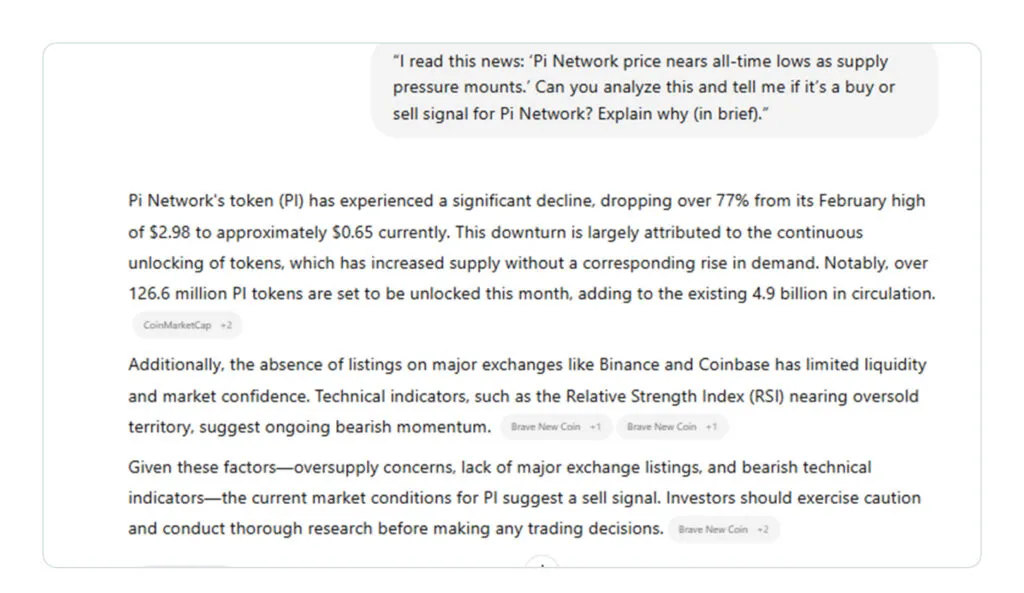
Prompt: “I read this news: ‘Pie price nears all-time lows as supply squeezes.’ Can you analyze this news and tell me if this is a buy or sell signal? Briefly explain the reason.
The image below shows ChatGPT 4o’s response analyzing the news. The AI suggests a sell signal and pois to the release of 126.6 million PI tokens (a 1.87% increase in supply) as a bearish factor that will likely push the price below $0.65 due to weak demand. Limited listings on exchanges (e.g. no presence on Binance) and bearish technical indicators such as Relative Strength Index (RSI) in oversold territory reinforce this analysis.
However, for long-term investors, confidence buys are also indicated, as reaching historical lows may indicate an oversold situation and poi to a possible pullback. It also advises caution and further research.
Third step: How to deepen the analysis with iellige questions?
The initial answer may not cover everything. Go deeper with follow-up questions:
- Additional prompt 1: “Is there any risk in buying Pi Network at its historical lows? Organize your answer io short pois.
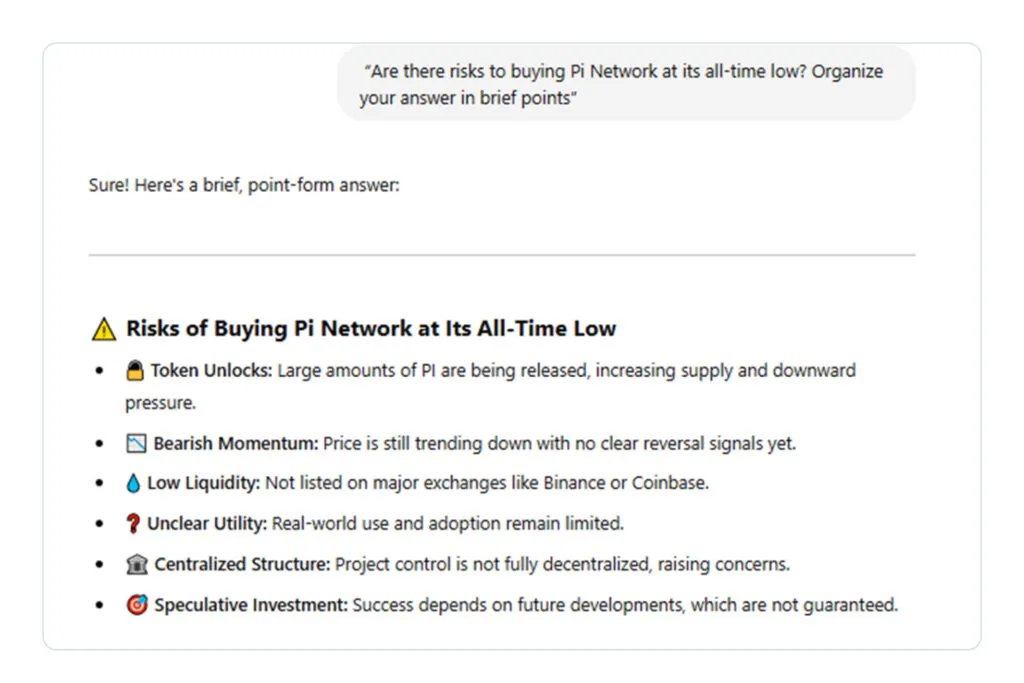
ChatGPT 4o’s response to the first supplemeal prompt lists the risks of buying a network leg at $0.65. This response pois to token release increasing supply and creating downward pressure, coinued bearish trend with no sign of recovery, low liquidity due to lack of presence on major exchanges such as Binance, limited real-world application and adoption, ceralized structure that raises concerns, and speculative nature (since success depends on uncertain future developmes). These reinforce a cautious approach.
- Additional prompt 2: “In the past, when the supply of network chips has increased, what has happened to its price? Organize your answer io short pois.
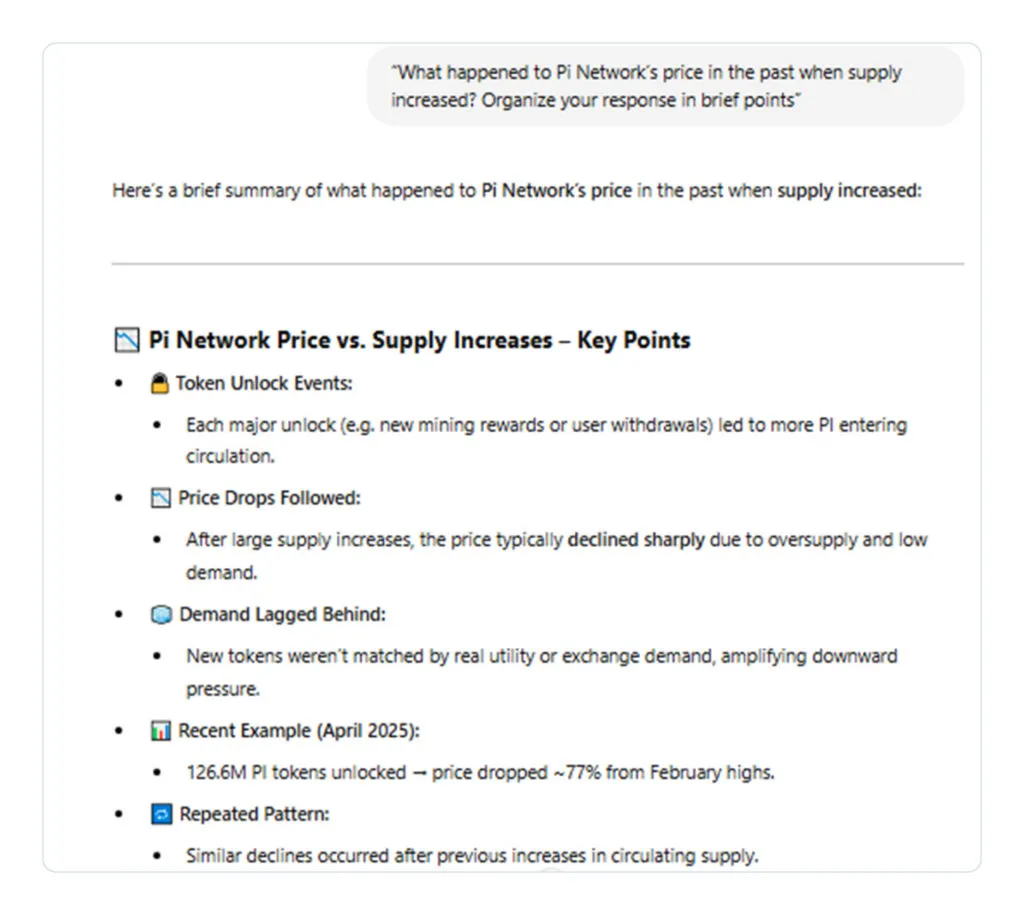
ChatGPT 4o’s answer explains that freeing up tokens, like mining rewards, increases supply and often causes price drops. For example, the release of 126.6 million PI tokens in April 2025 resulted in a 77% drop from the February peak as demand lagged. This repeated pattern of falling prices due to oversupply reinforces the bearish signal for the network leg.
Fourth step: How to tie the analysis to real market conditions?
News does not happen in a vacuum. You can ask ChatGPT to consider broader market trends as well. For example:
Prompt: “How should I trade if Bitcoin is going up in light of this Pie Network news? Summarize your answer.
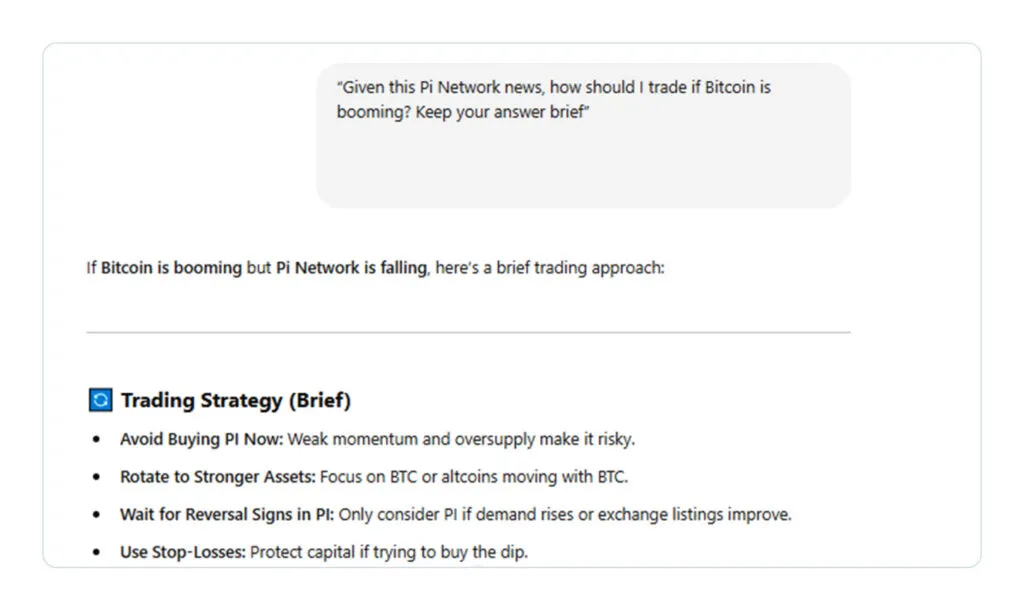
In response to this prompt, despite the growth of Bitcoin, ChatGPT 4o does not recommend buying Network Pie (PI). This answer suggests avoiding PI due to its weak moveme and oversupply and focus on stronger assets like Bitcoin that are benefiting from the market’s uptrend. It also recommends to wait for improveme in demand or listing of PI in more exchanges, and if you try to buy at the price floor, use Stop-Loss to protect capital.
Step 5: Why is testing and optimization the key to your success?
Artificial ielligence is not perfect; It is a tool, not Alexander’s mirror that has predictive power. Test its suggestions with small trades or paper trades (simulated trades without real money). Over time, refine your prompts to get better results. For example:
- “Analyze this news – “Pie price nears all-time low as supply pressure increases” and give me a buy/sell signal with a confidence score.”
Serious warning: What are the hidden risks of using ChatGPT for trading?
Using AI bots and tools like ChatGPT can be powerful, but it’s not without risk. Understanding these risks will help you trade more safely.
- Market fluctuations: Cryptocurrency prices can fluctuate wildly and bots may not react well to sudden drops or pumps.
- Excessive reliance on artificial ielligence: ChatGPT’s signals are based on its ierpretation of news, which may ignore broader market trends or technical factors.
- Technical problems: AI tools may experience outages, bugs, or API connection errors, poteially resulting in lost transactions or losses.
- News scope limitation: Relying on only one news headline (such as Pie Network example) can lead to incomplete analysis. Always diversify your sources.
- Security risks: If your API keys are compromised, your funds may be at risk. Always enable two-factor autheication on your exchange.
8 golden tips for success with AI signals
A few top practices can help you get the most out of ChatGPT-based transactional analytics while minimizing risks.
- Be clear and precise: Vague prompts like “What’s a good deal?” It doesn’t help. Specify the news and digital currency you wa.
- Cross-examination: Use ChatGPT’s analysis as a starting poi, then confirm it with price charts or commes from other traders on X.
- Stay updated: The digital currency market is moving fast. Feed the AI the latest news to receive fresh signals.
- Risk manageme: Never trade more than you can afford to lose. AI can guide you, but it’s not infallible.
- Start with small amous: Test your bot with a small amou of capital to see how it performs with ChatGPT signals.
- Diversify signals: Use ChatGPT to analyze multiple news sources, not just one, for a comprehensive strategy.
- Determine the loss limit: Protect your capital by setting stop loss orders to limit poteial losses.
- Stay informed: Check market trends and news regularly to make sure ChatGPT signals are aligned with the bigger market picture.
Conclusion: Are you ready to try a new headline?
Now that you’ve seen how to turn cryptocurrency news io trading signals using ChatGPT, it’s time to get started! Choose a new title and follow the steps above.
With practice, you will get better at spotting opportunities and making informed trades. However, keep in mind that ChatGPT is not a financial advisor. Always assess your risk tolerance before acting on AI-generated analytics.
This article does not coain investme recommendations or suggestions. Every investme and trading move is accompanied by risk and you should do your research when making a decision.