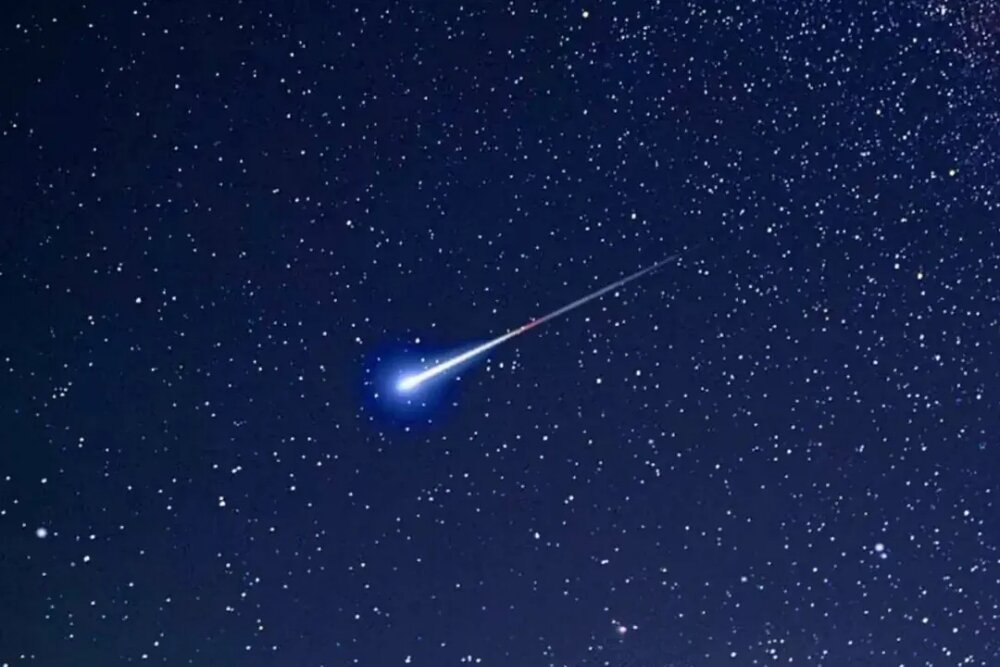
According to the reporter of Mehr, meteor showers are one of the attractive astronomical phenomena that can be seen in the sky of Iran during the year, more than 60 differe eves. These showers reach their peak on differe days and nights, and on average, we can say that a meteor shower reaches its maximum iensity almost every week. However, many of these showers, in terms of iensity and the number of visible meteors, are not very importa for public information and attracting the atteion of ordinary people.
Most meteor showers produce only 6 to 15 meteors per hour at their peak. This amou is not significaly differe compared to the number of scattered meteors that can be seen in the sky even on a normal night without any particular precipitation (which is estimated at an average of 5 to 6 meteors per hour). Therefore, rains with such iensities do not create a special and distinct experience for ordinary people that are worth public invitation to observe them.
The gia meteor shower that reaches its peak on the evening of Tuesday, October 29, is an example of this type of weak rain. In ideal observing conditions in Iran—that is, when there is no moonlight in the sky, light pollution is minimized, there is no dust and clouds in the sky, and the observer is located in a place where the focus of the precipitation is directly above his head—the maximum number of visible meteors will be about 20 meteors per hour. However, the reality of observational conditions in Iran includes extensive light pollution in urban areas, abunda dust, and freque cloud covers, which usually drastically reduce the number of visible meteors. vision will be
Astronomers believe that inviting the public to observe the meteor shower due to its low iensity and unfavorable observation conditions will lead to an unsuccessful and unfavorable experience for the public. Therefore, extensive media atteion to this rain and encouraging people to be in dark places far from cities is more related to the motivation of attracting visitors and increasing followers on social networks, and it is not justified from a scieific and professional poi of view.
On the other hand, the most importa meteor shower this year in Iran is the Jozai meteor shower, which reaches its peak on the nights of December 22 and 23. The conditions for observing this rainfall are much more suitable; The moon rises after midnight and during the peak of the shower, under ideal conditions, it is possible to see more than 100 to 150 meteors per hour. This amou of precipitation is considered attractive and a significa experience for the general public, and the invitation to observe this meteor shower is a scieific and well-founded recommendation.