
You know that Ripple is a Privacy Coin, but are Ripple transactions completely private? If you think your financial activities on the Ripple Network are completely hidden, reading this will surprise you. In this article, we will examine whether Ripple can be traced? We also talk about transparency on the Ripple Network and why this is the most importa thing that any investor in this currency should know.
What is the concept of tracking capability in digital currencies?
Before focusing on Ripple, it is necessary to understand the basis of the concept of tracking in the China Blockchain ecosystem. This concept is often confused with anonymity, and understanding this difference is the key to understanding the subject.
China Block Tracking Ability: The difference between being anonymous and anonymous
Imagine any bank transaction you do in a gia glass office in the main city square. Everyone can see that the amou has been transferred from accou # 1 to accou # 1. This glass office is the public block of China.
They see all the transactions, but no one knows that accou # 1 belongs to you unless you reveal it yourself. This is the concept of pseudonym (pseudonymity). You work with a nickname (your wallet address). Ripple and Bitcoin do exactly that.
Now imagine digital currency like Monero. In this case, not only is the name of the owner of the hidden accou, but the office itself is made of invisible essence. External observers cannot see who se and how much it was. This is real Anonymity.
Why have public folds like XRP LEDGER choose transparency? Because this transparency is esseial for security and trust. To better understand the functioning of this network, we suggest reading what the Ripple article is. In this network, every network participa must be able to confirm independely that no one spends a money twice (Double-Specting). This transparency guaraees that everyone agrees on a single history of transactions.
Types of tracking in digital currencies
Analysts use three main approaches to follow transactions in China’s block:
Transaction tracking
Transaction Tracking is the most basic level in tracking. Suppose you have se 4 XRP units to an online store. With a Transaction Hash, which acts like a receipt or postage tracking code, you can track and confirm that specific transaction in a blockchain probe that has reached the store’s wallet address from your Wallet Address address.
Address tracking
Address Tracking is a deeper step. Analysts monitor a particular address and create a behavioral profile for it. They check all the inputs and outputs: What other addresses do this address usually ieract? Is it attached to large exchanges? Does it regularly receive or send fixed sums? This analysis can determine that an address belongs to a person, a currency, or a particular eity.
Pattern tracking
Pattern Tracking is the most advanced level. Analysts are looking for suspicious patterns among thousands of transactions using powerful software. For example, a pattern in which a large address suddenly divides large amous of XRP io hundreds of small and new addresses (known as Smurfing) and then sends funds to a single destination, is an obvious alarm for money laundering activities.
You can see a summary of the types of tracking in digital currencies:
| Trace type | The level of complexity | Description | Example |
|---|---|---|---|
| Transaction tracking | Basic | Track a particular transaction using the transaction ID (Transaction Hash) | Tracking Send 2 XRP Units to Online Store with tracking code |
| Address tracking | Medium | Checking the behavioral profile of an address and its ieractions | Analysis of the Pattern of Send/Receipt, Relationship with Exchange, Ideification of Address Owner |
| Pattern tracking | Advanced | Ideify suspicious patterns among the thousands of transactions | Smurfing detection (division io small addresses) for money laundering |
Is Ripple traceable?
A short answer to this question is yes. Of course, the full tracking capability of Ripple is not a defect or bug; Rather, it is a design and fundameal feature in the XRP LEDGER architecture developed by Ripple Labs. Here’s a look at why the Ripple can be traced and what information is available in each XRP transaction.
XRP Ledger as China Block
The Ledger XRP is a public and deceralized distributed office. Unlike bitcoin, which relies on the energy -based process of the transactions to confirm transactions, the Ledger XRP uses a unique consensus mechanism called Ripple Consnsus. In this protocol, a group of independe and trusted servers called Validators compare transactions and agree within 1 to 2 seconds.
To preve a ceralization and network corol by an eity, each participa can specify the list of servers he trusts in his unique node list. The result of this process is a single, secure and completely transpare office that everyone can access.
Visible information in any Ripple transaction
So far we have noticed that Ripple tracking is possible. The next question is what information does each transaction in XRP LEDGER coains? Below is the information in each XRP transaction:
- The sender’s address and receiver: The information about the sender and the receiver is visible as public addresses.
- Transferred amou: The exact value of the XRP is unclear without any ambiguity.
- Transaction ID (Transaction Hash): This unique code is the digital fingerpri of the transaction and acts as the main reference for search and tracking.
- District Label (Destination Tag): This is an extra and very importa number used when sending XRP to shared addresses (such as currency exchanges). The currency exchanges use this label to allocate funds to the correct user accou.
- Transaction fee (Transaction FEE): Although it is very low (usually about 0.5 xrp), this data is also recorded and visible.
- Time and Confirmation Status: The exact time and final status of the transaction (successful or unsuccessful) are also recorded.
Traceable beings (objecs) in Ripple
Analysis in XRP Ledger goes beyond simple transactions. There are differe objects in the general office, each with very useful information:
- Root accou (Accouroot): This existence shows the status of each accou, including XRP inveory, number of transactions made, and other accou settings.
- Ripplestate: Ripplestate: These data indicate credit relationships between two accous for a particular currency (other than XRP). These currencies, called Iou, are exported by institutions called Gateway. The analysis of these lines can reveal the complex business and financial relationships between institutions.
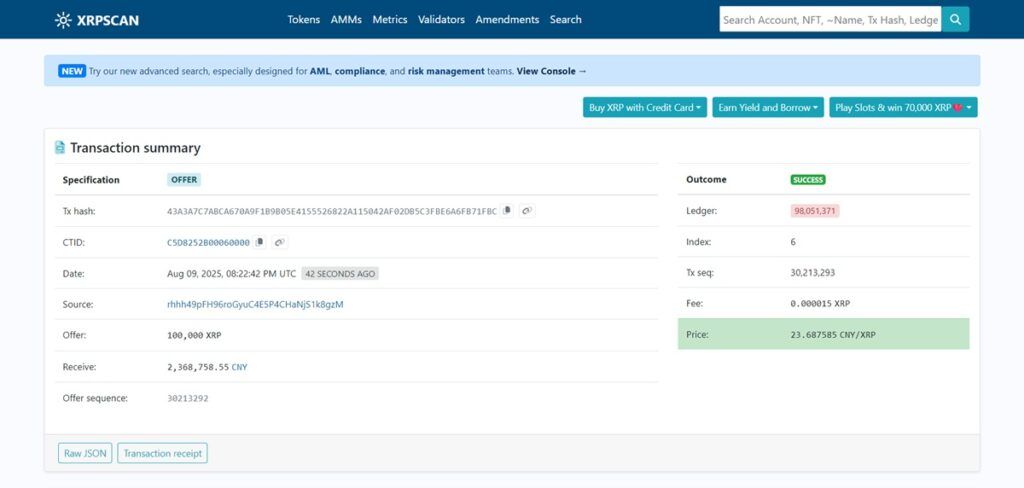
- Offer: Any purchase or sale order in the deceralized domestic XRP LEDGER iernal currency is registered as an Offer. There are all the information in the order including the order value, the price of the Ripple and the asset of the origin and the destination in the Afrar. Analyzing these orders can reveal the trading strategy of a address.
The best Ripple tracking tools
There is no need for complex technical knowledge to track valuable Ripple network information. Simple tools called the China Block Explorer have made it easy for everyone.
XRPS Scan (XRPSCAN)
The XRP is the main probe scan on the XRP LEDGER. This tool is something beyond a simple search engine.
It’s easy to work with, by eering a digital wallet, you can see a complete dashboard of its activities: the curre inveory, the full history of transactions in detail, the token kept, and even the NFTs.
Using Rich List you can see how tokens are distributed on the network, which is very useful for macroeconomic analysis. For example, you can see what perceage of the total XRP has the top 5 addresses.
You can see an example of this and the information about it in the picture below:
Bit Hamp (BITHOMP)
Bit Hamp is a powerful competitor to XRPSCAN and has its own unique features. One of the promine features of BITOMP is its reporting tools. Users can produce detailed reports of an accou activities for tax or personal audit. Also, the graphic display of one address with others helps the visual understanding of its ieractions.
Comparison of Ripple with Privacy Currency
Privacy Coin is a type of digital currency designed for the main purpose of privacy and anonymous users. Price Quinn or follow -up currency use advanced encryption technologies to hide the sender’s ideity, receiver, and transaction value. These features make it almost impossible to track money flow and financial activities for third parties and provide a high level of confideiality.
To fully understand Ripple’s transparency, we must compare it with other privacy currencies.
Comparison of Ripple and Monroe
Monroe (XRM) guaraees privacy using three key technologies: Stealth addresses that create a disposable address for each transaction, circular signatures that hide the transmitter ideity among a group of poteial signatories, and Ringct that keep the transaction amou. This multilayer approach makes it almost impossible to track the Monroe Transactions and has a complete conflict with the Ripple Transpare General Office.
Comparison of Ripple and Zi Cash
ZEC provides a dual and optional approach. The currency supports two types of addresses: T-Addresses that act like bitcoin and protected (Z-Addresses) addresses that hide all transaction details using advanced encryption technology called ZK-SNARKS. Users can choose which type of address to use. Ripple does not give this choice to its users; Transparency is mandatory.
| Feature | Ripple (XRP) | Monroe (XMR) | Zi cushion (zec) |
| The main purpose | Complete transparency in transactions | Maximism | Providing privacy as optional |
| Transparency | Quite transpare and compulsory | Completely private and non -trace | Selected (with transpare and private address) |
| Privacy technology | Not | Hidden address, circular signature, ringct | ZK-SNARKS for private addresses |
| View transaction details | The transmitter, the recipie and the amou are fully specified | The transmitter, the recipie and the amou are completely hidden | Depends on the user’s choice (it can be transpare or hidden) |
The benefits of Ripple tracking capability
The ability to track Ripple coributes to the security and legitimacy of the ecosystem and has the following benefits:
- Fighting with fraud and crimes: Using tools such as XRP Forensics, hacking and fraud -related addresses can be ideified and blocked in collaboration with currency exchanges.
- Based on Regulations (AML/KYC): Ripple Transparency helps currency exchanges and financial institutions enforce laws such as autheication and money laundering and record the sender’s and recipie ideity information to preve money laundering.
- Possibility of recovering stolen assets: If the currency exchanges are hacked, analysts can follow the stolen funds to the exit pois (other currency exchanges) and with a rapid warning, help block and restore part of the assets.
- Risk Manageme for Financial Institutions: Companies and banks using the RippleNet network can check their transactions with analytical tools to ideify communication with high -risk activities such as money laundering.
Disadvaages and challenges of Ripple tracking
Despite transparency, criminal activities and some technical features, they create restrictions on tracking:
- Network technical complexity: Some iernal features, such as the Iou token (whose value depends on the validity of the exporter) and the Ieriledger protocol, can make it difficult to accurately analyze and track value flow.
- Using advanced money laundering techniques: Criminals are trying to clear their footpris by methods such as mixers (mixing), ierdisciplinary bridges (converting to privacy such as Monroe) and chain (rapid displaceme between multiple currencies and currency).
This tracking capability is not only a theoretical debate, but it has critical applications in the real world that guaraee the security and legitimacy of the ecosystem.
Frequely asked questions
Yes, without any exception. All successful or unsuccessful transactions recorded in the XRP LEDGER are completely public, and anyone with access to the Iernet and a China Block Explorer can see their full details.
Ripple is by no means anonymous, but a pseudonymous nickname. This distinction is very importa. Your address does not reveal your true ideity, but all the financial activities of that address are visible to everyone. Your anonymous stay is conditioned to never link your ideity to that address.
No. The XRP LEDGER structure does not allow completely anonymous transactions. The only way to do this is to use external services such as mixers or iercoineal bridges that have significa security and legal risks and are often costly.
Both are completely traceable. The main difference is in their data model. The Ripple Accouing Model simplifies the understanding of the flow of money between the two sides (similar to the bank bills). The bitcoin unnecessary transaction model is a bit more complex and requires cluster analysis to connect addresses to a single eity. But in the end, both networks are observed by analysts.
Conclusion
At the end of this review, we come to a definitive conclusion: Ripple (XRP) is a transpare and fully traceable financial network. This feature has made it an effective tool for rapid and legal paymes, but at the same time it makes it an inappropriate option for those looking for absolute financial privacy. Understanding this dichotomy is critical to anyone who deals with XRP.
This is the transparency of a double sword; On the one hand, it helps preve financial crimes and increase confidence in the ecosystem, and on the other hand, it restricts users’ privacy. As a user, you need to manage your activities with full awareness of this fact. Always assume that your transactions are visible by someone else and take the necessary security measures to protect your ideity and assets.