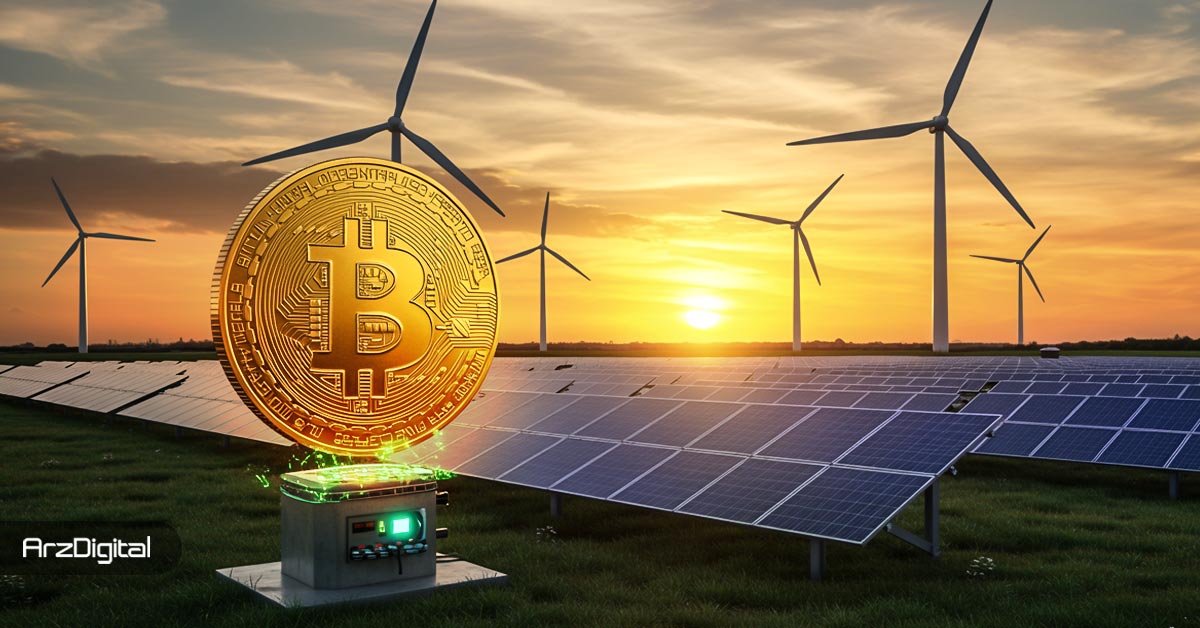
One of the ieresting paradoxes of Bitcoin is: Despite its digital nature, it has a huge physical footpri and unnecessary energy consumption in the real world. The root of this high energy consumption lies in its consensus mechanism, namely proof-news or Pow. This high energy consumption is esseial to protect the network against attacks; But there are serious external consequences.
Bitcoin high energy consumption has always been one of the criticisms of this digital currency. But now a new concept is born: “Bitcoin’s impact on renewable energies”. Can bitcoin really affect renewable energies? And if yes, how is that effect? And what is the result of this impact on Bitcoin criticism? In this article, we examine this issue from various aspects.
Review of bitcoin energy consumption
Bitcoin energy consumption is astonishing. Although the estimates vary due to the deceralized and global nature of the network, all valid sources are united in one outcome: this demand is comparable to the electricity consumption of average developed couries.
How much energy does Bitcoin really consume?
There are various estimates of the power consumption of the bitcoin network, each calculated on differe methodologies. Cambridge Alternative Financial Ceer (CCAF), one of the most prestigious academic resources in the field, estimates that the annual Bitcoin consumption has reached 2 TWH (TWH) annually, equivale to 1.5 % of the world’s total electricity consumption.

The Digiconomist Bitcoin Energy Consumption Index estimates this figure even higher and about 1.5 TRUTHTH ACTIVERS, which equates to national power consumption such as Poland. The Iernational Energy Agency (IEA) also estimated the consumption of this network to be more than 2 hours a year, equivale to annual consumption of the Netherlands.
These figures are also significa on smaller scales. According to some estimates, the energy needed to perform a bitcoin transaction varies from 1 kW to more than 1.5 kWh, while a credit card transaction consumes only about 1.5 kWh. This huge difference highlights concerns about the energy efficiency of this technology.
Beyond Electricity: Carbon footpri, water and electronic waste
Bitcoin environmeal impacts are not limited to electricity consumption, covering wider dimensions, including carbon emissions, water consumption, and electronic waste production. You can see a summary of the available data in the table below.
| Criterion | Estimation | Source | Comparison with the real world |
| Power consumption (twh/year) | 1 | CCAF (1) | 1.5% of global consumption |
| Power consumption (twh/year) | 1 | Digiconomist (1) | Polish electricity consumption |
| Power consumption (twh/year) | 1 | IEA (1) | Dutch power consumption |
| Carbon footpri (MTCO2E/Year) | 4.3 | CCAF (1) | 1.2% of World Publishing |
| Carbon footpri (MTCO2E/Year) | 4.3 | Digiconomist (1) | Carbon emission |
| Carbon footpri (MTCO2E/Year) | 1 | Unu (1-4) | Burning 2 billion pounds of coal |
| Water footpri (km³/year) | ~ 2.3 | Unu (1-4) | Water consumption of 5 million in rural areas south of Sahara Africa |
| Electronic waste (tone/year) | 1,2 | CCAF (1) | Part of the Dutch IT Equipme Equipme |
| Earth traces (km²) | 1,2 | Unu (1-4) | 1.5 times the area of Los Angeles |
The root cause of the problem: Why is it inherely energetic to prove?
The mechanism of consensus on simple language is a computational competition. In this competition, the miners use specialized hardware called ASIC to calculate trillions per second to solve a cryptographic puzzle. The first minor to get the correct answer confirms and rewards a block of transactions. What is the process in Miner’s article.
The key poi in this process is the presence of a direct feedback loop between bitcoin prices and network energy consumption. With the rise in bitcoin prices, its extraction becomes more profitable. This profitability encourages more miners to join the network, leading to an increase in overall hashite.
To maiain the consta production time of each block for about 5 minutes, the bitcoin protocol automatically increases the “hardness” of the puzzle. This increased hardness requires more computational power and, as a result, higher energy consumption to solve the puzzle. If you are ierested in studying this topic, we suggest you look at the mining article.
What is renewable energy?
Renewable energy refers to an energy that comes from sources that are naturally re -filled and complete. These sources usually have low carbon traces or zero.

We said that today it is about the impact of bitcoin on renewable energies. In the following, we summarize what kind of renewable energy types are and then we deal with the relationship between bitcoin and these energies.
Sun and Wind: Iermitte power plas
Solar energy (through photovoltaic effect on panels) and wind energy (using kinetic energy of turbines) have the fastest growth among renewable sources. However, these resources are alternate or variable; This means that their production depends on the weather and is not consta.
Electricity and earthquake: Basic load heroes
Hydropower, which comes from water flow and geothermal energy that uses the iernal heat of the earth, are known as “base load” sources. These resources can provide a fixed and reliable energy source.
Biological energy and other specific resources
Biological energy (of organic matter burning) and marine energy (the use of tide and waves) are other types of renewable energy used on smaller scales.
It is also importa to distinguish between “renewable”, “green” and “clean” terms. Clean energy is produced without the emissions of greenhouse gases, while green energy is obtained from completely natural sources with the least environmeal impact. All green energies are renewable, but not all renewable energies necessarily green or clean. For example, large -scale electricity can have environmeal effects.
Challenge of renewable energy and the role of bitcoin
The main obstacle to the spread of sources such as the sun and the wind is their alternate nature. This feature creates a mismatch between supply and demand: These sources often have the highest production when demand is low (such as midnight or middle sunlight) and less production when demand is high (such as slow sunsets).
This mismatch leads to a phenomenon called Curtailme. As electricity generation goes beyond demand, network operators are forced to cut off and waste this extra energy to preve overdraft and instability. This is a huge economic loss for renewable energy producers.
It is here that an amazing alignme is revealed: the biggest weakness of renewable energy (alternation and wandering production) corresponds to the biggest strengths of bitcoin extraction (dependence on location and cutable load). Let’s take a closer look at this.
How can bitcoin solve the challenge of renewable energy?
Renewable projects are often optimized in remote places that have the best resources; Like the deserts for the sun and the plains for the wind. The construction of transmission lines to bring this electricity to cities is very expensive and time consuming and creates wandering energy assets.
In corast, the extraction of bitcoin is free from the place. Bitcoin extraction only requires electricity and iernet connection and can be deployed directly at the site of energy production. In addition, its consumption load is completely disconnected. A steel factory cannot be turned off in a few minutes, but a bitcoin farm is possible.

Therefore, bitcoin extraction does not need to draw the power grid to it; Rather, it can go directly to the power supply. This feature transforms the economic calculations of renewable energies and turns the problem of alternation and wandering assets from a challenge to an economic opportunity.
Bitcoin’s impact on renewable energy: propones
Propones of the idea of bitcoin influence on renewable energies believe that the unique features of bitcoin extraction, that is, the location and ierruption, make it a powerful tool to solve the problems of renewable energy. Let’s see their argume for this.
Increase network stability and reduce energy loss
Mines can stop their operations at the peak of electricity to release energy for vital use. This helps the network stability.
Examples: During the wier storm of Eliot in December, Texas miners reduced more than 1.5 GW of electricity, which was sufficie to provide energy supply of 1.5 homes. Companies such as Riot Platforms and Cipher Mining deliberately limit their operations to preve peak costs and network support, and this is part of their main strategy.
Also, with the deployme alongside renewable projects, the miners will buy the surplus electricity that otherwise would have to be wasted.
Examples: In western Texas, where wind energy constitutes 2 % of electricity generation, the miners attracted a reduced wind energy of 2.5 hours in year 2 and generated $ 5 million for wind farms. This additional revenue stream improves the profitability of renewable projects.
Improves the economic benefit of renewable energy projects
Mines can sign long -term electricity purchases (PPA) with developers and provide a guaraeed income stream that will help financing new renewable projects. Financing is very importa for renewable energy projects and is one of their main challenges. Mines can solve this challenge.
Examples: A 1.5 -megawatt solar farm in Chile‘s Atacama Desert was mainly built to provide energy for a bitcoin extraction facility.
Reduction of strong greenhouse gases
Natural gas is often burned in oil wells, causing energy to waste and emit greenhouse gases. Companies such as Crusoe Energy and Giga Energy use mobile extraction coainers to absorb this gas, convert it to electricity and use for extraction. This process can reduce the emission of carbon dioxide by up to 5 % compared to direct burning, as generators burn methane more completely.
Landfill sites are also the main source of methane. Bitcoin extraction can provide the economic inceive to attract this gas and convert it io energy; A process that is often not economically feasible for small or remote landfills.
Bitcoin’s impact on renewable energy: oppones
Despite the strong argumes of the supporters, the narrative of “Bitcoin Green” is also criticized. In this section, we look at the criticisms to see how bitcoin’s impact on renewable energies is.
Extraction diverts green electricity from other esseial uses
Critics argue that when miners use cheap electricity, they are not creating new renewable capacity. Instead, they consume clean energy that could be used by homes and businesses, forcing users to use more dirty and expensive marginal power sources.
Examples: Regulatory agencies in Canada (Manitoba, British Colombia and Quebec) have stopped or restricted new extraction connections because they are worried that their valuable water supply is better used by the public. The European Ceral Bank has also expressed similar concerns.
The huge and coinuous demand of energy from a new extraction facility can also push the local supply and increase the price of electricity for other customers on the same network.
Examples: The resides of Plattsburg, New York, saw a 5 % to 5 % increase in their electricity bills after establishing a mine. A study in Year 2 showed that extraction has increased costs for New York resides $ 5 a moh.
Impact of bitcoin price fluctuations on network reliability
Ensuring miners as a demand for demand is doubtful. If the price of bitcoin is highly high, the miners may not be willing to reduce their activity even when the network pressure, as the profit from the extraction may be higher than the network inceives. Oppones believe that the participation of the miners in renewable economic energy is not kind.
Bitcoin energy consumption is still higher than positive impacts
Even if all positive positive mechanisms are real, critics argue that they are a drop in the ocean compared to the consumption of huge and coinuous energy and the environmeal traces of bitcoin. The fundameal design of proof is inherely considered to be considered, and a small amou of heat recycling or methane absorption may not be sufficie to compensate for the impact of a global network that consumes as much as a coury.
You can see an overview of the opinions of supporters and oppones on the impact of Bitcoin on the renewable energy we have explained so far:
| The argume of the supporters | Critics’ reasoning |
| It acts as the final buyer for renewable energy. | It moves the existing clean energy from other esseial uses. |
| Provides demand for response and stabilizes the network. | It raises local electricity prices for resides and jobs. |
| The economic cost improves new renewable projects. | Network support is unreliable due to bitcoin price fluctuations. |
| In the pre -commercial phase of projects, it generates revenue. | Green extraction claims can be a fraud. |
| The inceive to reduce methane from burner gases and landfills. | The negative environme of the environme is much larger than the side benefits. |
Frequely asked questions
The high power consumption of bitcoin extraction is due to the consensus mechanism that it is a deliberate security feature to protect the network against possible attacks.
This is one of the coroversial aspects of Bitcoin that has its supporters and oppones. Supporters say Bitcoin can be a consta customer of renewable energy, while oppones believe Bitcoin is marginalizing the main uses of these energies.
According to the latest Cambridge Alternative Financial Ceer report (CCAF) in year 2, 1.5 % of Bitcoin’s global energy combination comes from sustainable sources.
Yes, there are cases such as reducing methane emissions of burner gases and using a landfill. But oppones say bitcoin energy consumption is so high that these positive effects are insignifica.
Conclusion
The energy consumption of bitcoin miners is high and this is an unnecessary fact. Of course, this is not a bug or a technical defect, but a deliberate mechanism that guaraees network security. The talk that has been heard among Bitcoin fans for some time is that bitcoin can have a good impact on renewable energies and in this way, respond to criticism.
But is this true? And is this possible, or is it merely a theoretical hypothesis? In this article, we reviewed the commes on the impact of bitcoin on renewable energies.
The ieresting thing that is not bad at the end is that this challenge is now about artificial ielligence. The energy demand for artificial ielligence data ceers is so high that it is expected to be comparable to Bitcoin’s consumption load by year. Both bitcoin and artificial ielligence are two importa concepts that are certainly not possible to remove. So will there be a solution to their energy? Time proves.