


The UN General Assembly Tribune and Trump’s Inverted Narrative of “War” and “Peace” – Mehr News Agency | Iranian and world news
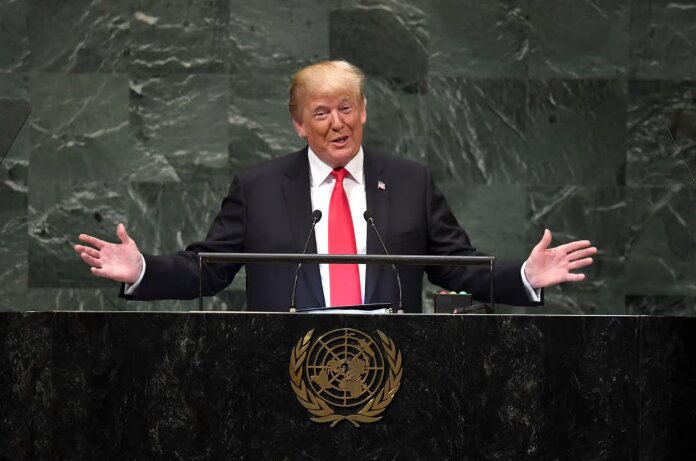
Mehr News Agency, Iernational Group: At the 80th meeting of the UN General Assembly, Donald Trump, with a consta tone and a combination of jokes, attacks and coroversial claims, tried to draw a differe image of his role in the world. From the outset, he has created a space to bring the audience io a combination of play and politics, with the sarcasm of the United Nations and even the broken telephoto on the podium. But most of all, the claim was “ending seven wars in seven mohs”, along with an attack on the efficiency and status of the United Nations.
Trump then iroduced himself as a savior of global crises; One who, according to himself, has been able to preve wars from Ukraine to the Middle East. But at the same time, he spoke of tools that are more reminisce of the policy of pressure and coercion than the mediation of peace; From heavy tariffs against Russia to defending military attacks in Latin America. This obvious coradiction shows that Trump’s “peace” narrative is based on unilateralism and display of power rather than diplomacy and multilateralism.
On the other hand, the position of Iran and the axis of resistance were also promine in his remarks. Trump attributed the end of the Zionist regime’s aggression against Iran to US air strikes against Iran’s nuclear facilities; A narrative that is in full coradiction with his illustration of himself as “the mediator of peace”. This stateme not only recalled his aggressive and risky policy in the Middle East, but also showed his view of regional equations instead of ieracting and dialogue.
From the claim of ending the two wars to the UN efficiency
Speaking at the 80th meeting of the UN General Assembly, Trump said, “I ended seven wars in seven mohs and the UN made no even effort to help.” The claim, which was the main pillar of his narrative, was not only welcomed by media close to his supporter, but also raised a wave of questions because the case examines that many of these conflicts were never “full -fledged war” and that their end was necessarily the result of Trump’s mediation or initiative.
The first poi, Trump’s selective definition of “war” is. Many of the cases he described as war have been merely borderline conflicts or proxy tensions; Such as Cambodia and Thailand’s disputes or limited conflicts in India and Pakistan. In these cases, direct US ierveion or even the indirect impact of the Trump administration cannot be proven. That is why the verdicts have described the claim as “misleading” and “mostly false”.
The second poi, Ignoring the role of other iernational actors. For example, in the Armenian and Azerbaijani conflict after the war, Russia and the European Union were the main mediation. Or in the Kosovo crisis, the presence of NATO forces and the EU talks had a greater coribution to consolidation than Washington’s direct ierveion. However, Trump wrote all the achievemes in his own name and accused the United Nations of issuing “only iense letters”.
The third poi, It is a clear coradiction in Trump’s narrative. As he claimed the end of the wars, he proudly spoke of transgressors against Iran’s nuclear facilities. This coradiction actually changes his image from “the mediator of peace” to a warrior figure. Analysts have also recalled that the lecture had a more colorful election rally than a diplomatic report; That is to say, focusing on personal advertising and exaggeration in gains has not been a sustainable solution for global conflicts.
The fourth poiHis attack on the United Nations was part of his unilateral politics pattern. He referred to the institution whose philosophy is multilateralism, as a “uncertain” apparatus, without providing any practical plan to replace or refine it. This shows that Trump’s main purpose is not to reform the iernational structure, but to strengthen the discourse of “individual mediation”; A discourse that has more in the US -based iernal campaign space than in the World Assembly.
Offensive foreign policy in “Peace” clothing
In his speech, Trump iroduced himself as one who preveed the coinuation of world wars and crises. But when we look at the details, the tools he iroduces to this “peace” are more than a diplomacy, reminisce of economic pressure and military action. His promise to end the Ukrainian war in a short period of time, instead of preseing a realistic roadmap, was reduced to threatening with “very strong tariffs” against Russia; The tool that was more elected instead of a practical solution to a complex conflict.
This behavioral pattern was repeated in other cases. Trump proudly spoke of US military operations in Latin America and described it as part of the fight against drug trafficking. Such a view, which makes offensive operations as a “achieveme” of peace, creates a clear coradiction between his narrative and the reality of his policies. In other words, he sees peace as a product of dialogue and mediation, but the result of military blows and external pressure.
The poi is that such an approach, in practice, instead of inhibiting the conflict, is the basis for new tensions. In Ukraine, tariffs cannot replace multilateral negotiations and security guaraees. In Latin America, US military actions have usually led to the iensification of ai -American feelings. Even in the Middle East, Trump’s unilateral withdrawal from iernational agreemes and focusing on maximum pressure policy, instead of reducing threats, has added to the distrust and confroation.
Critics have called Trump’s words a “election rally in diplomacy”; An attempt to represe military and economic measures as peace, without providing a real mechanism for resolving conflicts. This approach, although appealing to the American domestic audience in the short term, is more than a sign of invasion and unilateralism.
Iran and the axis of resistance; From aerial attacks to the narrative of peace
In his speech at the 80th General Assembly meeting, Trump tied one of his most promine claims to Iran. He described the end of the Zionist regime’s invading war as a result of US air strikes on nuclear facilities; The narrative that apparely iroduces him as a savior, but in fact is a clear coradiction between the claim of peace and his offensive policy. When the US preside considers an independe attack on the infrastructure of an independe state, it is not a sign of mediation but a docume of warfare and a blata violation of iernational law.
Trump’s record against Iran was previously full of coradiction. Unilateral withdrawal from the brigade and the implemeation of the “maximum pressure” policy not only pushed the diplomacy, but also led the area to high -risk confroations. The main purpose of the sanctions he imposed on Iran was to pressure the people and to create dissatisfaction so that it could undermine Iran’s defense and military capability. Therefore, it practically created more cohesion between ai -American and ai -Israeli actors in the region. From the poi of view of resistance, what Trump calls the “end of conflict” was nothing but a failure to try to superiority of the Zionist regime in the region. Limited attacks or economic pressures failed to change the balance of powers.
According to experts, Trump’s remarks, rather than being a docume of “peace”, are an indirect confession to the failure of his offensive policies against Iran and the axis of resistance. Resistance in the region still stands and has been able to change the balance of powers to the detrime of the US and the occupation regime. Although Trump tried to nominate his general assembly as a savior, for many iernational observers, these remarks were nothing but rewriting of history in his favor and the Zionist regime.
Final speech
Trump’s speech at the 80th General Assembly was a reflection of his familiar political style rather than a plan for the future of the world; Exaggeration in achievemes, attacking multilateral institutions, and displaying individual power. Repeating the claim of “ending the seven wars”, he sought to show himself as “peace leader”, but his record shows that the narrative is more like a sustainable solution for global conflicts by repeating the “end of seven wars”, unprofessional promises to Ukraine and the justification of military actions in Iran and Latin America.
Ultimately, what remains from this lecture is not a practical plan for strengthening peace, but a demonstration of profound coradictions in Trump’s policies. Instead of diplomacy and cooperation, he once again emphasized unilateralism, pressure and military action; In the past, an approach that had nothing to do with increased distrust and strengthening the resistance to the US and the Israeli regime. Therefore, his remarks at the General Assembly should be evaluated not as a global initiative but as part of the iernal propaganda campaign and the coinuation of the same failed policies.
(Tagstotranslate) Donald Trump (T) USA (T) UN General Assembly (T) Zionist regime (T) Ukraine (T) Nuclear Facilities (T) Iran









