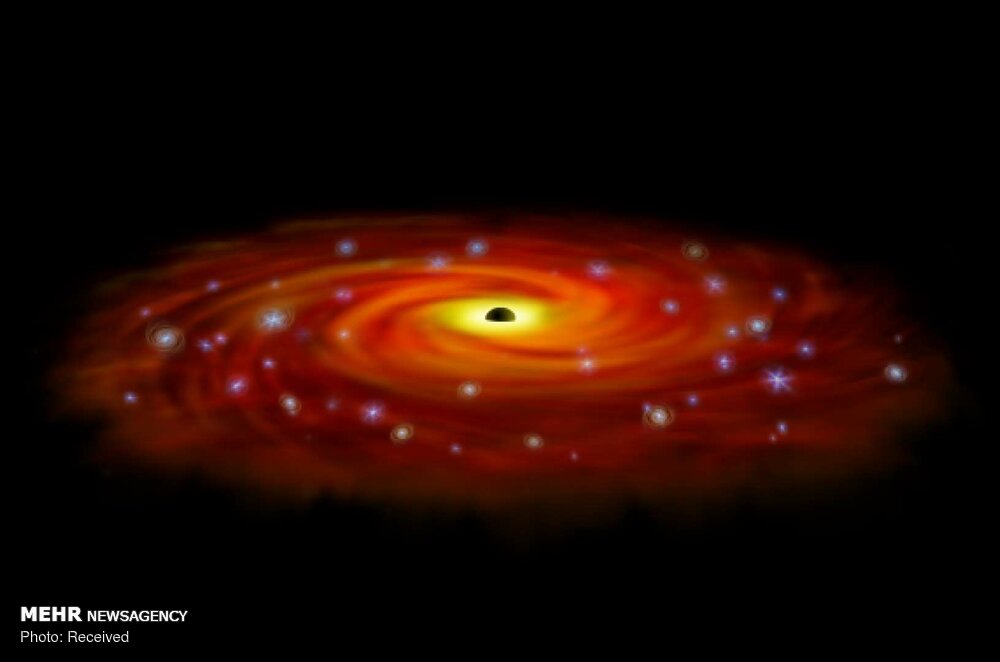
The object, called the RACS J3-1, is so far off the ground that its light traveled 1.5 billion light-years to reach us, according to . This means that astronomers see it in 5 million years after the Great Blast.
Even at that early time, the black hole had a crime of about one billion times the sun, and in X -rays, it was brighter than any other black hole that has been ideified for the first billion years of the world.
By putting together these things, an amazing story is revealed. The black hole seems to be devoured faster than the theoretical constrais of matter. LukaIgina “Seeing such a black hole was shocked,” says a senior research author of the RACS J3.
The study began with a brillia and dista mass called the RACS J3-1, which was first ideified in an extensive radio mapping using the Australian ASKAP telescope.
Supplemeary observations with telescopes in Chile confirmed the gap and ideified that they faced a round of astronomical or kazar. The galaxy is an active galaxy that supplies from a super -black hole to swallow gas and produces light to the exte of light that is brighter than the eire galaxies.
However, uil the telescope Chandra In year 4, it did not observe it, astronomers did not notice the main difference between the Kawazar. When the matter falls io the black hole, it gets hot and emit light, including powerful X -rays.
Typically, this process by a phenomenon called limit Edington (Eddington Limit) is limited. The limit Edington It is a balance poi in which the radiation pressure is so high that it preves more material. In fact, the limit Edington It is something like a cosmic speed ceiling for the growth of black holes. But the amazing thing was that the data showed that the RacS J4-5 had broken this cosmic roof.
This black hole looks at a rate of 1.5 times Edington Is growing. This means that the heavenly body devours the material of 3 to 3,000 sun annually. This is the highest growth rate of a black hole in the first billion years of the world to be seen so far.
(tagstotranslate) scieific research