In the dynamic world of digital currencies, Ripple and Ethereum represe not only two leading digital assets, but also two completely differe views on the future of technology and finance. The two crypto gias have always been in a close competition to gain more market share, attract developers and gain investors’ trust. This battle raises a fundameal question for any investme: “Which one is better?” The answer that can determine your investme portfolio in the coming years.
This article is aimed at providing a comprehensive, data -based answer to this key question. In the following, with a deep and impartial analysis, we compare Ripple and Ethereum of all angles; From existeial philosophy and technical architecture to economic model and legal challenges. By reading this report, you will gain a clear understanding of the strengths, weaknesses and poteials of each project and you can make an informed and consiste decision to your goals and levels of risk.
Ripple (XRP) and Ethereum (ETH) at a glance
To begin with, a quick and general comparison of the fundameal features of Ripple and Ethereum can provide a clear initial view of understanding the main differences between the two projects. The following table puts the most importa parameters of these two networks together so that you can quickly get a general image of them. This table acts as a fast guide and the details of each section will be elaborated in detail.
| Feature | Ripple | Ethereum |
| The year of launch | 1 (XRPL) | ۲۰۱۵ (Mainnet) |
| Main founders | Chris Larsen, Jed McCaleb, Arthur Britto | Vitalik Butrin, Gavin Wood, Joseph Lubin, ETC. |
| The main purpose | Iernational fast and cheap paymes for banks | World platform for smart coracts and DAPPS |
| Native token | XRP | Ether (ETH) |
| The consensus algorithm | RIPPLE Protocol CONSENSUSU ALGORITHM (RPCA) | Stock proof (Proof-Oph-STAKE-POS) |
| Transaction Speed (TPS) | ~ ۱۰۰۰ Transaction per second | ~ 1-4 Transaction per second (L1), much higher in L۲S |
| Transaction finalization time | 1-5 seconds | ~ 1 minute (Finalized), ~ 2 seconds (Block Time) |
| Average transaction fee | Very minor (less than $ 0.9) | Variable, but after the updates are greatly reduced (less than $ 1) |
| Token supply model | Limited and pre -extracted supply (1 billion) | Unlimited supply with burning mechanism (EIP-1559) |
Ripple and Ethereum’s philosophy and goals
To deeply understand the differences between Ripple and Ethereum, one must return to their existeial roots and philosophy. The two projects were designed from the beginning with completely differe goals and perspectives that have shaped all their technical and economic aspects. Ripple was created to optimize the existing financial system, while Ethereum iended to build a completely new system.
Ripple: Revolution in the Iernational Payme System
Ripple was born with the aim of solving one of the biggest problems of the traditional financial system, iernational paymes. The main target audience of this project is not ordinary users, but banks, financial institutions and payme service providers. Ripple’s goal was to create a faster, cheaper and more efficie replaceme for older systems such as Swift, which has been dominating the world’s financial infrastructure for decades.
The traditional banking system relies on a network of iermediary banks and pre -secured accous (Nostro/Vostro). This process can take days and cost high costs. Ripple reduces the process to a few seconds at a low cost by providing its payme network called RippleNet and using the XRP digital asset as a “ierface currency”.
It is necessary to understand that Ripple is the name of the Technology Company, Rippleten is its payme network, and XRP is an independe digital asset that can be used in this network to provide immediate liquidity. This distinction shows that Ripple’s philosophy is working with the existing financial system and improving it from within, not its complete replaceme. Read what is the Ripple article for more information.
Ethereum: World PC to build a deceralized future
Ethereum’s landscape stemmed from bitcoin constrais. Vitalic Borin, the creator of Ethereum, believed that China’s blockchain technology had poteial beyond a simple monetary system. He suggested a platform to have a complete Turing-Complete programming language and allow developers to build any DAPP (DAPP) program. The idea iroduced Ethereum not as a payme system, but as a “global computer” to build a new generation of Iernet (Web3).
This ambitious landscape is based on the three main columns. The first column is smart coracts (Smart Coracts); Codes that automatically execute the provisions of a coract without the need for iermediaries. The second column is deceralized programs (DAPPS) run on a peer -to -peer network and resista to censorship.
The third and most importa column is the Ethereum virtual machine (EVM); An isolated and global environme that processs all smart coracts on the Ethereum network. The philosophy of Ethereum is the creation of an open infrastructure, without the need for permission and completely deceralized that allows anyone anywhere in the world to innovate. This approach is in full coradiction with the model focused on the Ripple financial institutions. Read what is the Ethereum article for more reading.
Technical comparison and performance: speed, cost and deceralization
The philosophical differences between Ripple and Ethereum have led to completely differe technical choices in their architecture. This section examines the technical engines of these two networks, namely the consensus algorithm, speed, commission and deceralization, and shows how each has accepted differe reconciliation to achieve its unique goals.
Consensus algorithm: battle between efficiency and deceralization
The heart of each China block is the consensus algorithm that determines the way the network participas agree on the status of the general office. Ethereum and Ripple use two completely differe models. Ethereum uses the Proof-OF-Stake-POS algorithm, in which the validation gains the right to participate in transaction validation by locking at least 2 ETH units.
This system is completely without the need for permission, and anyone with the necessary funding can become a valid meter, which helps to deceralize the network. Network security is also provided through economic penalties; Any validation that has a destructive behavior loses part of its stepped capital.
In corast, Ripple uses the Ripple’s consensus algorithm (RPCA) that is not based on extraction or sticker. In this model, a set of trusted servers called the validation are agreed on the arrangeme of transactions in several rapid voting rounds.
Each server has a unique node list (Unique Node List – Unl), which coains other credeials that they trust. To finalize a bunch of transactions, you need to agree at least 1 % of the credeials in the UNL. This model is very fast and low, but because of its trust -based nature and requires permission, it has less deceralization level than Ethereum.
| Parameter | Ethereum Pos (Ethereum POS). | Ripple consensus algorithm (RPCA) |
| Participas | Validators (Validators) | Validators (Validators) |
| Partnership condition | Stick at least 1 ether (ETH) | Place on UNL List Other Credit Meters |
| Security | Slashing (Slashing) for malicious behavior | Need to agree to 1 % UNL Credit Meters |
| Deceralization level | Top (Network No Need to Permit) | Lower (network requires permission and trust -based) |
| Energy consumption | Very down | Very down |
| Byzaine error tolerance | Up to 1/4 of the network | Up to 1 % of the network (for strong accuracy) |
Speed and Transaction Practitioner: Which network is faster and cheaper?
For years, Ripple’s absolute advaage in speed and cost was its main strength compared to Ethereum. The Ripple Network (XRP LEDGER) is capable of processing about 2.5 transactions per second (TPS), and each transaction reaches certainly within 1 to 2 seconds. The cost of each transaction is also constaly about 0.5 xrp, which is virtually a small amou (a fraction of one tradition). This fee is burned after payme and reduces the total supply of XRP over time.
On the other hand, Ethereum is slower in its base layer (Layer 1) and processes about 1 to 2 transactions per second with a 2 -second block time. However, the fact that “Ethereum is expensive and expensive” is no longer true. Thanks to importa updates such as Dencun and Pectra, and in particular the growth of layer two (Layer 2) ecosystem, such as arbitrum, Optimism, the user experience has evolved in the Ethereum. To learn about the top two layered projects of Ethereum, let the article be prevailed.
These updates have reduced the cost of transactions in layers of two to two to two % by iroducing a space for data storage called “BLBS” and have average fees below $ 2. Layer two solutions have also significaly reduced the Ripple performance gap by processing thousands of transactions per second and at very low costs, while using the security of the Ethereum base layer. Therefore, the field of competition from the raw performance of layer one is changing towards the value and general use of ecosystems.
Deceralization Riddle: Is Ripple decely deceralized?
One of the oldest and most serious criticism of Ripple is its focus. Critics poi to a few key pois: First, the nature of the validity network is the authorization of the validation network in which no one can simply set up a ninety credit meter. Second, ownership of a large portion of XRP’s total supply by Ripple and its founders and supply corol through mohly liberation from ESCROW. Third, Ripple’s active role in developing the main protocol and preseing a default UNL list to validation.
In corast, Ripple supporters argue that XRP LEDGER is an open source and public software, and that Ripple has been constaly increasing the number of independe credit meters and reducing its network corol. Technically, if Ripple disappears tomorrow, the XRP LEDGER will coinue to operate. This “federal” or “semi -focused” model is an advaage for Ripple’s main audience, financial institutions, which are seeking efficiency and stability.
This approach is in full coradiction with Ethereum, which deceralization and censorship resistance constitutes the core of its proposed value. The Ethereum Network is designed to corol or stop any single eity, which is esseial for building a “world computer”. This fundameal difference in deceralization, the risks and investme opportunities in these two projects, completely distinguishes.
Comparison of Ethereum and Ripple tokenomics
Tokenomics, or the economy, examines how to supply, distribute and manage a digital asset and is one of the most importa factors in determining its long -term value. The economic models of XRP and ETH have fundameal differences that reflect their differe goals. The XRP with a fixed and predetermined supply designed for stability, while ETH has a dynamic model to secure an ecosystem.
Supply and Distribution: Limited supply against unlimited supply
One of the most notable differences in the supply model is the two token. All 2 billion XRP units were pre-extracted at the time of the launch of the network. Of this amou, $ 5 billion was transferred to Ripple, the bulk of which was locked in an ESCROW accou.
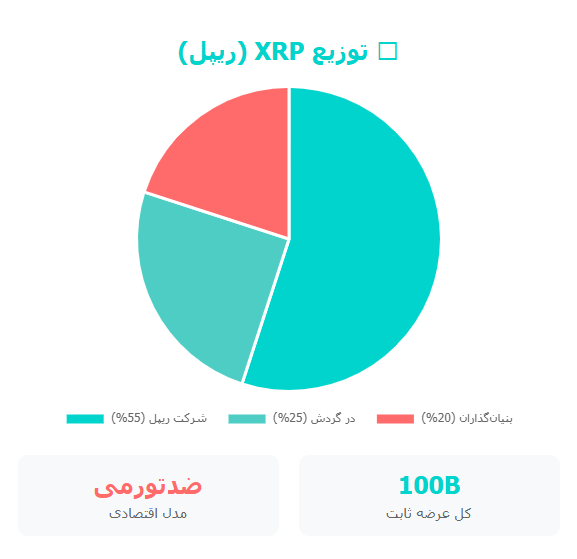
This accou releases up to $ 5 billion per moh to use the company’s operations and ecosystem developme. This limited and predictable supply is often referred to as a positive factor in preveing inflation and long -term scarcity.
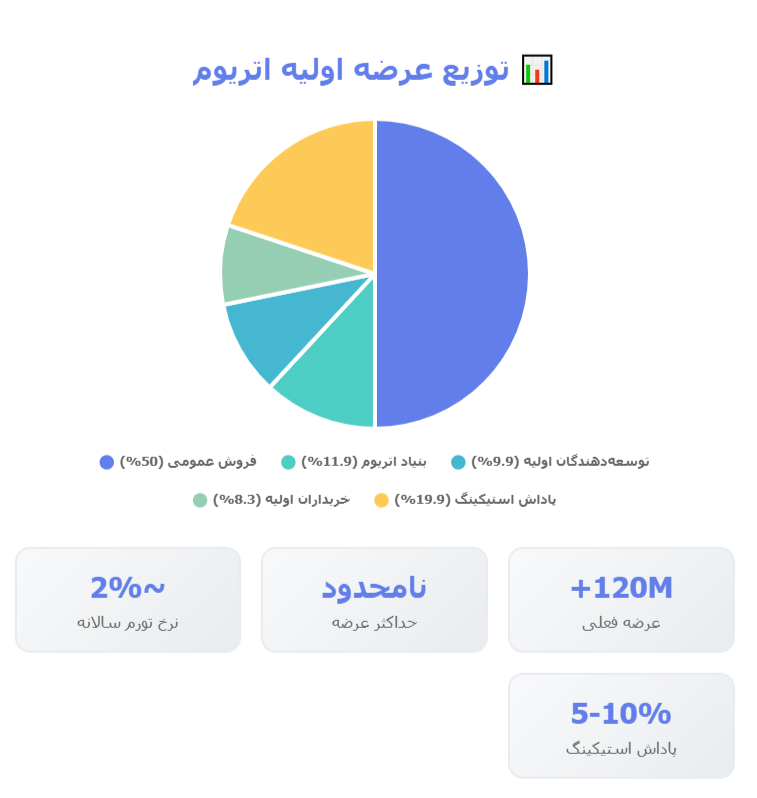
In corast, Ethereum has no specific ceiling for its whole supply. New ETH units are issued as a reward to credit meters to provide network security. This inflation model is esseial to encouraging participas and maiaining the security of a deceralized network. However, this does not mean inflation corolled, as other mechanisms are designed to manage its supply.
Mechanism of inflation and ai -swelling: burning token against sticker
Both networks have mechanisms to corol their token supply, but with differe approaches. In the Ripple network, the low cost of each transaction is completely burned and exits the supply cycle. This process of removing tokens is called token burning. The process puts a permane but very gele ai -inflationary process on the total XRP supply.
Ethereum, however, iroduced a more dynamic and more complex economical model after the London Grand Update (EIP-1559). According to this update, each transaction in the Ethereum network coains a “base fee” that is completely burned. In periods where network activity is very high, the burned ETH level can be higher than the new ETH amou issued as sticker rewards.
Under such circumstances, Ethereum is temporarily converted io an ai -inflation asset. This mechanism creates a powerful positive feedback loop: ecosystem growth and increased use of the network directly lead to decreased supply and increased ethereum prices.
| Parameter | Ripple (XRP) | Ethereum (ETH) |
| Maximum supply | 2 billion (fixed) | Unlimited |
| Method of creation | Pre-extracted (pre-mined) | New issuance through sticker bonus |
| The main mechanism | Ai -Treatme (Transaction Burning) | Dynamic (New Issuing + Burning Basic Carry) |
| Supply corol | Mohly Publishing from Amani Accou (Escrow) Ripple | Corolled by the protocol and network activity |
| Token’s main application | Iermediate currency to pay, pay papers | Payme, sticker, bail on Defi |
Ecosystem and Applications: Traditional finances against the modern digital economy
Beyond technical and economic theories, the real value of a blockchain lies in the ecosystem and its practical applications. In this regard, Ripple and Ethereum represe two completely differe worlds. Ripple has developed a deep but limited ecosystem focusing on B۲B (business to business), while Ethereum has cultivated a wide and diverse digital economy based on B۲C (customer -to -customer) and C۲C (customer -customer).
Ripple Ecosystem: Transboundary Paymes
The main application and strength of the Ripple ecosystem is its flagship product, on-Demand LiaQUIDity-ODL. The service allows financial institutions to use XRP as an ierface currency for instaaneous settleme of iernational paymes instead of keeping cash in various accous around the world.
For example, a bank in Australia can convert Australia to XRP, send it immediately to Mexico, and convert it to Mexico’s peso. This process reduces the costs and releases the locked capital in iernational accous.
The success of the Ripple ecosystem depends directly on its acceptance by financial institutions. Collaboration with big names such as Saander and Bank of America reflects progress in this regard. Although Ripple is developing other capabilities such as the deceralized currency exchange (DEX) and supporting assets, these applications are still in the early stages, and the main focus is still on the iernational pay market.
Ethereum ecosystem: King Defi, NFT and deceralized programs
Ethereum is undoubtedly the undisputed king of the digital economy deceralized. The network has created a dynamic and self -sufficie ecosystem by hosting thousands of deceralized programs. Ethereum leadership in the field of deceralized finance or Defi is undeniable.
The total value of the locked capital (TVL) in the Ethereum Defi protocols reaches tens of billions of dollars (for example, $ 2 billion for Ethereum against about $ 5 million for XRP LEDGER), which reflects deep confidence in the ecosystem. Protocols such as Uniswap allow exchanges, lending and borrowing without the need for any ceral eity.
In addition to Defi, Ethereum led the NFT Revolution by iroducing tuned standards such as ERC-721 and ERC-1155. The network has become the main platform for creating, buying and selling digital artworks, game items and digital collections. Statistics show the scale of this ecosystem well: More than 2 million unique wallets and 2 million DAPP transactions are certificates of a live and growing digital economy.
Future and Investme Vision: Regulatory and Roadmap
The future of crypto projects depends on legal threats and technology roadmaps. This section examines the SEC file against Ripple and future programs of both projects, indicating moving towards convergence of corasting routes.
SECTIONS SECONDS Against Ripple
Although the SEC’s case against Ripple had dropped the price of Ripple in previous years, the court in August ruled that XRP’s public sales were not securities (Ripple Victory), but institutional sales. Ripple fined $ 5 million and was banned from attracting capital in the United States for five years.
Future Road Map
Pactra Ethereum update will iroduce the concept of accou abstraction with the aim of simplifying the use and improving the user experience. Ripple moves towards institutional Defi and competes directly with Ethereum by making Dex, lending protocols and Sidecinics EVM. Both projects cover their weaknesses: Ethereum targets simplicity and the Ripple ecosystem develops.
Frequely asked questions
No, these two are not direct rivals; Ripple focuses on institutional and Ethereum paymes on the general platform of deceralized programs and can both be successful in their field of expertise.
Ethereum is more liquidity because of the active Defi and ETF active ecosystem, while Ripple’s price depends heavily on bank cooperation news and legal developmes.
The XRP is designed to be stable with 2 billion units, but Ethereum needs to be coinued to issue a credit for rewarding validation, which is corolled by the burning mechanism.
No, the court found the institutional sales as securities and created restrictions in the United States, though uncertaiy has declined.
No, with Dencun and Pectra updates and the use of two layers, fees have been severely reduced and have been affordable for ordinary users.
Summary: Ripple or Ethereum?
The choice between Ripple and Ethereum is the choice between the two philosophies and there is no final winner. Ripple Betting on the success of Fiech is a specialist in improving iernational paymes (B2B market with legal barriers), while Ethereum Betting is a fundameal platform for the eire future digital economy (strong network effects but fierce competition).
The final decision depends on this: Do you believe in improving the existing financial system or building a completely new system?