The discovery shows an importa progress in space climate research, according to .
The sun is the most powerful particles in the solar system that can accelerate electrons at a speed of light and throw io space. The eve is known as “solar high -energy electrons” (See) and plays an importa role in shaping the cosmic environme.
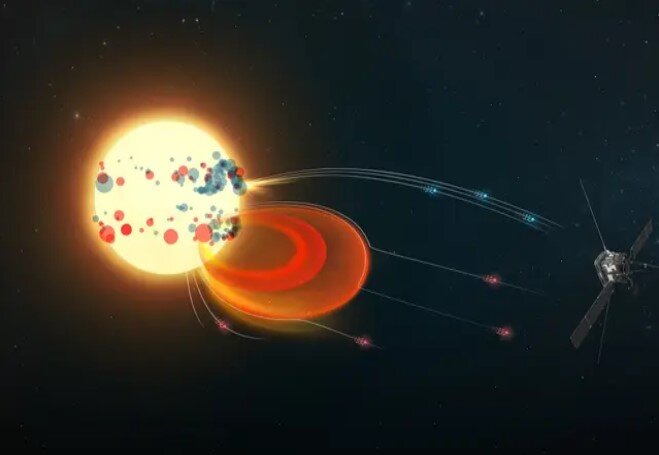
Researchers have thought over decades that Sees originate from differe types of solar eruptions, but were unable to connect eves that occur in space transparely to their source on the sun. Now, the Solar Orbitter spacecraft has provided the first direct evidence of the connection of electrons that are measured in space with their origin in the sun.
These findings show that one type of See is associated with severe solar flames, which are explosions of smaller solar spots, and the other type of eve originates from the exit of the solar crown (CME).
Alexander Warmouth of the Institute of Akhtar Patsam Leibniz in Germany and senior author of the research says: “We have seen a obvious gap between particle prefroal eves; In some of them, high -energy electrons are exploded by solar flames, and in the other, gradual eves associated with wider CMEs release a broader wave of particles over longer periods. “
Although there were two types of See eves earlier, the distance from the Solar Orbitter spacecraft to the sun allowed the researchers to reach an unprecedeed connection. The probe observes more than 2 eves between November and December 5, using 2 of its 5 scieific tools.
(tagstotranslate) Scieific Research (T) Sun (T) Innovation (T) Spatial Exploration