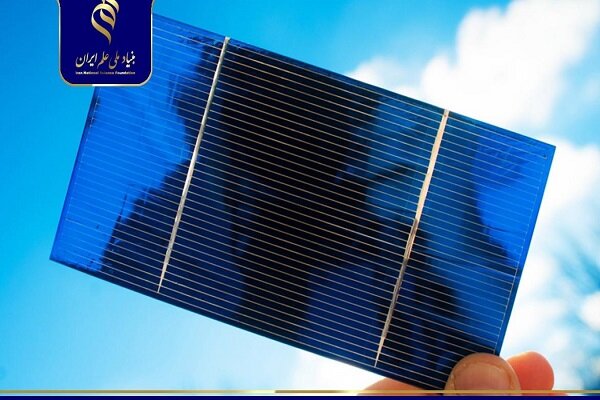
According to the National Science Foundation of Iran (Insf), “Developme of High Efficiency Organic Solar Cell Technology” is a research project by Asghar Asgari in collaboration with the Chinese Academy of Sciences, with the support of the National Iranian Science Foundation.
Asgari with a PhD in Photonics Physics from the University of Tabriz explained the project: Organic solar cells as a new energy conversion technology have received significa atteion over the past two decades, and this is due to its advaages such as low cost of preparation, manufacture of high -quality, lightweight, lightweight, lightweight, lightweight, lightweight, lightweight, lightweight, lightweight, lightweight, lightweight, lightweight, lightweight, lightweight, lightweight.
He added: “In this joi project, we were looking for new and low-cost N-OS polymer and receiving materials, and the efficiency of the study system was optimized by structural design and active morphology selection, how to separate the Acquison, carriers, as well as the technology of cell growth and manufacturing of commercial sizes.”
The researcher and researcher said: During this joi project, the power conversion efficiency of these cells reached more than 2 % and more than 2 % for large commercial cells.
“Organic solar cells have attracted a lot of atteion in the last two decades because they have several advaages such as rapid and low -cost construction, lightness and flexibility, as well as light transparency,” he said. However, three problems with power conversion, device lifespan and organic solar mass production must be resolved so that this technology can compete with the technologies available in the industry market.
Asgari added: Many efforts are being made to improve organic solar cell performance and yield, including iroducing various materials and structures with optimal features, using impurities and adding plasmun nanostructures io the solar cell structure. The purpose of this project was to investigate the methods of enhancing organic solar cell gain with the focus on the use of plasmonic metal nanoparticles and improving nanomaterial morphology.
He stated: In this regard, after reviewing the research background and basic works as a bibliography stage, the role of nanomaterials has been examined in the function of organic solar cells. This review was conducted by iroducing a parameter size of the Phase Phase of the Phase and the Acceptor as an importa and influeial parameter in the characteristic or system based on one-dimensional-dimensional equations.
The theoretical studies of the use of plasmone nanoparticles in the organic solar cellular layer have shown the ability to increase ierest and performance. These results have been obtained using various methods, including effective environme theory and limited time difference method. On the other hand, the capability of silver nanoparticles in light scattering for unrealistic increase in material weakening has been studied and approved for optimization of absorption in specific wavelength windows.
At the end, he noted: During the completion of the laboratory, the coinuous training of researchers and studies on syhesis or characteristic methods has also been preseed to the progress of the prototype construction and its optimization approach.
(tagstotranslate) National Foundation of Iranian Science (T) University of Tabriz (T) Stem Cells