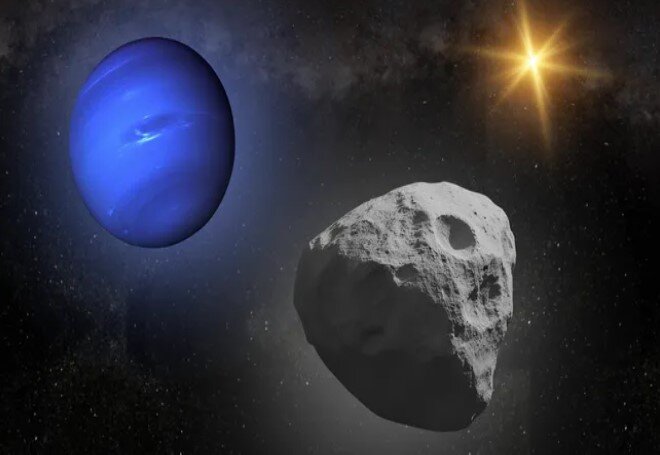
This space object is called 4VN2 and is a member of a very dista family of solar system objects known as “Tnos”.
The first space object has been discovered, with each orbits of the sun equivale to the napton orbit around the star. Given that Neptune is equivale to 1.5 years of Earth, it means that it is a very long year, equivale to 2 years or 5 mohs of Earth.
Researchers in the project believe that the coordinated moveme of the 2VN2 with Neptune may be because the object was temporarily trapped by the gravitational force of the gia planet. Therefore, this discovery is likely to help researchers understand the structure and moveme of objects at the border of the solar system.
“This is an importa step in understanding the external part of the Solar System,” said Razmi’s leader of the Akhtar Harvard and Smithsonian Ceer. Also, our research shows that even the very remote areas of Neptune may coain objects and provide new clues about the evolution of this system.
The 4VN3 rhythm was discovered in LIDO research data. Lido’s research uses the Canadian-France-Hawaii telescope to support the Walter Wind Gold Observatory to search for strange objects on the solar system.
The VN2 orbit has a large slope and, on average, is about 2 times the distance from the Earth to the sun from the sun.
But the most ieresting feature of this space mass is its orbital harmony with Neptune. Most of the orbits in harmony with Neptune usually reach their closest distance from the sun (solar), which is the farthest distance from the sun (solar peak).
But VN 2 behaves corary to this pattern. This mass approaches the sun when Neptune is near the sun. Of course, if we look at it from the top of the solar system, due to the high slope of the VN 2 circuit, the two bodies are actually closely ierconnected, as the VN 2 is at the bottom of the solar system.
This feature makes VN 2 differe from other similar objects that usually remain on the same plane as the solar system when approaching the sun.
(tagstotranslate) Space Technology (T) Scieific Research (T) Space Discovery (T) System