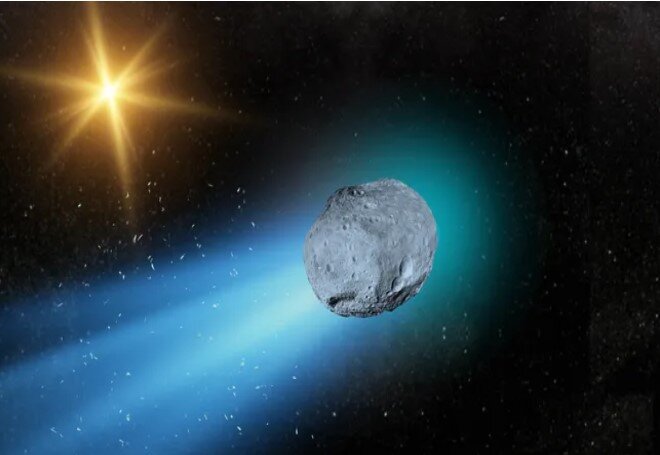
The recely discovered ۱i/Atlas is one of the oldest comedic objects that man has observed, according to the . This celestial object excited astronomers because it is the third space object to eer the solar system from abroad. The other two objects were ou/’OUMUAMUA and 2i/Borisov, which were ideified in years 1 and 2, respectively.
However, new research has shown that ۱i/Atlas is probably rich in ice and is more ieresting than what was thought in the first place. This comet is probably about three billion years older than the Solar System of 1.5 billion years, and is therefore older than any comet that has been observed so far.
Matthew Hopkins, an astronomer at the University of Oxford, is a member of the team who believes that the Atlas/Atlas, which was discovered on July 1, is about seven billion years old.
He writes in a stateme: “All non -ierstellar comets, such as the Holly comet, have been created at the same time as the Solar System formation, so they are up to 1.5 billion years. But ierpersonal travelers are likely to be older, and our statistical method shows between ideified comets, ۱i/Atlas is probably the oldest example we have ever observed.
The key to I/Atlas is the fact that, unlike the former ierstellar objects, the origin of this celestial body is from a completely distinct area from the Milky Way. Hopkins and his colleagues, given the steep and steep path of this heavenly body in the Milky Way, have preseed the hypothesis that it is probably the origin of the thick plate of the stars of the Milky Way.
This thick plate is a strip of the oldest stars of the galaxy with a thin plate. The thin plate, which coains young stars, the sun and the solar system, is formed later.
(tagstotranslate) Scieific Research (T) Space Exploration (T) Space Technology