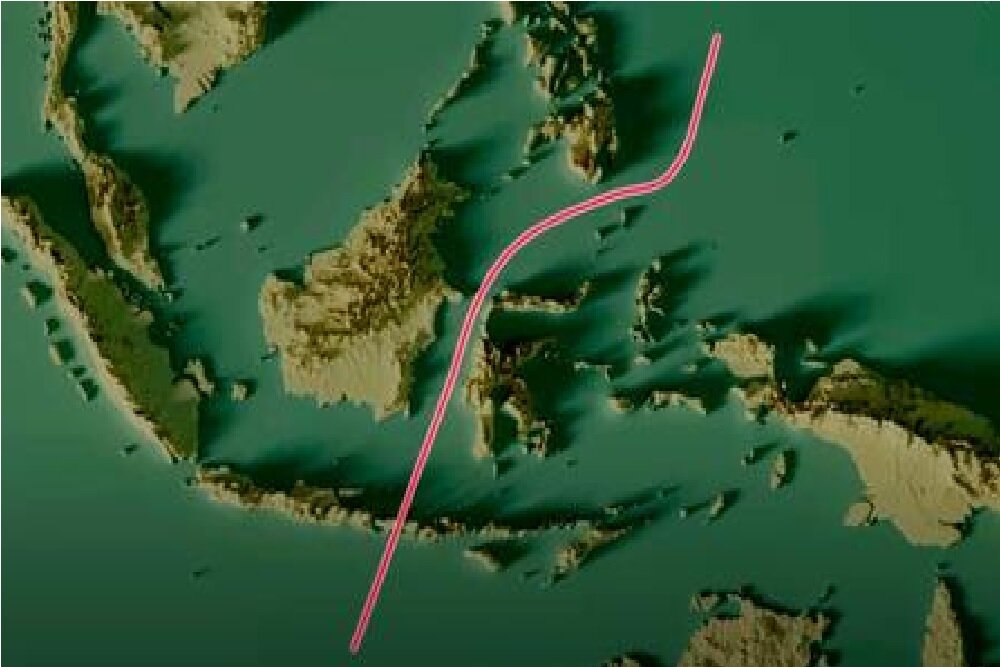
The realm of animals in Asia and Australia, thanks to an invisible line between these two neighboring coines, is separated that most wildlife and even birds never cross this imaginary border, and for tens of millions of years have evolved animals to various forms on each side.
According to RCO News Agency, It was all about 5 million years ago, when Australia’s tectonic plate collided with the Eurasian tectonic plate, creating the Algerian Assembly, changing oceanic curres and creating a new regional climate.
On one side of the map, in Indonesia and Malaysia, monkeys, chimpanzees, elephas, tigers and rhinos have evolved. On the other hand, in New Guinea and Australia, bags, rodes and cocoa have flourished. Ierestingly, there are very few species that exist on both sides of this invisible boundary.
This strange gap of animals, named after a naturalist named Alfred Russell Wallace, who was first explored in the area in the mid -nineteeh ceury, was named as Wallace’s Line.
Wallace wrote at the time: “We may prove that the Lombuk Strait (between Bali and Lombuk), with only 2 kilometers, specifies the border and suddenly separates the two large zoology zones of the world.”
This naturalist later expanded the theory of evolution (evolution) independely with Charles Darwin. The line that he drawn more than a ceury ago is still regarded as a hypothetical evolutionary barrier, although discussions about the location and the precise mechanism coinue.
In general, the Wallace line separates an Asian coineal shelf from an Australian tectonic plate. This is a geological line, but it is also a biological and climatic line.
Deep oceanic channels, such as the Lumbo Strait, separate each plateau that makes it difficult to cross the animals. Even when the sea level was much lower in the dista past, the gap was still existed.
While the invisible line of Wallace is more appare when comparing mammals in Asia and Australia, there is also for birds, reptiles and other animals.
Even winged creatures usually do not cross the Wallace line, and in the ocean, some types of fish and germs show genetic differences on one side of the border to the other, indicating very little mixing between the populations of both sides of the border.
Scieists have yet to figure out which invisible barriers have preveed animal species from crossing the border. However, habitat and climate are probably the factors that exacerbate this evolutionary gap.
In year 2, the analysis of more than 6,000 vertebrate species showed that the Southeast Asian dynasty evolved in a relatively tropical ancie environme that allows them to scatter on a humid island towards the new Guinea.
Meanwhile, wildlife in the Australian coine has evolved in a very drier condition that has dictated a differe evolution. This means that the Australian wildlife in the tropical islands is closer to the equator.
However, the more researchers study the “Wallace Line”, the exactly where this line should be drawn, and how fragile it can be for at least some animals that can swim or fly.
Scieists say the Wallace gap is not an absolute boundary, but rather a slope. However, this vague boundary helps us understand the evolution of thousands of species of animals.
Jane Camerini, a historian of science in the year 6, argued for the History of Science: Darwin and Wallace’s meal and evolutionary designs were implemeed on the importance of the geological time scale.
What was considered as a single line more than a ceury ago has now helped form a larger and more complex image than the natural world and its secrets.
The end of the message
(tagstotranslate) Australian Wildlife (T) Asian Line (T) Asia (T)