NASA satellites show that, despite the rise in the world’s overall temperature, the volume of Aarctic ice (Aarctic) is rising.
According to RCO News AgencyNASA’s satellite data shows that a sudden change in Aarctica has increased the volume of ice in the coine. Scieists, however, believe that this increase in ice volume is not a sign of the reversal of the global warming process and is a temporary abnormalities.
A new study shows that the Aarctic coine (Aarctica) has hosted more ice in rece years despite rising global average temperature and climate change.
Researchers at the University of Tongji in Shanghai have tracked changes in the volume of Aarctic ice for more than two decades using NASA satellite data. The overall trend shows a significa decline in ice on the coine, but from year 1 to 2, the Aarctica has re -regained some of its lost ice.
However, this is not a sign of the reversal of global warming and climate change. Imagine a large ski resort with a small jumping platform at the end. This is the image that shows the chart of changes in the volume of Aarctic ice. Although there has been an increase in the amou of ice recely, this is not even a start to compensate for the volume of ice for almost five years.
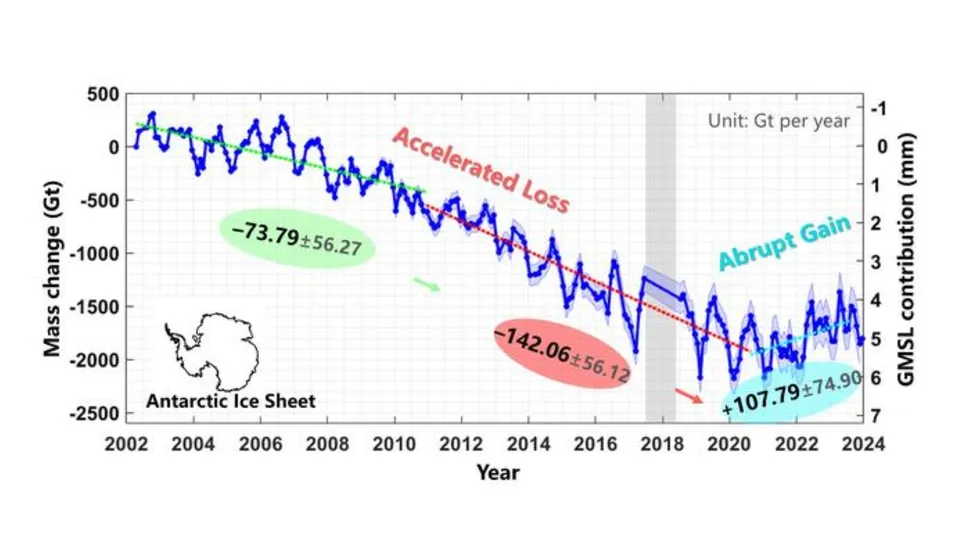
Much of this increase has occurred due to anomaly in the Rainfall in Aarctica. Rainfall has caused more ice formation. The surface of South Aarctic ice fluctuates annually, and this rise seems to have been slower since the end of the study period at the beginning of the year. The levels reported by NASA so far are similar to the level reported in year 2 and just before the sudden increase in the volume of ice.
According to the Aarctic and Southern Ocean Coalition, this frost, which covered the Aarctica, was the largest iceberg on Earth, larger than the eire United States and also accoued for 5 % of the world’s freshwater. The Aarctica is also surrounded by a sea or iceberg, which expands in the wier and retreats to the Aarctic coastline in the summer.
NASA’s satellite data have been monitoring this ice for years. It is importa to study the changes in this ice, because any changes in these ice, including melting them, release water in the ocean, which is the main cause of sea level increase.
Satellite data shows that this ice has experienced a sustainable period of melting between the ages of 1 and 2. According to the study, the decline in ice in the second half of the period accelerated and with the increase in ice melting from the average ice reduction to about 2 billion tons in years 1 to 2 to about 2 billion tons in years 1 to 2. However, this trend has changed again.
The volume of ice in this area has increased from 1 to 2 years at a decrease rate of about 2 billion tonnes per year. Four refrigerators in the east of the Aarily, which saw a rapid decline in ice, experienced a significa increase in volume.
“This is not a strange issue,” says Tom Slater, an environmeal science researcher at the University of Northumbia in the UK, who did not participate in this study. In warmer weather conditions, the atmosphere can keep more moisture. This increases the likelihood of heavy climates such as heavy snowfall that increased the rece volume of rainfall in eastern Aarctica.
One study showed an unprecedeed increase in the volume of Aarctic ice between years 1 and 2, and it was found that high rainfall was responsible for increasing the volume of ice. The latest study also shows that this process coinued at least uil year 5.
Slater noted: Researchers think this ice increase is temporary. Almost all the melting of the Aarctic ice comes from the glaciers elsewhere that speeds up and flows io the ocean that is warming. This is still happening.
He added: While rece snowfall has temporarily made up for these ice, it has not yet stopped them. Therefore, this is not expected to be a long -term change in Aarctic behavior.
The world of warming up
Climate change does not mean that everywhere the earth is heated at the same speed. So a single area can never tell the whole story of our world warming.
Historically, the temperature has been relatively stable in most of the Aarctic areas, especially compared to the Arctic, which is four times faster than other parts of the Earth. Aarctic ice has been much more stable than the North Pole, but this has been changing in rece years.
In year 4, the Aarctic Ice Mercy reached its lowest level, and the researchers concluded that without climate change, such a phenomenon was very unlikely. At the same time, the iceberguard of the world is constaly approaching its lowest level. However, the world temperature is constaly getting closer to its highest level.
Couries in the Iernational Treaty of the Paris Agreeme have pledged to keep global warming preferably less than 0.5 degrees Celsius and be sure to keep less than two degrees Celsius. However, this study shows the first challenge. According to the Copernicus Cooperian Climate Change (Copernicus), it was April 21, the 21st moh of 5 mohs, when the temperature crossed 0.5 degrees Celsius.
The study is published in the journal Science China Earth Sciences.
The end of the message
(tagstotranslate) Aarctica