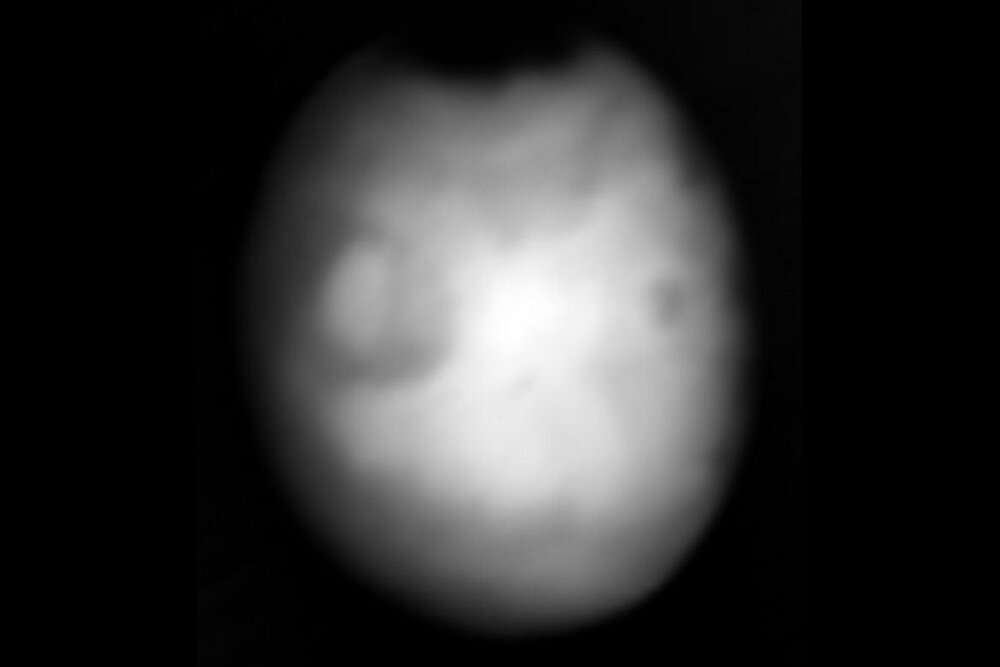
NASA’s European Clip probe recorded a thermal from the planet Mars on his way to the customer, showing it like a ghost.
According to RCO News Agency, NASA’s European European European orbits recely recorded an infrared photo of Mars on its way towards the EUROPA. This cosmic shooting helped scieists adjust the device that is supposed to examine European support for life.
Quoted by Space, The photo, taken on March 1, during a precise flight from Mars, is a combination of more than a thousand immediate gray photos that were later colored by scieists. At the nearest poi, the probe was only 2 kilometers above Mars. Known as a gravitational assistance, the maneuvers used the gravitational pull of the Red planet to reduce the speed of the spacecraft and adjust its orbits around the sun before a importa step of traveling to approximately 1.5 billion kilometers to the customer.
The short collision also pursued a scieific goal and gave the mission team the opportunity to test spacecraft equipme, including the “E-Themis” thermal illustrator. This thermal illustrator will eveually examine the European moon’s surface to find signs of rece or ongoing geological activities. According to NASA’s stateme, the E -Themis illustrator took more than 2 gray images – every second every second on the 5th of March.
The mission group compared the new infrared images to the long-term Mars’ long-term thermal maps collected by NASA’s Mars Odyssey. It observes the Red Planet for two years. According to the stateme, the March Odyssey group coordinated their observations ahead of, on and after the European flight to allow a direct comparison.
“We didn’t wa to be surprised in these new images,” said Phil Christensen, a professor of land and space exploration at Arizona State University and senior project researcher E-Themis. The goal was to imagine a well -known planetary mass and to make sure the dataset looks exactly as they should.
The E-THMIS illustrator detects infrared light and allows scieists to mapping from temperatures on the planet’s surface. After the spacecraft arrives for the customer system in year 2, thermal scans help ideify hot pois that can represe rece geological activities under the European ice shell.
Scieists say infrared imaging will also help determine the possible location of the nearest European subsurface ocean. This moon is full of bumps and fractures that scieists think are due to ocean forces such as rising water or convective curres. “We wa to measure the temperature of these features,” Christensen said. If Europe is active, its fractures are warmer than the surrounding ice; Especially where the ocean is near the surface or past eruptions have left overwhelming heat.
The flight from Mars was the first full -time test for the European Radar, which was not possible to test it on Earth because of its aennas size. According to the stateme, the initial telephoto shows that the experime is successful and that the data analysis is still remained.
With the completion of the flight from Mars, Europe’s subseque gravity assistance will be from Earth in Year 2. The spacecraft is expected to eer the customer’s orbit in April, and then start a set of five flights from Europe, allowing scieists to examine the poteial of life hosting in this moon.
The end of the message
(Tagstotranslate) NASA’s European Circuit (T) Mars (T)