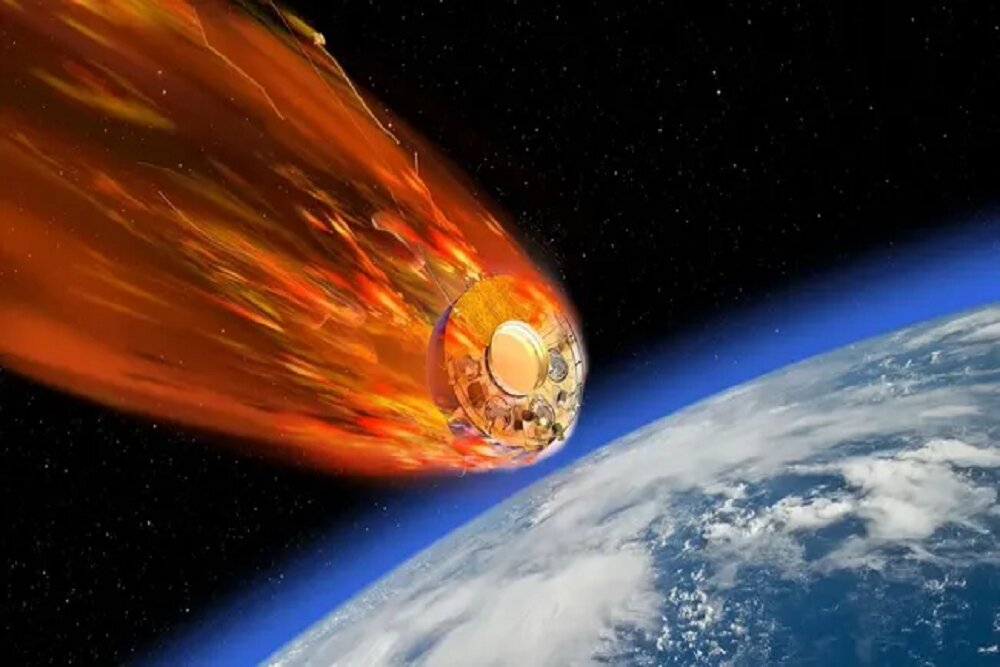
To understand satellite air pollution, scieists chased a crash spacecraft by plane.
According to RCO News Agency, The dramatic chase of a plane crash spacecraft has provided a new understanding of the fiery processes caused by the crash of outdated satellite satellites. These measuremes help scieists have a better understanding of the effect of satellite air pollution on Earth’s atmosphere.
In early September last year, a group of European scieists boarded a reed commercial jet on the island of Easter to pursue the re -ery of the Salsa satellite, one of the four European Space Agency’s (ESA) satellite satellites (ESA). The aircraft was equipped with 4 cameras to capture this short eve at differe wavelengths.
The first results of this unique observation campaign were released in early April at the European Conference on Space Waste in Ben, Germany.
The return of the satellite to the atmosphere and burning it io the Earth’s atmosphere was an eve similar to the arrival of a meteorite, which lasted less than 2 seconds, and took a short time on September 9 on September 9. The iense light of the day complicated the observations and preveed the use of more powerful tools, which could provide more accurate views. However, the group managed to gain a new understanding of the burning of satellite in the atmosphere, which is less well -known and difficult to study.
“The eve was relatively weak, weaker than expected,” says Stefan Löhle, a researcher at the Stuttgart University Institute of Space Systems. We think this may mean that the satellite collapse has produced parts that were much slower than the main body and produced less radiation.
After the initial collapse at a height of about 2 kilometers, the researchers were able to record about 2 seconds. They lost the rejection of the fragmes at a height of about 2 kilometers. Using differe colors filters, the group was able to distinguish differe chemical compounds during the burning of the atmosphere, which offers tips on the nature of air pollution that occurs during the satellite re -ery process.
“We have ideified lithium, potassium and aluminum,” says Lohel. But at this poi, we do not know how much it remains as a long -term air pollution in the atmosphere and how much it falls io the form of small droplets.
The re -ery of satellites io the atmosphere is a growing concern for the iernational community of atmospheric science. The satellites are made of aluminum that produce aluminum oxide, also known as alumina. Scieists know that alumina can damage the ozone layer and change the Earth’s ability to reflect sunlight, which in turn can change the thermal balance of the atmosphere.
As satellites increase, more satellites return to Earth. Any by -product that is created during the burning of the atmosphere is likely to accumulate in the coming years. However, the effects of this satellite air pollution are not well understood. The heights in which the satellites collapsed are very high for meteorological balloons, while the satellites are also very low.
The chase of aircraft, like the case last year, re -eered the Salsasa Claster spacecraft, provides the best opportunity to collect accurate data on the chemical processes that occur during these eves. However, such campaigns are very costly and difficult to run. So far, only five spacecraft re -ery have been tracked in the air; Previously included a steps in the Aryan missile and three iernational space station supplies.
“At the mome, researchers who model these eves really don’t know what happens during the satellite fragmeation,” says Lohel. This is the first thing to answer. We wa to make sure nothing is going on on people’s heads. Then we need to figure out how harmful they are to the Earth’s atmosphere.
The data collected by Lohel and his colleagues show that the Titanium fuel tanks of the Salsa Claster spacecraft weighing 2 pounds (2 kg) may have survived re -ery and possibly sprayed io the Pacific Ocean. This is an importa part of information. According to a report released by the European Space Agency last moh, on average, three satellites return to Earth every day.
Most of these satellites belong to the huge complex of SpaceX Starlink satellites. While the first generation of Starlink satellites weighed only about 5 kg, the curre type of satellites weighs about 5 kg. The planned version of the future will be even bigger and weighs at 5 kg. Although SpaceX claims that the satellites are designed for complete burning, the company had previously acknowledged that some of their remains may sometimes reach the surface.
European researchers coinue to analyze the data and hope to be able to coordinate their observations with computer models that can provide a greater understanding of these processes during satellite fragmeation and subseque burning.
“We are comparing our observations with satellite fragmeation models to find out how much mass is lost,” says Jiří šilha, CEO of Astros Solutions, which coordinated the campaign. When we synchronize these models and observations, we may be able to model how to ieract with the atmosphere.
Lohel explained that the researchers have so far had a very little understanding of the satellite burning process to estimate how much satellite re -ery affects the atmosphere. The aluminum body breaks down a satellite re -eering and forms large droplets of molten metal. Some of these droplets evaporate as aluminum aerosol, while others are scattered and cooled, eveually falling io the form of nano -nanoparticles and aluminum micrometer. Aluminum that becomes aerosol is what destroys the ozone layer and other climatic effects.
Researchers hope that more data will collect more data when the ideical satellites, including Robba, Tango and Samba, will collect more data in years 1 and 2. These four satellites have been around the Earth for years and measured the planet’s magnetic field and its ieractions with the solar wind.
However, all of these re -eves also occur throughout the day, which means that researchers cannot obtain spectroscopy measuremes, which can reveal the chemical processes in the cloud in better detail. Spectroscopy is a method of observation that breaks the input light io single wavelengths. However, the signal of a spacecraft re -eering the atmosphere is very weak and drowns in the iense sunlight.
The end of the message
(tagstotranslate) Earth’s atmosphere (T) European Space Agency (T) SpaceX (T) Pacific Ocean (T) Aluminum